
Until September 8, 2026, Empire Flippers listed businesses as a multiple of monthly profit. It now uses yearly profit, so a site that would have shown 36x appears as 3.0x at the same asking price. Accountants, traditional brokers and BizBuySell were already working in annual figures.
Mixing up which profit number the multiple applies to does more damage than the units. Take the cookware store used as the example further down. Three times its net profit is about $341,000, and three times its SDE is about $588,000. If the seller means one and the buyer hears the other, they start about $247,000 apart.
The short version
- An online business is priced as earnings times a multiple. Getting the earnings figure right matters more than arguing over the multiple.
- For small, owner-run businesses the earnings figure is usually seller's discretionary earnings (SDE): profit with the owner's pay, personal perks and one-off costs added back.
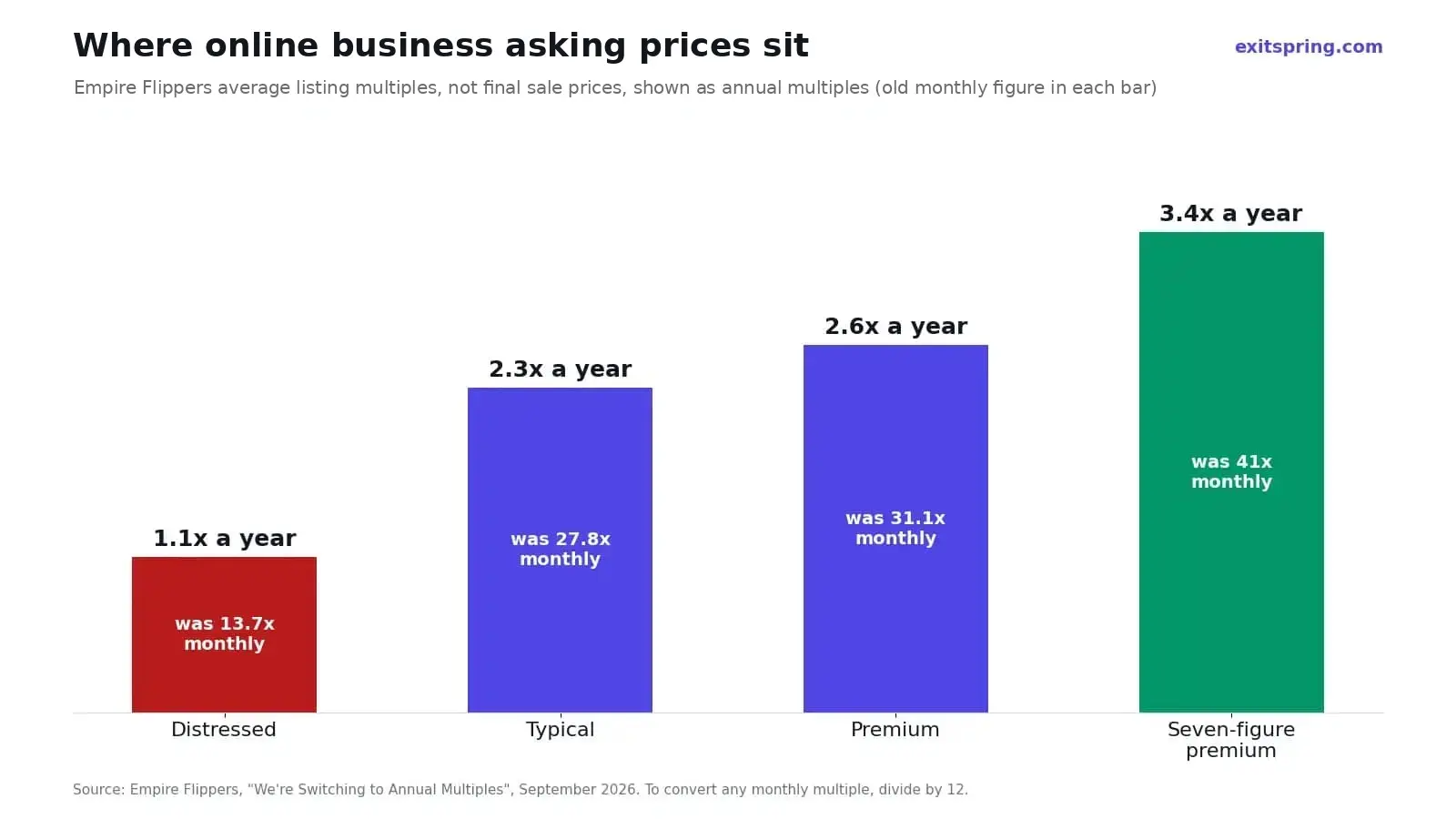
- Empire Flippers now reports annual multiples. Its typical listings average about 2.3x a year's profit, with distressed businesses near 1.1x and seven-figure premium businesses around 3.4x.
- Across 2,117 US small businesses sold in the second quarter of 2026, BizBuySell recorded an average of 2.7 times cash flow.
- Ecommerce deals usually add stock on hand at cost on top of the multiple.
- Earnouts, holdbacks and seller financing change what you actually receive at closing, so compare offers on cash at close, not headline price.
The formula, and the three earnings figures people confuse
Price is earnings times a multiple. Three different earnings figures get plugged into that sum, and for the same business they can be tens of thousands of dollars apart.
| Earnings figure | What it is | Who tends to use it |
|---|---|---|
| Net profit | Revenue minus every expense on the profit and loss statement, owner's pay included if it's on payroll | Marketplaces and brokers for smaller sites, often with the owner's pay excluded |
| SDE (seller's discretionary earnings) | Net profit with the owner's salary, personal perks, one-off costs, interest, depreciation and amortization added back | Most brokers for owner-run businesses up to a few million in value |
| EBITDA | Earnings before interest, tax, depreciation and amortization, with a market-rate salary for management still deducted | Larger businesses, private equity and anything with a real management team |
The same store can produce three very different numbers. The store in the example below shows about $114,000 of net profit, $196,000 of SDE, and roughly $160,000 of adjusted EBITDA once the owner's pay is swapped for a market-rate manager's salary. If you're comparing an offer to a published multiple, check which figure that multiple was applied to. Otherwise you're comparing a 2.7 that means one thing with a 2.7 that means another.
Working out SDE, line by line
SDE starts from your profit and loss statement and adds back anything a new owner wouldn't have to pay. The rule a buyer will apply is simple enough. If the cost keeps the business running, it stays in. If it exists because of you personally, or it won't happen again, it can come out.
Here's a made-up example. It's a Shopify and Amazon store selling cast-iron care products: seasoning oil, chain-mail scrubbers, pan handle covers. The figures are its last 12 months.
| Line | Amount |
|---|---|
| Revenue | $640,000 |
| Cost of goods sold | −$224,000 |
| Ad spend (Meta and Amazon) | −$128,000 |
| Shipping and fulfillment | −$70,400 |
| Apps and software | −$9,600 |
| Freelance designer | −$12,000 |
| Owner's salary on payroll | −$60,000 |
| Owner's car lease, run through the business | −$7,200 |
| One-off legal fees for a trademark dispute | −$9,000 |
| Depreciation and amortization | −$2,400 |
| Interest on a business loan | −$3,600 |
| Net profit | $113,800 |
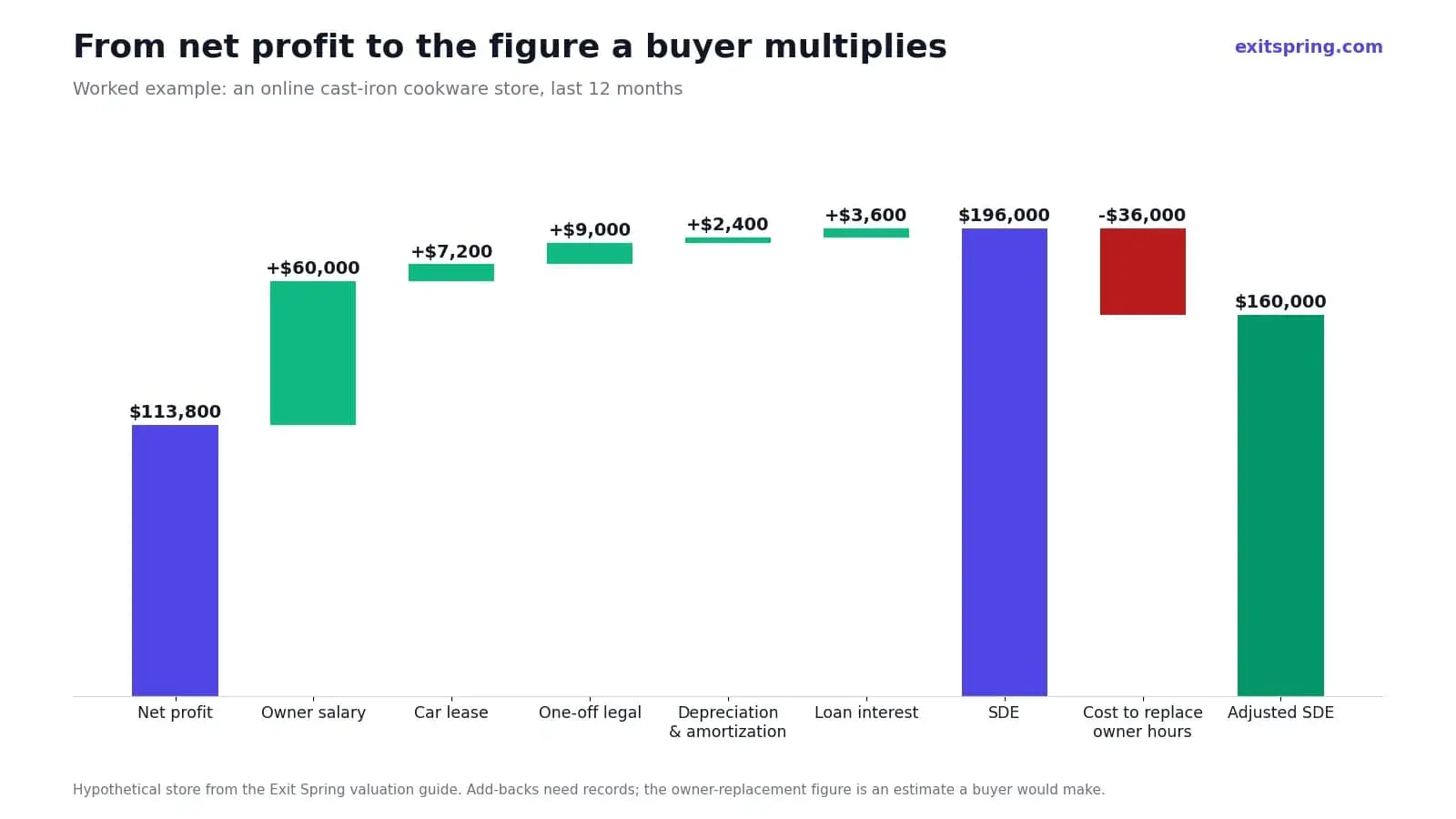
Now the add-backs. The owner's $60,000 salary goes back in, since a buyer will decide for themselves how to pay whoever runs the place. So does the $7,200 car lease, which is a personal perk. The $9,000 trademark fight is a one-off, provided there's paperwork showing it's settled. Depreciation and amortization ($2,400) don't involve cash leaving the account, and the loan interest ($3,600) stays with the seller, because the loan doesn't transfer.
That's $82,200 of add-backs, which brings SDE to $196,000.
What a buyer won't accept as an add-back
Sellers stretch this part, and buyers know it. Here's how buyers tend to treat the common ones:
| Usually accepted | Usually rejected |
|---|---|
| Owner's salary and payroll taxes | "We'd cut ad spend if we had to" |
| Personal car, phone, travel with no business purpose | Ad spend you paused for two months to make profit look better |
| One-off legal, setup or migration costs, with invoices | Costs that happen "once" every year |
| Interest on loans that don't transfer | Freelancers you plan to stop paying |
| Depreciation and amortization | Revenue you expect from a product that hasn't launched |
Everything in the right-hand column is a decision that hasn't been made yet, and the seller wants paying for it now. Buyers pay for last year's numbers, with receipts.
The owner's time still costs something
Our cast-iron store's owner works about 25 hours a week on it: answering customer emails, reordering stock, managing the ad accounts, approving designs. Adding back the full salary assumes none of that work needs doing after the sale. It does. A buyer will estimate what it would cost to hire someone for those hours. Say a part-time operations manager at $36,000 a year.
Take that off the $196,000 of SDE and the figure a buyer actually multiplies is closer to $160,000. That's the adjusted EBITDA figure from the table above; some brokers call it adjusted SDE. The more hours the business needs from you, the bigger the deduction, which goes a long way to explaining why hands-off businesses sell for more.
Monthly multiples, annual multiples, and the data behind them
For most of the last decade, Empire Flippers and many online business guides quoted monthly multiples. A site making $5,000 a month and selling for $150,000 went for "30x". Traditional business brokers, accountants and private equity buyers have always used annual multiples, so the same deal was "2.5x" to them.
When Empire Flippers made the switch, it also converted the average listing multiples from its 2026 State of the Industry Report into annual terms. These are multiples on listings, not final sale prices, so treat them as a guide to where asking prices sit.
| Empire Flippers category | Old monthly multiple | Annual multiple |
|---|---|---|
| Distressed businesses | 13.7x | 1.1x |
| Typical businesses | 27.8x | 2.3x |
| Premium businesses | 31.1x | 2.6x |
| Seven-figure premium businesses | 41x | 3.4x |
To convert any monthly multiple you find in an older listing or article, divide it by 12.
For comparison, BizBuySell's Insight Report for the second quarter of 2026 tracked 2,117 US small business sales, mostly offline ones like restaurants, services and shops. The average cash flow multiple was 2.7, and the median business sold for $349,250 on median cash flow of $155,921. BizBuySell's "cash flow" works much like SDE, so it's a fair yardstick for a profitable online business with an owner doing real work in it.
The gap between "distressed" and "typical" in Empire Flippers' data is worth noticing. Distressed businesses are listed at roughly half the multiple of typical ones, and selling under pressure, because of a deadline, a partner dispute or a falling business, pushes you toward that end. On a business clearing $100,000 a year, that's the difference between about $230,000 and $110,000.
Putting a number on the example
Back to the cast-iron store, with $160,000 of adjusted SDE.
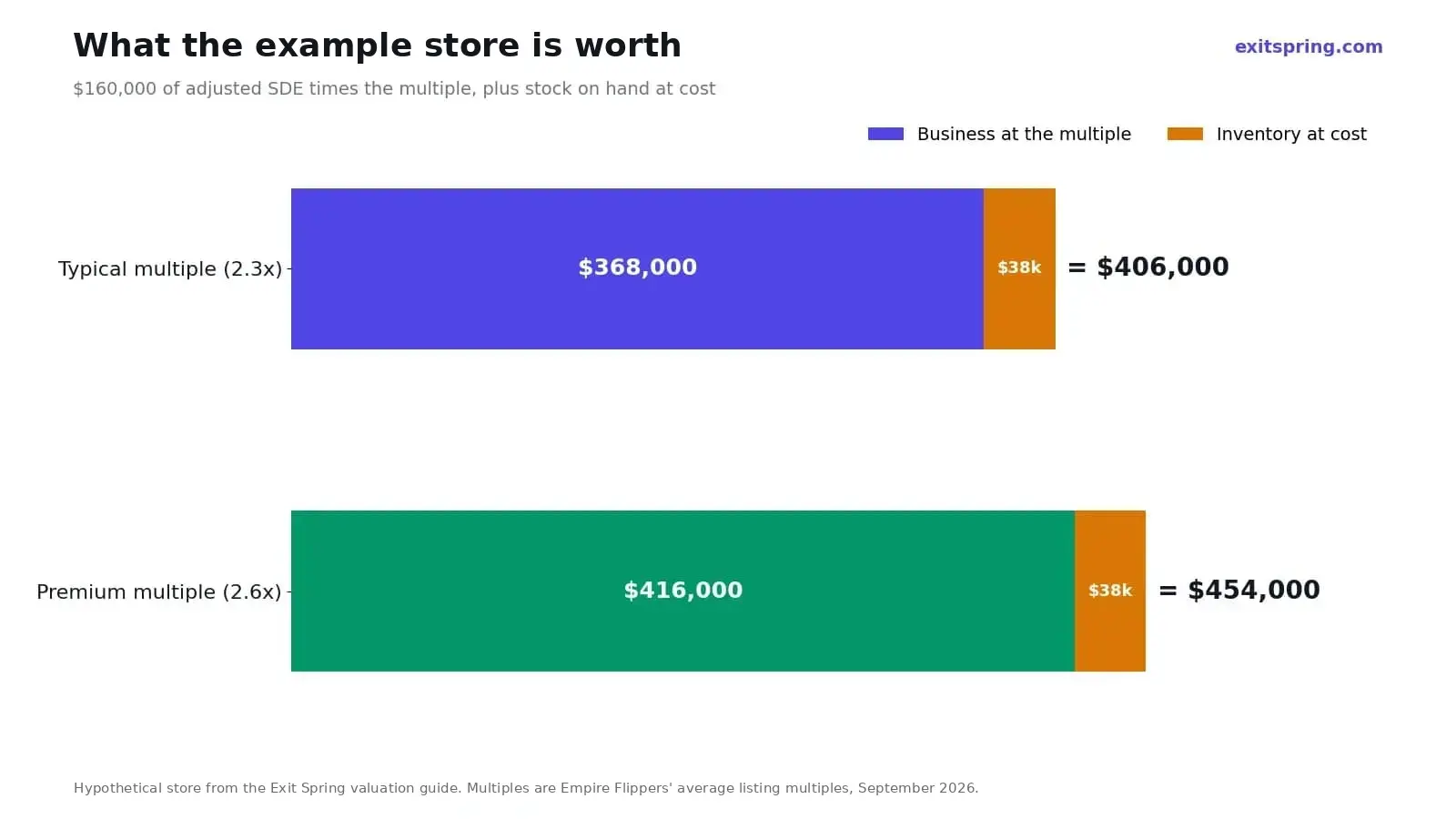
At Empire Flippers' typical listing multiple of 2.3x, the business itself is worth about $368,000. If it qualified as premium, with steady growth, clean books and little owner time, 2.6x would put it at $416,000.
Ecommerce has one more piece. Stock on hand is usually paid for separately, at cost or wholesale value, on top of the multiple. Empire Flippers has described its formula this way for years. If the store is holding $38,000 of seasoning oil and scrubbers at cost, the total comes to roughly $406,000 at the typical multiple, or $454,000 at the premium one.
A seller who'd multiplied the original $196,000 of SDE by 3 would have been expecting $588,000 plus stock. That figure isn't impossible, but it assumes the owner's 25 hours a week are free and that the business deserves a top-tier multiple, and a buyer will challenge both.
What moves the multiple
The multiple is the buyer's view of risk. Lower risk and stronger growth push it up; anything that makes next year's profit less certain pulls it down. These are the factors buyers weigh most often.
| Factor | Higher multiple | Lower multiple |
|---|---|---|
| History | Three or more years of clean records | Under 12 months of profit data |
| Trend | Revenue and profit rising over the last year | Flat, falling, or one strong quarter propping up the average |
| Owner time | A few hours a week, with documented processes | The owner runs operations, ads and support personally |
| Traffic sources | Several channels, including email and direct | Nearly all traffic from one Google ranking or one ad platform |
| Platform risk | Own store, own customer list | Most revenue through one Amazon account or one app store |
| Customer concentration | No customer above a few percent of revenue | One client or wholesale account is 30% or more |
| Margins | Healthy margin after ad spend, stable for a year | Profit that depends on ad costs staying low |
| Recurring revenue (SaaS, memberships) | Low churn, annual plans | High monthly churn, mostly monthly plans |
| Supplier position | Contracts that transfer, a backup supplier | A single supplier and an informal arrangement |
| Size | Seven figures and above, which attracts more buyers | Small deals that only individual buyers will look at |
Dependence on one platform
Content sites that rank well in Google are exposed to core updates. Amazon sellers live with account health and policy changes. Apps depend on Apple and Google's store rules. None of that rules out a sale, but a buyer will look at the last two or three years to see how the business handled the last shock. A site that lost 40% of its traffic in one update and hasn't recovered will be priced on today's numbers with a discount on top.
Ad-funded growth
Plenty of healthy stores spend around 20% of revenue on Meta and Amazon ads, and the cookware store is one of them, at $128,000 on $640,000. A buyer will pull a year of ad account history and set it next to the monthly margins. In this case, cost per purchase on Meta jumped in the fourth quarter, margin slipped by two points, and it had recovered by February. A buyer would read that as a store that can absorb rising ad costs, and price it accordingly.
Recurring revenue
For software and membership businesses, buyers look at churn before almost anything else. A SaaS product losing 2% of customers a month keeps most of its revenue through a year. One losing 8% a month is replacing most of its customer base annually, and it'll be priced like it. Smaller SaaS deals are often discussed as a multiple of annual recurring revenue as well as profit, so expect both numbers to come up.
How deal structure changes the number
Here are two offers for the cast-iron store. Both say $400,000 at the top of the letter.
| Offer A | Offer B | |
|---|---|---|
| Cash at closing | $400,000 | $250,000 |
| Seller financing | None | $100,000, paid over two years |
| Earnout | None | $50,000 if revenue holds for 12 months |
| Money you're sure of on day one | $400,000 | $250,000 |
Acquire.com's 2025 annual report on small SaaS deals found that buyers were adding more conditions: holdbacks in 14% of the deals it analyzed, seller financing in 13%, and other conditions across 41%. Expect similar terms in other online business sales, where buyers face the same traffic and platform risks.
Compare offers on how much you receive at closing, how much depends on things you no longer control, and what happens if the buyer struggles after taking over. A slightly lower all-cash offer is often worth more than a higher one with a large earnout. Sellers outside the US should also check how earnouts are taxed before agreeing to one. Our guide to selling an online business from outside the US covers the 30% US tax that can apply to performance-based payments.
Mistakes that cost sellers money
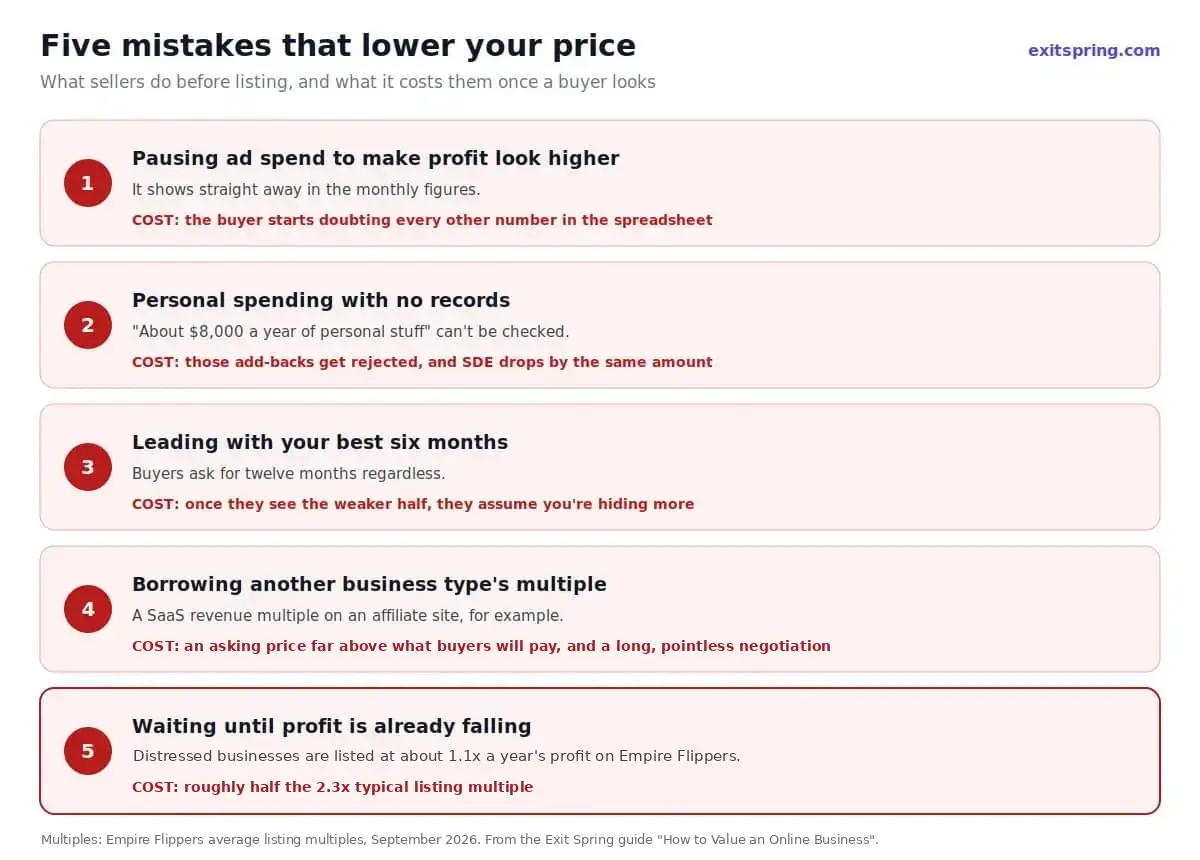
A common one is pausing ad spend for a couple of months before listing so profit looks higher. It shows up straight away in the monthly figures, and the buyer then starts doubting everything else in the spreadsheet too.
Personal spending is another. Running your phone, car and family trips through the business is fine for SDE, but only if there's a record of each one. "About $8,000 a year of personal stuff" won't get added back.
Some sellers lead with their best six months. Buyers ask for twelve regardless, and once they see the weaker half they tend to assume there's more you haven't shown them.
Borrowing a multiple from a different kind of business causes long, pointless negotiations. A SaaS revenue multiple applied to an affiliate site, for instance, sets an expectation far above what buyers will pay.
And the expensive one: waiting until profit has already started to fall. In Empire Flippers' numbers, distressed businesses are listed at about half the multiple of typical ones.
Valuing specific types of business
The method above works for most online businesses, but some models have their own details.
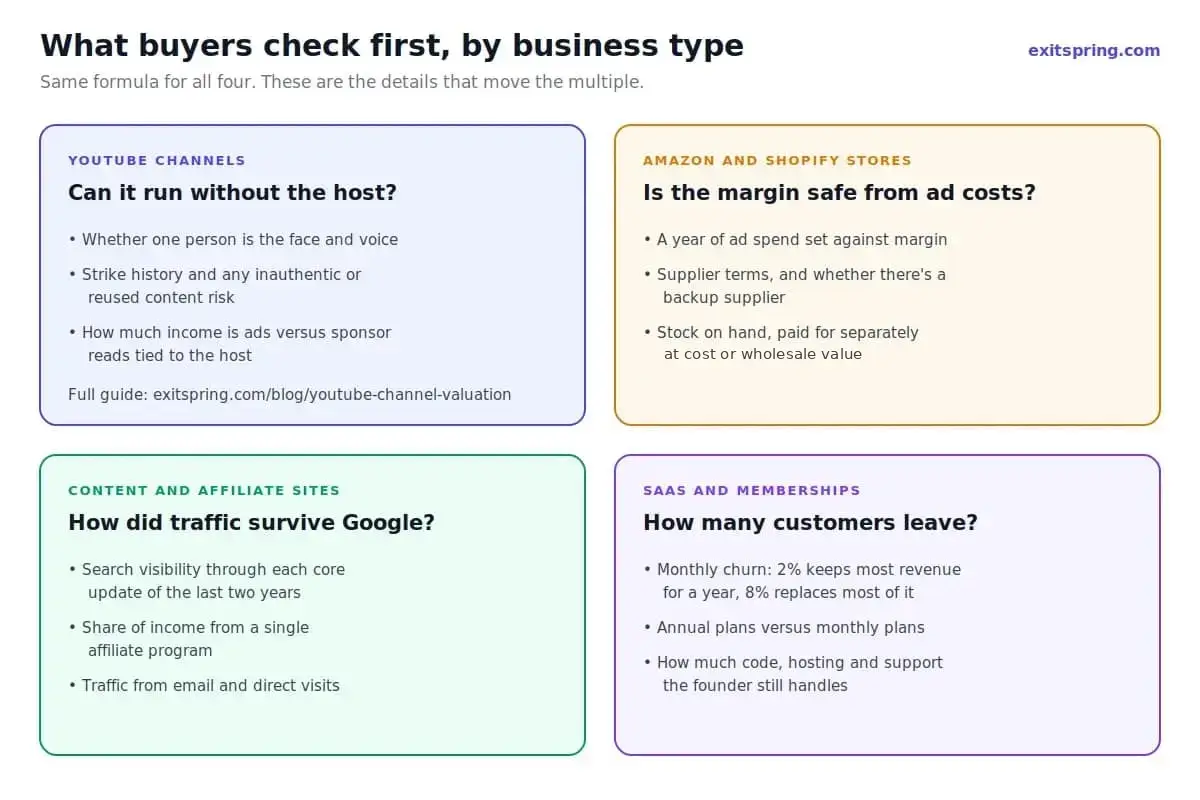
YouTube channels follow the same method, with extra weight on whether one person is the face of the channel and on YouTube's content policies. We go through that in how much a YouTube channel is worth.
With Amazon and Shopify stores, expect questions about supplier terms, ad efficiency and stock levels, and remember the inventory is priced separately.
A content or affiliate site gets judged mostly on its traffic history. Buyers will pull up its search visibility through each Google core update of the last two years and check how much income depends on a single affiliate program.
For SaaS and membership products, churn comes first, then how much of the code, hosting and support the founder still handles personally.
Whatever the model, a buyer will check every number before closing. Our online business due diligence checklist goes through what they ask for.
FAQ
What multiple will my online business sell for?
Most profitable online businesses with a year or more of clean records sell for about 2 to 3 times annual profit, which is 24x to 36x monthly. Empire Flippers' typical listings average 2.3x annually. Businesses that are shrinking, very new or heavily owner-run go lower, and large, growing businesses with little owner involvement go higher.
Should I use SDE or net profit?
Use whichever figure the buyer or broker you're talking to uses, and say which one you mean. For a small business you run yourself, SDE is standard. Just remember that a buyer will deduct the cost of replacing your time.
Is my owner's salary deducted from the valuation?
Usually it's added back to calculate SDE. But if the business needs your hours to run, a buyer will subtract what it would cost to hire someone to do that work, so the salary doesn't vanish completely.
Do I get paid for my inventory separately?
For ecommerce businesses, usually yes. Stock on hand is normally valued at cost and added to the price, so count it carefully before you list.
How many months of data do buyers want?
Twelve months is the norm, and the 12-month average is what most multiples are applied to. Six months can work for a young business, but expect a lower multiple. Two or three years of history helps a lot, especially if the business came through a Google update or an ad-cost spike in that time.
Does revenue matter, or only profit?
Profit sets the price for most online businesses. Revenue matters mainly for SaaS, where buyers often look at annual recurring revenue, and as context for margins. A store with $2 million in revenue and $60,000 in profit is a thin-margin business, and it'll be valued on the $60,000.
Getting a valuation from Exit Spring
Exit Spring is run from the US and Hong Kong. Send us your last 12 months of profit and loss, a list of what you think should be added back, and a rough count of the hours you put in each week. We'll come back with an SDE figure, the multiple range buyers are likely to use, and an estimate of the cash you'd see at closing.
Request a free valuation and attach whatever you have.
Sources
- Empire Flippers, "We're Switching to Annual Multiples" (September 2026)
- Empire Flippers, seller FAQ on valuation
- BizBuySell, Insight Report, Q2 2026
- Paddle: Acquire report: financing options play growing role in small SaaS M&A
Get new listings in your inbox
Fresh businesses for sale every Monday, plus practical buying and selling tips.
Unsubscribe anytime. No spam.
Keep reading



Ready to make a move?
Browse vetted online businesses or get a free valuation of yours.