
Buying an Online Business in 2026: What to Pay, What to Check, How to Finance It
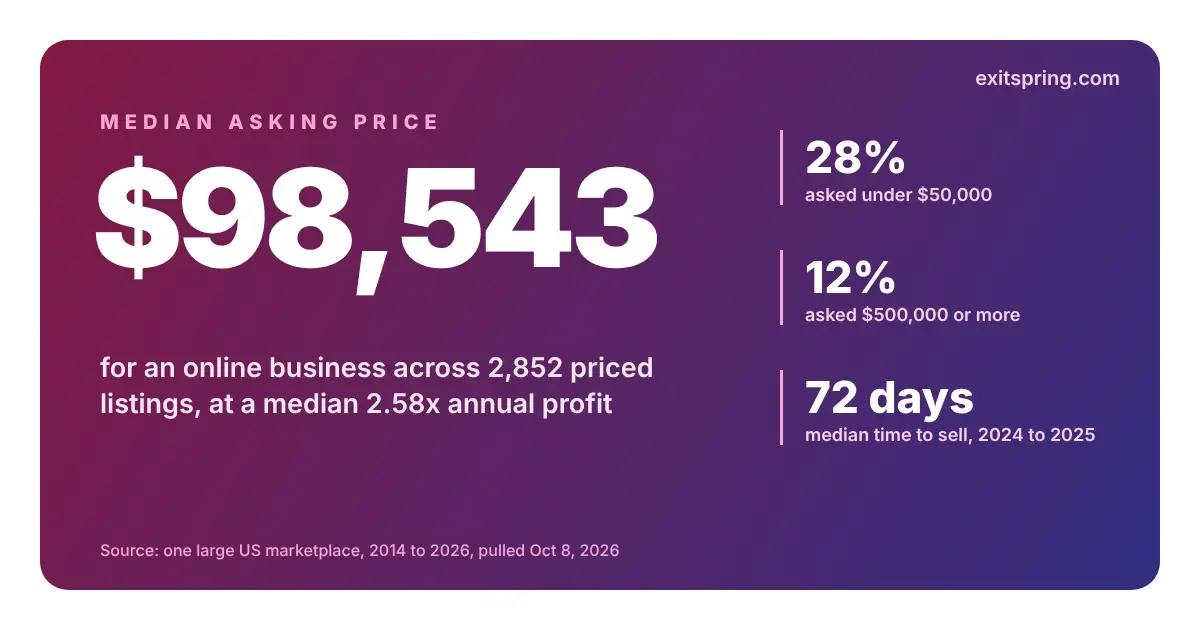
The median online business on one large US marketplace asked $98,543, or 2.58 times a year's profit, across 2,852 priced listings we pulled on October 8, 2026.
Half of those listings asked less than $100,000, and 12% asked $500,000 or more. Prices peaked in 2021, when the median listing asked 3.50x profit; businesses listed in 2025 asked 2.42x.
Take a buyer in Colorado, a former ecommerce operations manager with $90,000 in savings. She wants a Shopify brand selling trekking poles and trail packs that clears $180,000 a year of seller's discretionary earnings (SDE), which is profit before the owner's own pay. The seller asks $585,000. The buyer, the brand and every figure about them are a composite we built for this guide.
How much does an online business cost in 2026?
An online business is usually priced at two to three times a year of SDE, so its price follows its profit. On the marketplace data, 28% of listings asked under $50,000 and the median asked $98,543. Only 336 listings asked $500,000 or more, and 238 of them sold physical products through Amazon or their own store.
| Asking price | Listings | Share of listings |
|---|---|---|
| Under $50,000 | 811 | 28% |
| $50,000 to $100,000 | 635 | 22% |
| $100,000 to $250,000 | 715 | 25% |
| $250,000 to $500,000 | 355 | 12% |
| $500,000 to $1 million | 180 | 6% |
| Over $1 million | 156 | 5% |
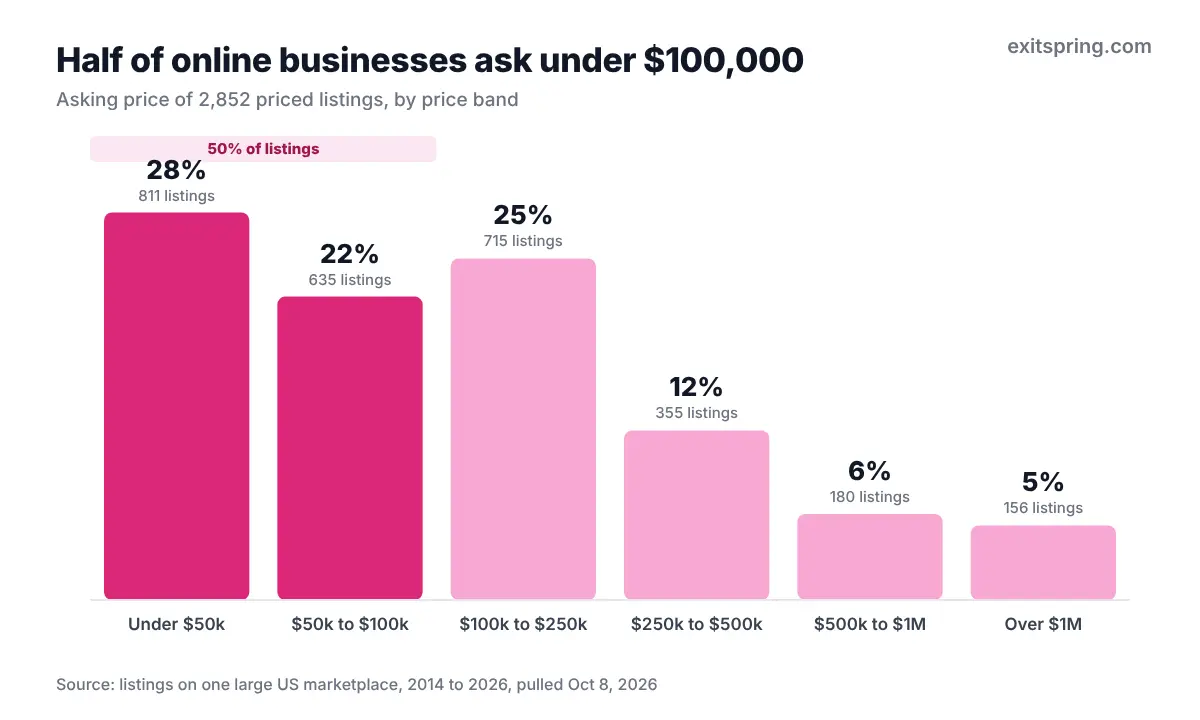
Most were already sold when we pulled them, and listings go back to 2014. Every figure is an asking price, not what a buyer finally paid.
Multiples by business type
| Business type | Listings | Median asking multiple, all years | Listed 2024 to 2026 | Median annual profit | Owner hours a week |
|---|---|---|---|---|---|
| SaaS | 61 | 3.33x | 3.21x | $50,000 | 3 |
| Affiliate sites | 553 | 2.75x | 2.67x | $31,000 | 2 |
| Display ad (content) sites | 865 | 2.70x | 2.50x | $26,000 | 2 |
| Amazon FBA | 794 | 2.67x | 2.58x | $78,000 | 5 |
| Amazon KDP publishing | 152 | 2.75x | 2.50x | $52,000 | 3 |
| Ecommerce | 340 | 2.50x | 2.42x | $81,000 | 6 |
| YouTube | 49 | 2.08x | 2.08x | $55,000 | 8 |
A listing with several income types counts in each row, and sites earning from Amazon Associates aren't included in the affiliate row.
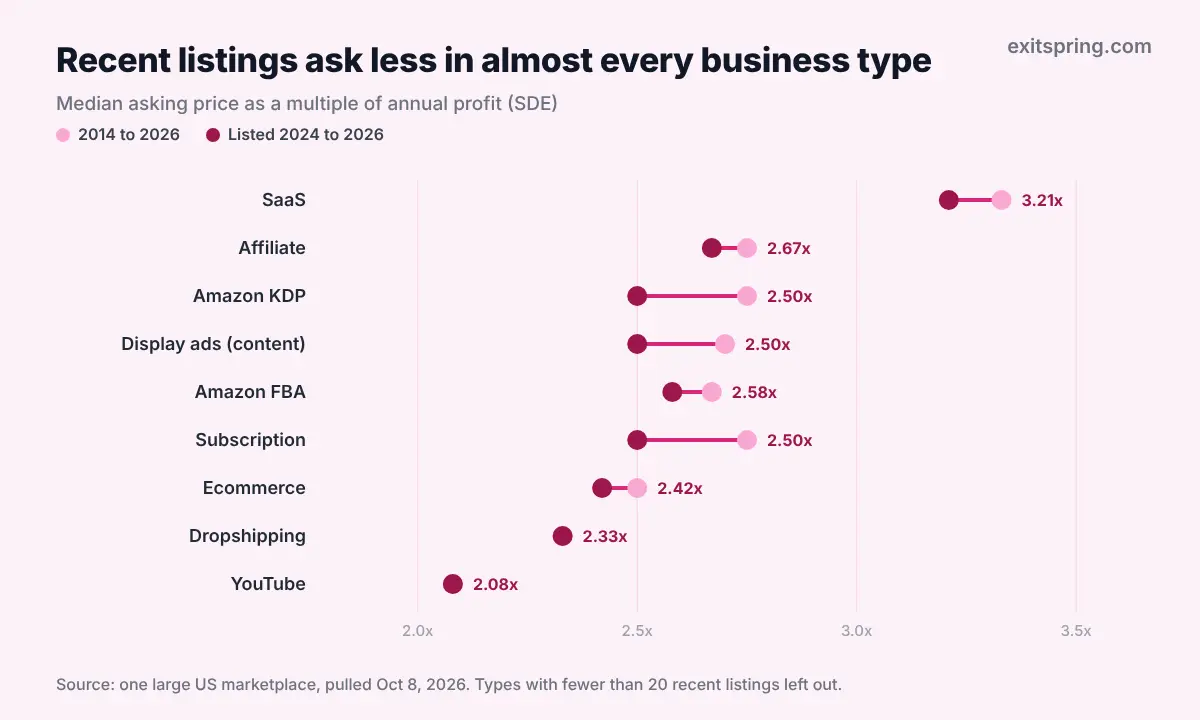
Flippa's H1 2026 report put the average historical sold content business at 2.32x profit and ecommerce at 1.55x, against asks of 2.70x and 2.50x across all years on our data. The two marketplaces list different businesses at different sizes, so the gap can't be read as a negotiating discount. Our guide to online business multiples by type breaks the asks down further.
Reading a listing
A listing gives a buyer six or seven numbers, and each one needs a question behind it before an offer. The trail-gear brand's listing said it was four years old, earned $180,000 a year and needed 10 hours a week.
| Listing field | The question to ask | What the trail-gear seller sent |
|---|---|---|
| Annual profit (SDE) | Which personal costs were added back, with receipts | The seller's phone plan, a trade show trip and a one-off logo redesign, $14,200 in total |
| Revenue trend | Month by month for 24 months, not just the last 12 | A spring peak each year and a dip every January |
| Age | When the first sale happened and when the current products launched | First sale in 2022; the trail pack, now 40% of sales, launched in 2024 |
| Hours a week | Who does each task today | 10 hours from the seller, plus a part-time customer service contractor |
| Traffic sources | Share from search, ads, email and marketplaces | Google search 34%, email 27%, Meta ads 21%, Amazon the rest |
| Reason for sale | What the seller plans next and whether it competes | A new job in outdoor retail, not a rival store |
Age matters to price. Listings under two years old asked a median 2.25x profit, against 2.92x for businesses five years or older, and 23% of all listings were under two years old when they went up for sale. Owners of 71% of listings said they worked five hours a week or less.
Matching a business type to the work you want
| Business type | Typical owner time on the data | Main thing that can go wrong | Who it suits |
|---|---|---|---|
| Content or affiliate site | 2 hours a week | A Google update or an affiliate program cutting rates | Writers and editors |
| Amazon FBA brand | 5 hours a week | An account suspension or a supplier delay | Anyone at ease with stock and freight |
| Shopify brand | 6 hours a week | Rising ad costs | Paid-ads marketers |
| SaaS | 3 hours a week | Churn, or code nobody else can maintain | Product managers who can brief a developer |
| YouTube channel | 8 hours a week | Views falling after the founder leaves the camera | On-camera creators or video producers |
The trail-gear buyer had spent six years managing ad budgets for an outdoor brand, which is why she chose a Shopify business over a content site at the same price.
Due diligence
The trail-gear buyer spent nine days matching read-only logins to bank deposits and found $11,000 of refunded 2025 wholesale orders.
| What you're checking | Access to ask for | What it showed on the trail-gear brand |
|---|---|---|
| Sales and refunds | Shopify staff account with a custom role (Shopify) | 24 months of orders; 4.1% refunded |
| Card payments | Stripe View Only role, which sees payments and payouts but can't move money (Stripe) | Payouts matched deposits within $300 a month |
| Traffic | Google Analytics 4 Viewer role (Google) | 61% of sessions from Google search and email |
| Search rankings | Search Console restricted user, which sees most data and changes nothing (Google) | No ranking drop through the 2026 core updates |
| Ad spend | Meta and Google Ads read-only | Ads at 11% of sales, flat for two years |
| Suppliers | Purchase orders and supplier emails | Two factories, one in Taiwan and one in Vietnam |
For an Amazon brand, a Shopify store or a SaaS product, the transfer itself carries its own risks. Our guides to selling an Amazon FBA business, a Shopify store and a SaaS business cover what has to move and what can block it. The full list of documents is in our due diligence checklist.
Content sites and Google updates
In a Pew Research Center study of 900 US adults, people clicked a regular result on 8% of visits that showed an AI summary and 15% of visits without one.
| Google update | Dates |
|---|---|
| June 2025 core update | June 30 to July 17, 2025 |
| December 2025 core update | December 11 to 29, 2025 |
| March 2026 core update | March 27 to April 8, 2026 |
| May 2026 core update | May 21 to June 2, 2026 |
| September 2026 spam update | September 24 to October 8, 2026 |
Dates come from Google's Search Status Dashboard. Plot a site's monthly Google traffic against these weeks before trusting its last 12 months.
The trail-gear brand (composite) at $540,000
| Line | Figure | Basis |
|---|---|---|
| Sales | $820,000 | Shopify 78%, Amazon 22% |
| SDE | $180,000 | 22% of sales; no salary taken by the seller |
| Asking price | $585,000 | 3.25x SDE, stock included |
| Buyer's offer | $520,000 | 2.9x, after the $11,000 revenue gap came out |
| Agreed | $540,000 | 3.0x SDE, including $62,000 of stock at cost |
| Working capital and closing costs | $60,000 | Ads float, legal fees, escrow and loan fees |
| Total to fund | $600,000 | Price plus working capital and closing costs |
Ecommerce brands with $100,000 to $250,000 of annual profit asked between 2.08x and 3.00x in the middle half of the data, so 3.0x sits at the top of that range. The $180,000 of SDE is 33% of the price before any loan payments, the figure most buyers use as a first test of return.
Negotiating from $585,000 to $540,000
Her first offer was $520,000.
The seller came back at $560,000 plus 60 days on call. They settled at $540,000. The 60 days went into the purchase agreement, along with a $30,000 standby note from the seller for the SBA loan. The buyer came up $20,000; the seller came down $45,000.
Stock was counted at cost the day before closing and came to $62,000, inside the price rather than on top of it. Our guide to how to value an online business explains how SDE add-backs are tested, and the marketplace shows current asks for brands like this one.
How do you finance an online business purchase?
Most US buyers use an SBA 7(a) loan, their own cash and a small seller note. SOP 50 10 8.1 changed the rules on October 1, 2026 (SBA notice; PilieroMazza). The buyer puts in at least 10% of the project. A seller note on full standby can cover up to half of that 10%. Every owner must be a US citizen or national living in the US.
| Source | Amount | Terms |
|---|---|---|
| SBA 7(a) loan | $540,000 | 10 years at 9.75%; about $7,060 a month |
| Seller note | $30,000 | Full standby, no payments while the SBA loan is outstanding |
| Buyer's cash | $30,000 | From her savings; $60,000 stays in reserve |
| Total | $600,000 | Buyer's equity injection of 10% |
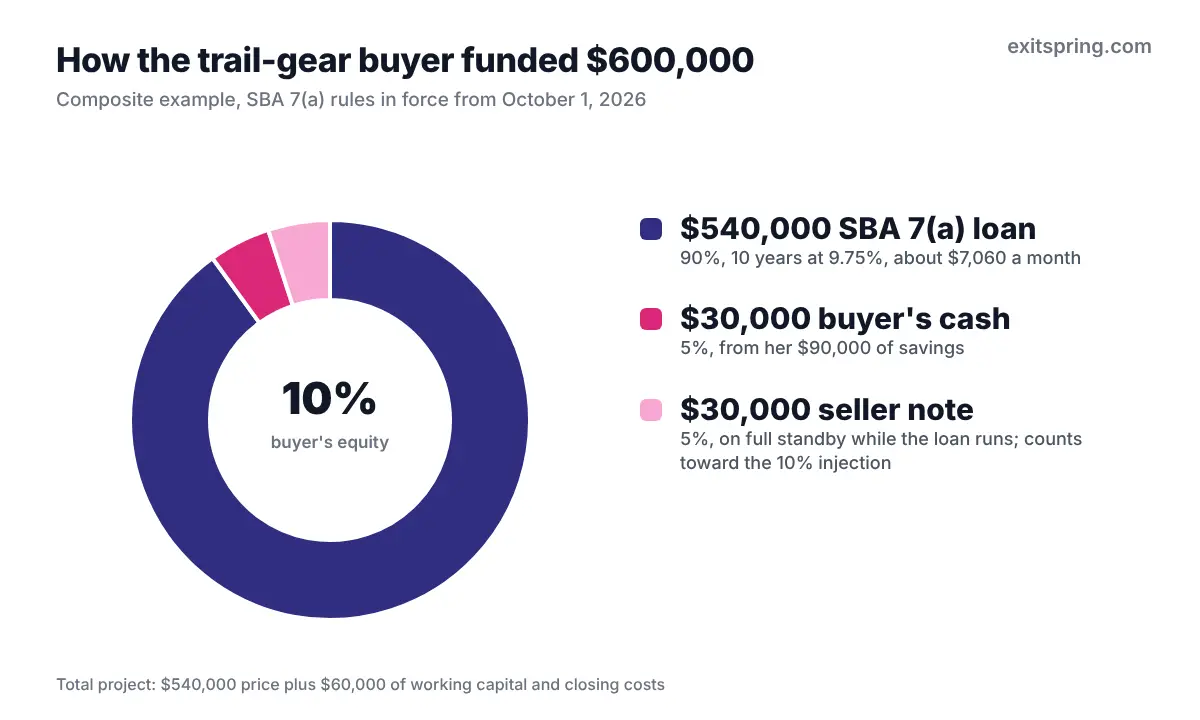
SBA caps the variable rate on loans over $350,000 at the base rate plus 3.0% (SBA notice). Prime rose to 7.00% on September 17, 2026, a day after the Federal Reserve's rate decision, so the ceiling sits at 10.00%. The updated rules also raise SBA's minimum debt service coverage for most acquisitions from 1.15x to 1.25x. After paying herself $70,000, the trail-gear buyer has $110,000 left against $84,700 of annual loan payments, a ratio of 1.30x.
SBA loans top out at $5 million, and purchases of $3 million or more now need a quality-of-earnings report (CLA). Buyers in Hong Kong or elsewhere outside the US can't own any part of an SBA-financed business under the new rule, so they usually pay cash or negotiate a larger seller note. Our guide to seller financing and earnouts shows how those deferred payments are written.
| Route | How it's usually set up | When it fits |
|---|---|---|
| All cash | Buyer pays the full price into escrow | Deals under about $100,000, and buyers outside the US |
| Seller note | Part of the price paid in monthly installments after closing, often with interest | Sellers who trust the buyer and want a higher headline price |
| Earnout | Part of the price paid only if revenue or profit targets are hit | Businesses with a short track record or a recent jump in sales |
| SBA 7(a) loan | Bank loan with a federal guarantee, 10% buyer injection | US citizens and nationals living in the US, buying businesses above about $150,000 |
Deal documents

| Stage | What it settles | The trail-gear deal |
|---|---|---|
| Letter of intent | Price, structure and an exclusivity period; mostly non-binding, with exclusivity often 30 to 60 days (Baker McKenzie) | 45 days of exclusivity at $540,000 |
| Asset purchase agreement | What's sold, the seller's promises and how long they last; general promises often survive 12 to 24 months, with claims capped at 10% to 20% of the price (PilieroMazza) | 18 months, capped at $81,000 |
| Non-compete | Federal rule set aside in 2024 and dropped by the FTC in September 2025 (FTC); states allow them on the sale of a business, as in California § 16601 | Three years, outdoor gear sold online in the US |
| Escrow | Funds held until the buyer confirms the handover; Escrow.com charges 1.2% between $500,000 and $1 million, with a $7,500 minimum (Escrow.com) | $7,500, split evenly at $3,750 each |
| Inspection period | Set at 1 to 30 days when the transaction opens (Escrow.com) | 10 days after the Shopify transfer |
Buyer taxes
| Item | Rule | On the trail-gear deal |
|---|---|---|
| Price allocation | Buyer and seller each file IRS Form 8594, normally using the allocation agreed in the purchase agreement | Agreed in the purchase agreement before closing |
| Goodwill, trademarks, customer lists, non-compete | Amortized over 15 years under 26 U.S.C. § 197 | About $478,000, or $31,900 a year of deductions |
| Inventory | Its cost becomes the buyer's basis, recovered as it sells | $62,000 |
Ask a tax adviser to model the allocation before the letter of intent. Our guide to taxes when selling an online business shows the same deal from the seller's side.
Scams aimed at buyers
The FBI's 2025 Internet Crime Report PDF logged $3.05 billion of losses to business email compromise, where a fake email redirects a payment. California's financial regulator has warned about a fake escrow company that used Escrow.com's license number on a forged license (DFPI).
| Warning sign | What it looked like in a case we built for this guide |
|---|---|
| The seller picks the escrow company | A link to "escrow-secure-payments.com" with Escrow.com's logo |
| Wire details change by email | A message on closing day with a new bank in another country |
| Screenshots instead of account access | A PDF of Shopify revenue with no staff login offered |
| Pressure to skip the inspection period | A discount of $15,000 for paying directly |
Type escrow.com into the browser yourself, and confirm wire details by phone on a number you found independently.
The first 90 days
| Days after closing | What the buyer does | The trail-gear buyer |
|---|---|---|
| 1 to 14 | Change every password, move billing to her card, confirm payouts land | 23 logins moved; first Shopify payout arrived on day 3 |
| 15 to 45 | Run the business exactly as it was, with the seller on call | Kept the seller's ad budgets and supplier order dates unchanged |
| 46 to 90 | Make the first change she planned before buying | Added a hip-pack product, her own idea from due diligence |
Mistakes buyers make
| Mistake | What it cost | Illustrative example |
|---|---|---|
| Paying for revenue the bank never saw | An overpriced business | $11,000 of refunded orders still counted as sales |
| Valuing a content site on its best year | A price set before a Google update hit | Traffic down 40% in the month after closing |
| Running out of cash after closing | No money for stock or ads | All savings in the down payment and none left for the next order |
| Letting the seller choose escrow | Funds sent to a fake site | A lookalike escrow domain registered two weeks earlier |
| No non-compete | The seller starts a copy | A rival store on the same supplier six months later |
Questions buyers ask
Can I buy an online business with no money down?
The trail-gear buyer put in $30,000 of her own cash on a $600,000 deal, the least SBA's 10% injection rule allowed once the seller's $30,000 standby note covered the other half. Deals with no buyer cash at all usually mean the seller finances most of the price, which few sellers above $100,000 accept.
Can a buyer outside the US get an SBA loan?
A buyer living in Hong Kong can't own a business financed with an SBA 7(a) loan, because since October 1, 2026 owners must be US citizens or nationals whose main home is in the US. Cash or a seller note are the usual routes, and a US partner can use SBA financing only if the Hong Kong buyer holds no stake at all. Our guide to selling from outside the US covers cross-border payments.
How long does it take to buy an online business?
Listings from 2024 and 2025 that sold spent a median 72 days on the marketplace. The trail-gear deal took 19 days from offer to letter of intent, 45 days of due diligence and SBA underwriting, and 10 days of escrow inspection. Our guide to how long it takes to sell an online business shows the same timeline from the seller's side.
What return does a buyer earn on an online business?
At 3.0x SDE, the trail-gear brand earns 33% of its price a year before debt. After her $70,000 salary and $84,700 of loan payments, the buyer keeps about $25,000 a year in the business until the loan is repaid in 2036.
Do I need a company to buy an online business?
The trail-gear buyer formed a Colorado LLC before the letter of intent, and the LLC signed the purchase agreement, held the Shopify store and took out the SBA loan, with her personal guarantee. No law requires a company, but it keeps the business's contracts and day-to-day liabilities in one place. Her personal guarantee still puts her own assets behind the SBA loan, and SBA's updated rules require the borrower's parent entities to be organized in the US.
Who pays the escrow fee?
The trail-gear deal split its $7,500 fee evenly, a choice buyer and seller make when the transaction opens. Escrow.com charges the buyer the full fee if the buyer rejects the business or the transaction is canceled after funding (Escrow.com).
Is a content site still worth buying after Google's updates?
Content sites asked 2.50x on listings from 2024 onward, against 2.70x across all years, and Flippa recorded 39% fewer sales of traditional content businesses in the first half of 2026 than the half before. A site whose traffic held through the March and May 2026 core updates is the safer buy, and the asking multiple rarely reflects that difference.
Buying through Exit Spring
Create a free account, then unlock any listing on the marketplace to see its URL, analytics and profit and loss. Listings are grouped by type on our buy pages, and how buying works sets out each step. Deals close through Escrow.com, and Exit Spring never holds buyers' money.
General information as of October 2026, not legal, tax or investment advice.
Sources
- SBA: Information Notice on SOP 50 10 8.1 and 7(a) loans; PilieroMazza: Five SBA 7(a) changes and Indemnification provisions; CLA: Quality of earnings on SBA acquisition loans
- Federal Reserve: September 16, 2026 statement
- Escrow.com: Domain and website fees, Inspection period and Who pays escrow fees; DFPI: Fake escrow alert
- Baker McKenzie: Preliminary documents in US M&A
- FTC: Non-compete rule vacatur; California: Bus. & Prof. Code § 16601
- IRS: Instructions for Form 8594; Cornell LII: 26 U.S.C. § 197
- FBI: 2025 Internet Crime Report PDF
- Google: March 2024 core update, Search Status Dashboard, Analytics roles and Search Console permissions; Pew Research Center: AI summaries and clicks
- Shopify: Staff permissions; Stripe: User roles
- Flippa: H1 2026 Digital M&A Insights
- Empire Flippers public listings, retrieved October 8, 2026 (2,852 priced listings, asking multiples on SDE)
Get new listings in your inbox
Fresh businesses for sale every Monday, plus practical buying and selling tips.
Unsubscribe anytime. No spam.
Keep reading
Ready to make a move?
Browse vetted online businesses or get a free valuation of yours.