
How to Sell an Amazon FBA Business in 2026: Value, Account Transfer, Inventory and Tax
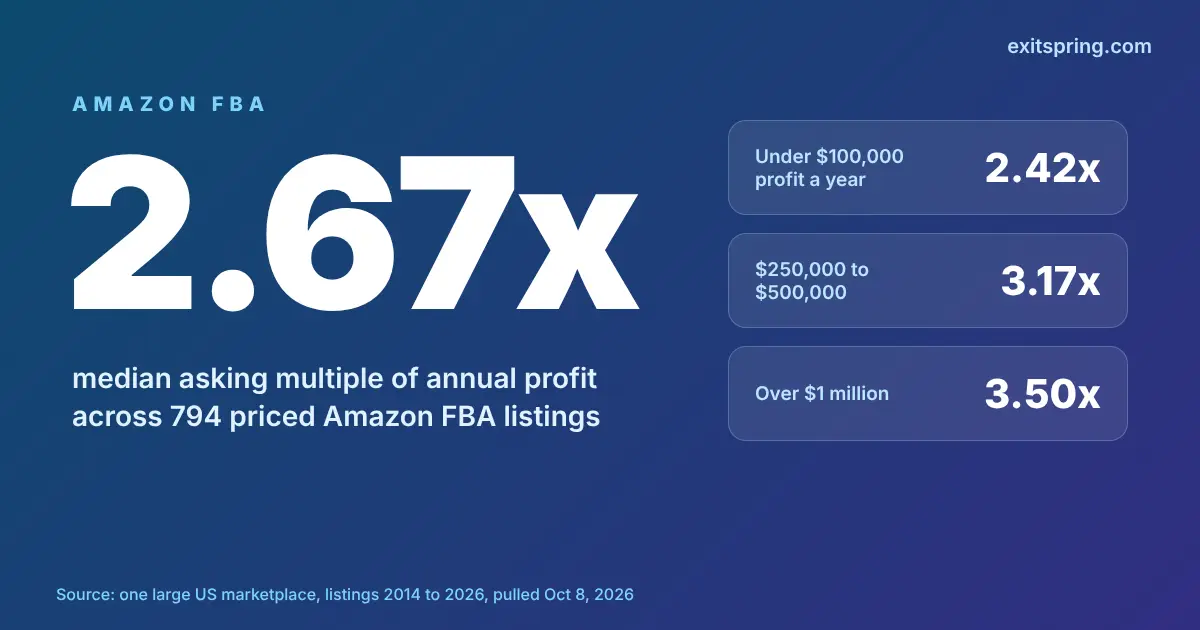
Across 794 priced Amazon FBA listings on one large US marketplace, pulled October 8, 2026, the median ask was 2.67 times a year's profit.
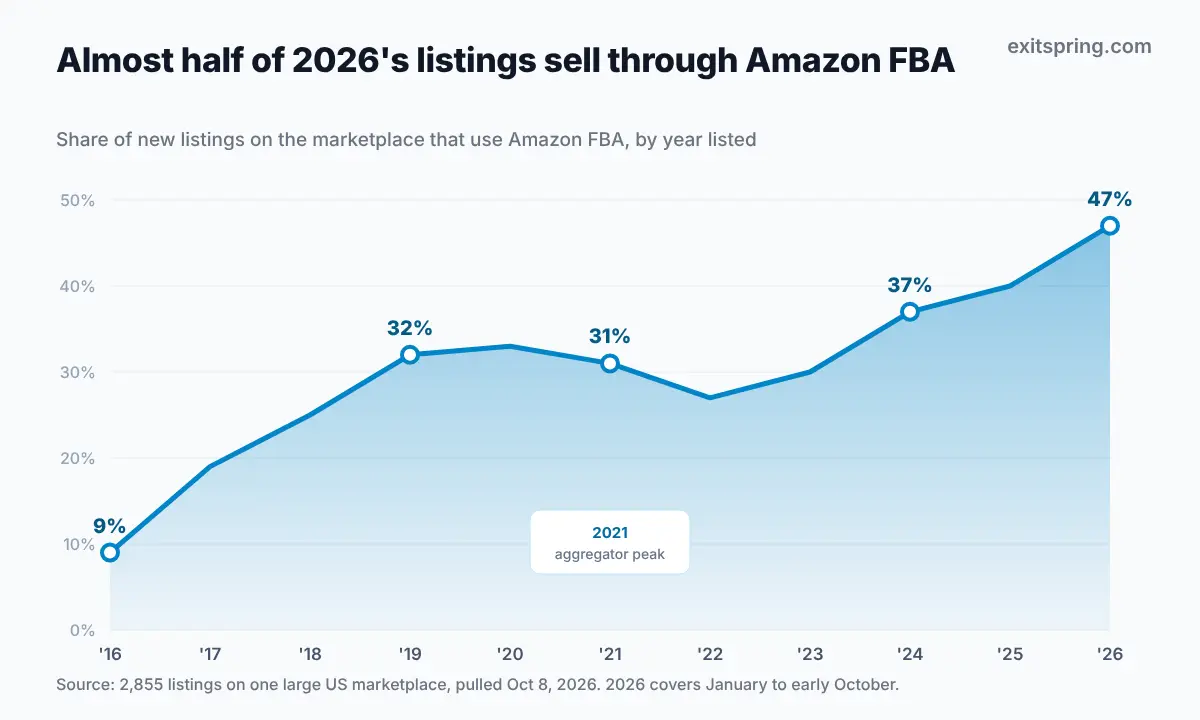
Amazon businesses also made up 47% of all new listings on that marketplace in 2026 through early October, the highest share since our data begins.
Take a brand that sells bamboo drawer organizers and spice racks. It does $1,850,000 a year in sales, 92% of it on Amazon.com and the rest through its own Shopify store. After landed product costs, Amazon fees, advertising, a freelance designer and a virtual assistant, the owner clears $388,000 of seller's discretionary earnings (SDE) on about 15 hours a week. SDE is profit before the owner's own pay and one-off personal costs. He formed the business in 2018 as a single-member LLC. The brand is a composite we built for this guide, and every figure about it below belongs to that composite.
How much is an Amazon FBA business worth in 2026?
An Amazon FBA business is usually priced as a multiple of its annual SDE. On the marketplace data, the median ask was 2.67x across all years and 2.58x for listings posted in 2025 and 2026. Profit size moves the number most: brands under $100,000 a year asked 2.42x, and brands over $1 million asked 3.50x.
| Annual SDE | Listings | Median asking multiple | A quarter asked under | A quarter asked over |
|---|---|---|---|---|
| Under $100,000 | 460 | 2.42x | 2.08x | 2.92x |
| $100,000 to $250,000 | 190 | 2.83x | 2.33x | 3.33x |
| $250,000 to $500,000 | 77 | 3.17x | 2.50x | 3.92x |
| $500,000 to $1 million | 43 | 3.00x | 2.58x | 3.50x |
| Over $1 million | 24 | 3.50x | 3.08x | 3.96x |
We pulled 797 listings tagged Amazon FBA, dated 2014 to 2026; 718 had already sold. The 794 with a price are the base for every multiple here, and each is an asking price on SDE, not a closing price.
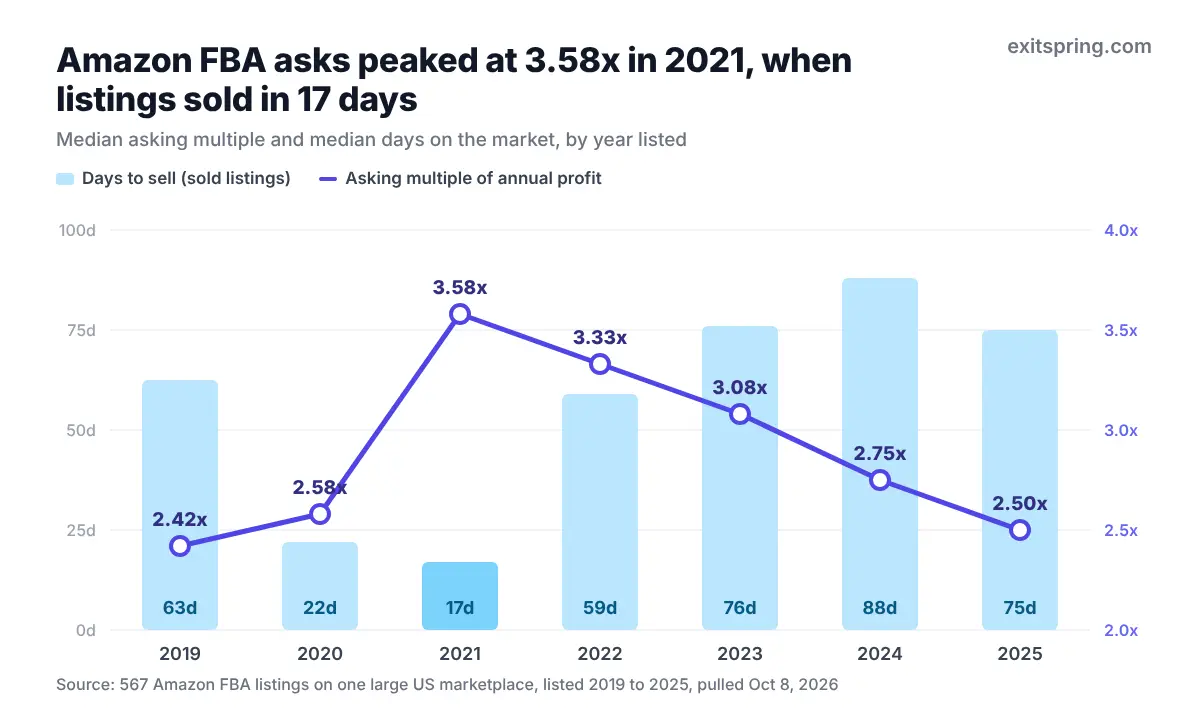
Prices peaked in 2021. Aggregators, companies that bought dozens of Amazon brands with venture capital and debt, raised more than $12 billion that year, Marketplace Pulse counted. The largest, Thrasio, had raised $3.4 billion in total and filed for Chapter 11 on February 28, 2024, CNBC reported. Our data can't say how much of the later fall came from aggregators leaving the market.
| Factor | Pushes toward the top quarter | Pushes toward the bottom quarter | The organizer brand |
|---|---|---|---|
| Years of sales | Six or more | Under three | Eight |
| Profit margin | Steady for 24 months | Falling as ad costs rise | 21%, flat since 2024 |
| Product spread | No ASIN above 30% of sales | One hero product | Top ASIN, the expanding spice rack, at 26% |
| Account health | No policy warnings or IP complaints in two years | An open intellectual property complaint | One resolved listing warning, March 2025 |
| Supply | Two factories quoted for the best seller | One factory, no written agreement | One factory, plus a backup quote on file |
| Sales outside Amazon | Own store or a second marketplace | Amazon.com only | 8% through Shopify |
The median Amazon business on the marketplace also had $358,000 of yearly sales on a 24% profit margin, and its owner worked about five hours a week. Brands asked about the same multiple at a 15% margin as at 35%, so a buyer looks harder at whether the margin is stable than at its level. Our guide to online business multiples by type compares Amazon with content sites, SaaS and ecommerce.
Almost half of 2026's listings are Amazon businesses
| Year listed | All listings | Amazon FBA listings | Share |
|---|---|---|---|
| 2021 | 377 | 117 | 31% |
| 2023 | 159 | 48 | 30% |
| 2025 | 194 | 78 | 40% |
| 2026, to early October | 210 | 98 | 47% |
Every owner gave a reason for selling, and by far the most common was moving on to other opportunities.
More sellers means a buyer can compare three spice-rack brands in a week. A clean data room and a written handover plan are what move a listing from the bottom quarter of asks to the middle.
Pricing the organizer brand (composite) at $1,202,800 plus stock
| Line | Figure | Basis |
|---|---|---|
| Sales | $1,850,000 | Amazon.com $1,702,000; Shopify $148,000 |
| Landed product cost | $536,500 | Factory price, ocean freight, duty and delivery to Amazon |
| Amazon referral fees | $255,300 | 15% of Amazon sales |
| FBA fulfillment, storage and placement fees | $278,000 | $236,000 of it fulfillment fees, from Amazon settlement reports |
| Advertising | $260,000 | Sponsored Products and Sponsored Brands |
| Shopify orders, apps and 3PL | $38,200 | A small warehouse ships Shopify orders |
| Designer and virtual assistant | $54,000 | Both freelance, both staying with the brand |
| Samples, software and other | $40,000 | Product photography, inventory software, bookkeeping |
| SDE | $388,000 | 21% of sales |
| First offer | $1,086,400 | 2.8x SDE with inventory included |
| Second offer | $1,164,000 plus stock | 3.0x SDE, inventory at landed cost on top |
| Agreed | $1,202,800 plus stock | 3.1x SDE; $120,280 held in escrow for 12 months |
The first offer looked close to the second until the owner took the inventory out. With $221,400 of stock inside it, that buyer was paying $865,000 for the business, or 2.23x SDE.
At 3.1x, the brand sits inside the middle half of asks for its profit band, which ran from 2.50x to 3.92x. The 10% escrow covers the owner's promises in the purchase agreement about account health and supplier terms. Our guide to how to value an online business explains each SDE adjustment, and seller financing and earnouts covers deals where more of the price is paid later.
How is inventory priced when you sell an Amazon business?
Inventory in an Amazon business sale is usually priced on top of the business multiple, at the seller's landed cost: what the goods cost to make and deliver to the warehouse. The buyer and seller count it the day before closing, so the final figure moves with sales. Stock that can't be sold, such as damaged or unfulfillable units, is usually left out.
| Where the stock sits | Value at landed cost | How it was counted |
|---|---|---|
| Amazon fulfillment centers | $142,600 | Amazon's inventory report the day before closing, 9,450 sellable units |
| Shopify warehouse (3PL) | $41,300 | The warehouse's own count, checked against a video walk-through |
| On a ship from the factory | $37,500 | Paid supplier invoice and bill of lading |
| Unfulfillable units | $0 | 640 units worth $4,100 left out; the owner wrote them off |
| Total paid at closing | $221,400 | On top of the $1,202,800 price |

Since April 1, 2024, Amazon has charged a low-inventory-level fee on standard-size products with less than four weeks of supply (fee announcement). Running the best seller short to save cash before a sale adds that fee to each unit shipped.
The organizer brand's agreement set a floor of 75 days of supply at closing. The owner placed his last factory order seven weeks before the sale, and the buyer paid for it as the in-transit line above.
Due diligence
| Check | Where it comes from | On the organizer brand |
|---|---|---|
| Account Health Rating | Seller Central's 0 to 1,000 score, with Amazon's target of an order defect rate under 1% (Amazon) | Healthy band, order defect rate 0.3% |
| Policy and IP history | Account Health page, 24 months | One listing warning about a product photo, fixed within two days |
| Sales and fees | Settlement reports tied to bank deposits | 24 months reconciled; payouts match deposits within $40 a month |
| Advertising | Ad spend as a share of all sales, by month | 14% of sales, between 12% and 16% for two years |
| Reviews | How reviews were collected | No paid or incentivized reviews; Amazon's Request a Review button only |
| Supplier | Purchase orders, quality reports, molds and design files | Molds paid for by the brand, ownership confirmed in an email from the factory |
| Storage | Amazon's monthly capacity limits and aged stock | No stock older than 365 days |
Reviews get extra attention since the Federal Trade Commission's rule on consumer reviews took effect on October 21, 2024. It bans fake reviews and rewards conditioned on positive or negative reviews, and each violation can cost up to $53,088, the FTC's current penalty figure. A buyer who inherits a brand built on bought reviews inherits that risk too.
Fees feed straight into the price. Amazon raised US FBA fees by an average of $0.08 a unit from January 15, 2026 (Amazon), then added a 3.5% fuel and logistics surcharge on fulfillment fees from April 17, 2026, which it called temporary (Digital Commerce 360). On the organizer brand's $236,000 a year of fulfillment fees, the surcharge costs $8,260. A buyer paying 3.1x knocks about $25,600 off the price if he expects it to stay. The full buyer's list for any online business is in our due diligence checklist.
Can you transfer an Amazon seller account to a buyer?
An Amazon seller account can move to a new owner only with Amazon's approval, through the legal entity change in Seller Central. Amazon's Business Solutions Agreement has long barred sellers from assigning it without Amazon's prior written consent. Handing a buyer the login without that approval breaks the agreement.
Amazon announced changes in late May 2026, effective August 24, 2026, and DAM Law Firm reads them as banning any transfer or pledge of a seller's rights, payouts included, outside Amazon's formal process. The steps below come from an Amazon staff answer on its European seller forums.
| Step | Who acts | On the organizer brand |
|---|---|---|
| Choose Transfer Account under Business Information in Seller Central | Current owner | Started the morning escrow confirmed the buyer's funds |
| Accept Amazon's transfer agreement | Current owner | Signed the same day, after the last disbursement went out |
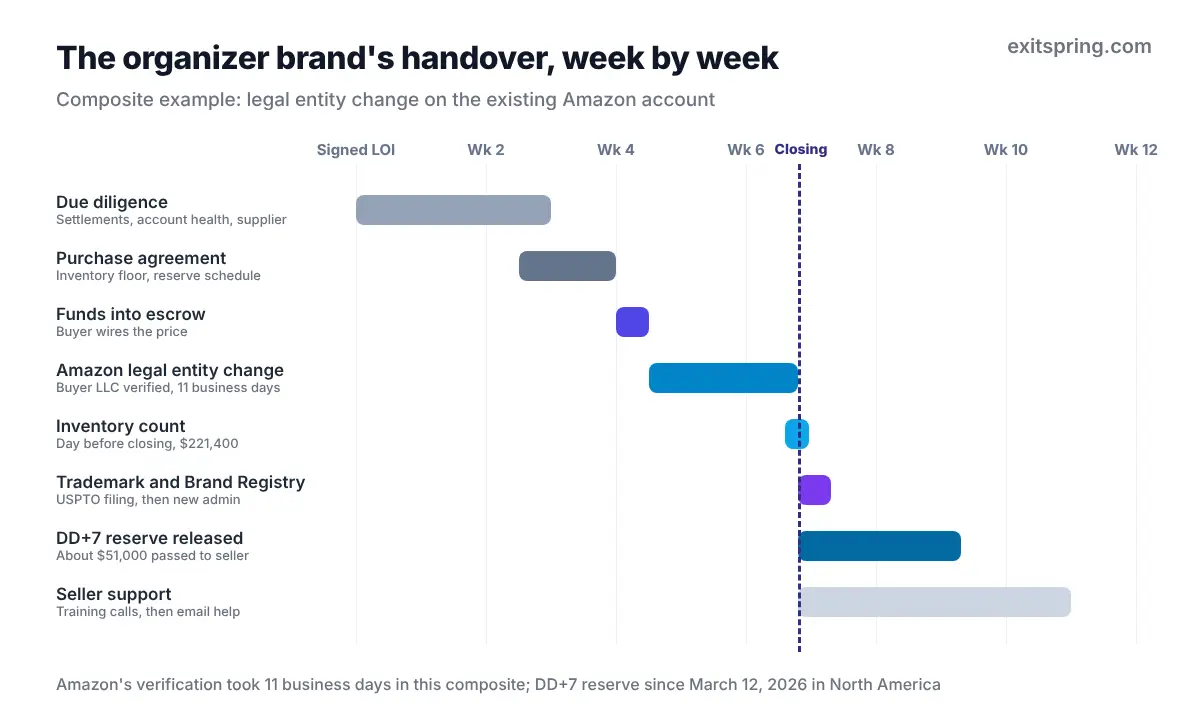
| Sign in as the new legal entity and complete verification | Buyer's company | LLC papers, ID and a US bank account; cleared in 11 business days |
| Route | What moves | What the buyer has to rebuild | Who suits it |
|---|---|---|---|
| Legal entity change on the existing account | The account, its listings, performance history and stock in Amazon's warehouses | Nothing on Amazon, once verification clears | Most asset sales between US companies |
| Buyer's own account, assets only | Brand, trademark, product listings, supplier relationships | Sends stock from the old account to the new one; account health starts fresh | Buyers who already run several brands |
| Sale of the company that owns the account | The whole LLC, account included | Nothing; Amazon still needs the new beneficial owners verified | Owners whose LLC holds only this brand |
Product reviews belong to the product listing, not the account, so they stay on the listing whichever route is used, according to Flippa's account transfer guide. The organizer brand used the first route, and Amazon's verification of the buyer's LLC took 11 business days in this composite.
Our guide to selling an online business from outside the US covers buyers and sellers in different countries.
Brand Registry, trademark and supplier contracts
| Asset | How it moves | On the organizer brand |
|---|---|---|
| US trademark | A written assignment, recorded in the USPTO's Assignment Center; the fee is $40 for the first mark and $25 for each one after (37 CFR 2.6) | Two marks, the word mark and the logo, recorded for $65 on closing day |
| Brand Registry | The current owner adds the buyer as an administrator and rights owner, then the buyer removes the old owner (Amazon staff answer) | Done the day after closing, once the USPTO filing receipt arrived |
| Factory relationship | A supplier letter introducing the buyer, plus a transfer of mold ownership | The factory confirmed the molds belong to the brand and quoted the buyer the same unit prices |
| Shopify store | Shopify's ownership transfer, covered in our guide to selling a Shopify store | Moved the same week |
US law lets a trademark be assigned only "with the good will of the business" it stands for, and an assignment that isn't recorded within three months, or before a later purchase, doesn't hold against a later buyer who paid without notice of it (15 U.S.C. § 1060). An intent-to-use application can't be assigned before use is shown unless it goes with the ongoing business it belongs to, so a pending application is worth checking with counsel before the letter of intent.
Getting paid: Amazon's payout hold and the closing cut-off
Amazon holds sale proceeds until seven days after each order is delivered. It moved North American accounts to this delivery-date reserve, known to sellers as DD+7, on March 12, 2026, according to Amazon's notice as sellers quoted it and EcomCrew's report. On any given day, one to three weeks of sales are sitting in reserve, and a separate account-level reserve can hold more for returns and claims.
| Money in motion at closing | Who it belongs to | How the organizer brand handled it |
|---|---|---|
| Sales delivered before the cut-off, still in reserve | Seller | Buyer pays it to the seller when Amazon releases it; about $51,000 over 16 days |
| Orders placed before the cut-off, delivered after | Agreed in the contract | Split at the order date, so the seller kept them |
| Refunds on pre-closing orders | Seller | Deducted from the escrow if over $2,000 |
| Ad spend billed after closing for earlier campaigns | Seller | Deducted from the reserve payment |
Amazon staff also advise disbursing pending funds before starting a legal entity change. The organizer brand requested its last disbursement two days before closing and listed everything still held in a schedule to the purchase agreement.
Loans and liens buyers look for
Amazon stopped underwriting new term loans for US sellers on March 6, 2024 (Fortune), and many brands now borrow from other lenders against future Amazon payouts.
A lender with a claim on the business usually files a UCC-1 financing statement with the state, which names the borrower, the lender and the assets pledged (UCC § 9-502). A buyer's lawyer searches for these before closing. The organizer brand had one, for a 2023 inventory loan already repaid, and the lender filed a termination statement 10 days before the sale.
Taxes on an Amazon business sale
Most Amazon businesses sell as assets, and each class of asset is taxed in its own way. Buyer and seller both report how the price is split on IRS Form 8594.
| Form 8594 class | What it covers here | Tax treatment for the seller |
|---|---|---|
| Class IV | Inventory | Ordinary income on any gain; inventory isn't a capital asset under 26 U.S.C. § 1221 |
| Class V | Equipment, such as a photo studio kit | Depends on depreciation taken |
| Class VI | Trademarks, customer lists, a non-compete | Generally capital gain if held more than a year; a non-compete payment is ordinary income |
| Class VII | Goodwill | Long-term capital gain for a seller who held the business more than a year |
The organizer brand's $221,400 of stock sold at its landed cost, so the seller's gain on it was close to zero. Almost all of the $1,202,800 landed in Classes VI and VII. The owner's LLC has one member, so the gain passed straight to his own return.
Sales tax runs in two lanes. Every US state with a sales tax now requires marketplaces like Amazon to collect it; Missouri was the last to adopt the rule, from January 1, 2023 (BDO). The Shopify sales are the seller's own responsibility, and a buyer will ask which states the brand registered in. Our guide to taxes when selling an online business goes further.
Mistakes that cost Amazon sellers money
| Mistake | What it cost | Illustrative example |
|---|---|---|
| Comparing offers without separating inventory | Accepting a lower price for the business itself | An offer of $1,086,400 "including stock" was really 2.23x for the business |
| Running stock down before listing | Low-inventory fees and a sales dip in the data room | A best seller with nine days of supply for three weeks |
| Handing over the login instead of using Amazon's process | A breach of Amazon's agreement and a frozen account | A buyer signs in from another country and triggers re-verification |
| Leaving a lender's filing in place | Closing delayed until the lien is released | A 2023 UCC-1 for a repaid loan, still on the state register |
| No agreement on reserved payouts | A dispute over the last two weeks of sales | About $50,000 in DD+7 reserve with nothing in the contract |
Questions Amazon sellers ask
How long does it take to sell an Amazon FBA business?
Amazon FBA listings that sold in 2025 took a median 75 days on the marketplace, against 17 days at the 2021 peak. Add the buyer's due diligence and Amazon's verification of the new owner, which took 11 business days for the organizer brand, and four to six months from listing to final payout is a fair plan. Our guide to how long it takes to sell an online business breaks the stages down.
Do I need a registered trademark to sell my Amazon brand?
707 of the 794 priced Amazon listings showed a trademark. A brand without one can't join Brand Registry, which needs a registered or pending mark, so it has no tool for removing a hijacker's listing and can't run Sponsored Brands ads. The organizer brand filed its word mark in 2019, a year after its first sale, and that registration is what the buyer's Brand Registry access rests on.
What happens to my Amazon reviews when I sell?
Reviews stay attached to each product listing. When the account moves through Amazon's legal entity change, the listings and their reviews move with it. If the buyer uses a new account instead, the listings are re-created under the same ASINs where possible, and the organizer brand's 4.6-star spice rack would keep its 3,100 reviews on that ASIN.
Does Amazon have to approve the sale of my business?
Amazon took 11 business days to verify the organizer brand's buyer before the seller account moved, and a sale of the LLC that owned the account would have needed the same check of its new owners.
Will Amazon's 2026 fee changes lower my price?
About $25,600 comes off the organizer brand's price if its buyer expects the 3.5% surcharge to stay. That is $8,260 a year on $236,000 of fulfillment fees since April 17, 2026, multiplied by 3.1. Twelve months of settlement reports under the 2026 fees let the buyer see the real cost instead of estimating it.
Can I sell if I still owe money to a lender?
A loan still owing is usually paid off from the sale proceeds at closing, using the lender's payoff letter, after which the lender files a UCC-3 termination so the buyer's lawyer finds a clean state register.
Selling your Amazon brand with Exit Spring
Pull your last 24 months of Amazon settlement reports and an inventory report from Seller Central, and send them with your Account Health page. We'll tell you where the brand sits in its profit band, how much of the price inventory should add, and which route for the account suits your buyers. Exit Spring works from the US and Hong Kong. You can request a free valuation or browse Amazon brands on our marketplace.
General information as of October 2026, not legal or tax advice.
Sources
- Amazon: Business Solutions Agreement, 2024 US fee changes, 2026 US fee changes and Selling policies and account health
- Amazon seller forums: Legal entity change, Brand Registry after a sale and Delivery date based reserve
- DAM Law Firm: Amazon BSA update, August 2026
- Flippa: Transferring an Amazon seller account
- Federal Trade Commission: Final rule on fake reviews and 2025 civil penalty amounts
- USPTO: Assignment Center
- IRS: Instructions for Form 8594
- Cornell LII: 15 U.S.C. § 1060, 37 CFR 2.6, 26 U.S.C. § 1221 and UCC § 9-502
- BDO: Missouri sales tax and marketplace legislation
- Marketplace Pulse: Amazon aggregators raised over $12 billion in 2021; CNBC: Thrasio files for bankruptcy; Fortune: Amazon ends seller loans
- Digital Commerce 360: Amazon fuel and logistics surcharge; EcomCrew: DD+7 payment policy
- Empire Flippers public listings, retrieved October 8, 2026 (797 Amazon FBA listings, asking multiples on SDE)
Get new listings in your inbox
Fresh businesses for sale every Monday, plus practical buying and selling tips.
Unsubscribe anytime. No spam.
Keep reading

Ready to make a move?
Browse vetted online businesses or get a free valuation of yours.