
How to Sell an Online Business From Outside the US
Many of the people buying online businesses are in the US. A lot of the people selling them are in Lagos, Manila, Cairo, Kyiv or Bogotá. Finding the buyer tends to be the easy half. Getting paid by them, in full, into an account in your own name, is where these deals stall.
Getting a five- or six-figure payment from a stranger in another country into an account that's actually yours sounds simple, right up until you're doing it. A bank account name that's off by one word. A missing intermediary bank. An escrow company that won't pay into your country at all. Any one of these can freeze a payout for a week or two, and usually at the worst moment, after you've already handed the business over.
Exit Spring runs from the US and Hong Kong, so we've built our process around cross-border payouts from the start. This guide walks through how the money moves, which accounts work, what it costs, the tax questions worth asking early, and the scams that go after sellers outside the US.
So, can you do it? Yes. Sellers outside the US close deals with American buyers all the time. The safe way is through a licensed escrow company, which holds the buyer's money until you've handed everything over. Before you even list, though, sort out whether the escrow company will pay into your bank's country, whether your bank account is in exactly the same name as the seller on the deal, and how your own country will tax the sale. If those are wrong, nothing else in the process saves you.
The short version
- Where your bank account is matters more than where you live.
- Use one legal name across the purchase agreement, the escrow profile and the bank account. A mismatch is enough to get your payout held.
- On Escrow.com's standard schedule, escrow on a $100,000 sale costs about $1,900. Decide up front who pays it.
- Stripe, AdSense and Amazon accounts are tied to your country and legal entity, so plan how the buyer takes over the revenue before you sign anything.
- Be careful with earnouts. Payments tied to future performance can be taxed at 30% in the US for non-US sellers.
Can you actually sell to a US buyer from abroad?
Yes, and it's more common than most people assume.
Most online business deals are asset sales. The buyer usually isn't buying your company. They're buying the domain, the content, the channel or store, the email list and maybe a few supplier relationships, and all of that moves over the internet. Nothing in that requires you to live in America.
The friction sits around the deal rather than in it. Escrow companies decide which countries they'll send money to. Stripe, AdSense and Amazon each have their own rules on who can own an account. Your bank will want paperwork for a large incoming wire, and the buyer's side may want a W-8BEN from you. And if a buyer in Texas goes quiet after closing, a seller in Manila has very few practical ways to make them pay. So the setup has to be right before a single login changes hands.
How the money moves
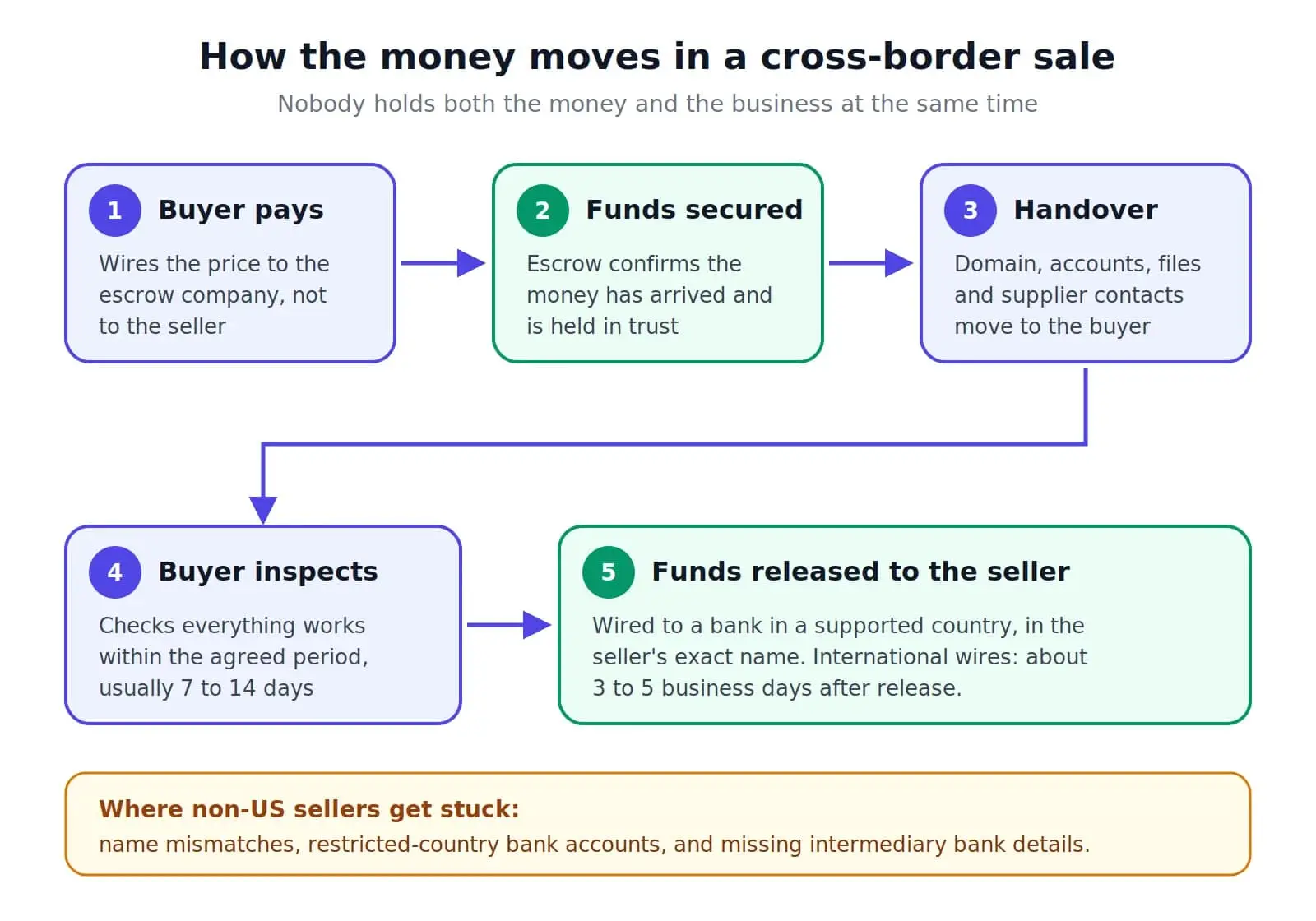
Nearly every well-run sale goes through the same five stages. For a seller abroad, the first and the last are where it usually goes wrong.
| Stage | What happens | What to watch |
|---|---|---|
| 1. Agreement | You sign an Asset Purchase Agreement (APA) and set up the escrow transaction with the price, fee split and inspection period. | The seller named in the APA has to match your escrow profile and your bank account. |
| 2. Funding | The buyer pays the escrow company. | Don't transfer a thing until escrow shows the funds as secured. |
| 3. Handover | You move the domain, accounts, files and contacts. | Time zones drag this out. Book a window when you're both online. |
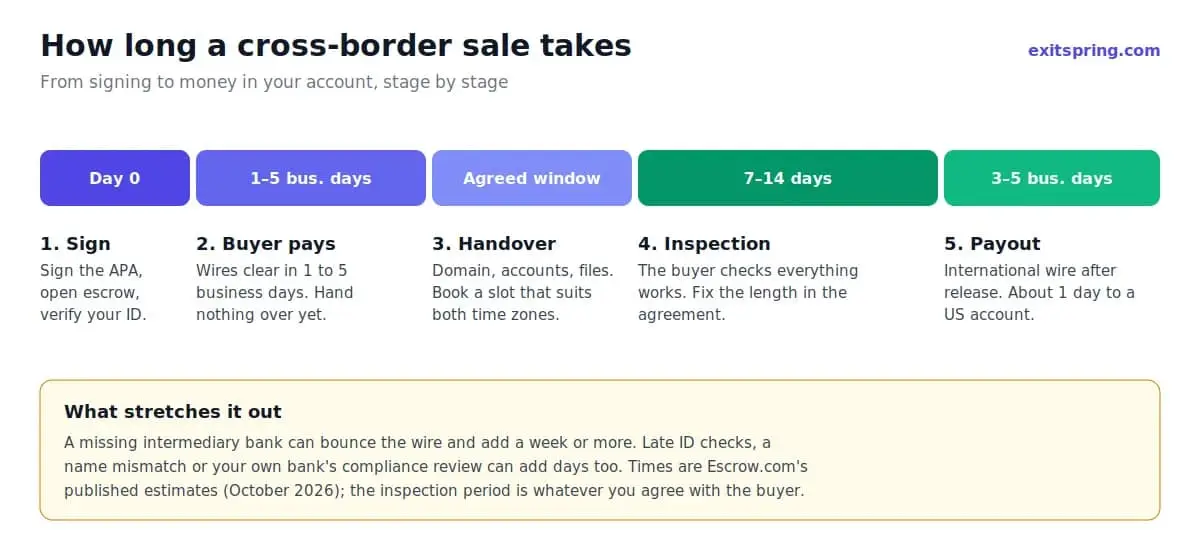
| 4. Inspection | The buyer checks everything works. | Keep it short and in writing. Seven to fourteen days is normal. |
| 5. Release | Escrow pays you. | Your bank's country, account name and intermediary bank decide how quickly. |
The whole idea is that nobody ever holds both the money and the business at once. The buyer can't walk off with your site before paying, and you can't take the money and keep the site.
Escrow options compared
Platforms handle the money differently, and when you're outside the US the differences matter more than you'd think.
| Option | Who holds the money | The catch for a non-US seller |
|---|---|---|
| Licensed third-party escrow (e.g. Escrow.com) | An independent escrow company | Neutral and rule-based, but country restrictions apply to your bank account |
| Broker-held funds | The broker | One contact for everything, but you're relying on the broker's own banking and controls |
| Marketplace payment system | A trust or payment partner the marketplace picked | Often built for international payouts, though supported countries vary. Read the terms |
| Attorney escrow | A lawyer's client account | Common on big deals. Slower, more expensive, and you may need a lawyer abroad |
| Direct wire, no escrow | Nobody | Fast and free, and whoever moves first takes all the risk |
Our view is simple. For a first sale, or any buyer you don't already know, use a licensed third-party escrow. A serious buyer will expect it. If one pushes back hard on escrow, that tells you something.
Check your country before you list
This step is easy to skip, and it causes the nastiest surprises because you tend to find out right at the end.
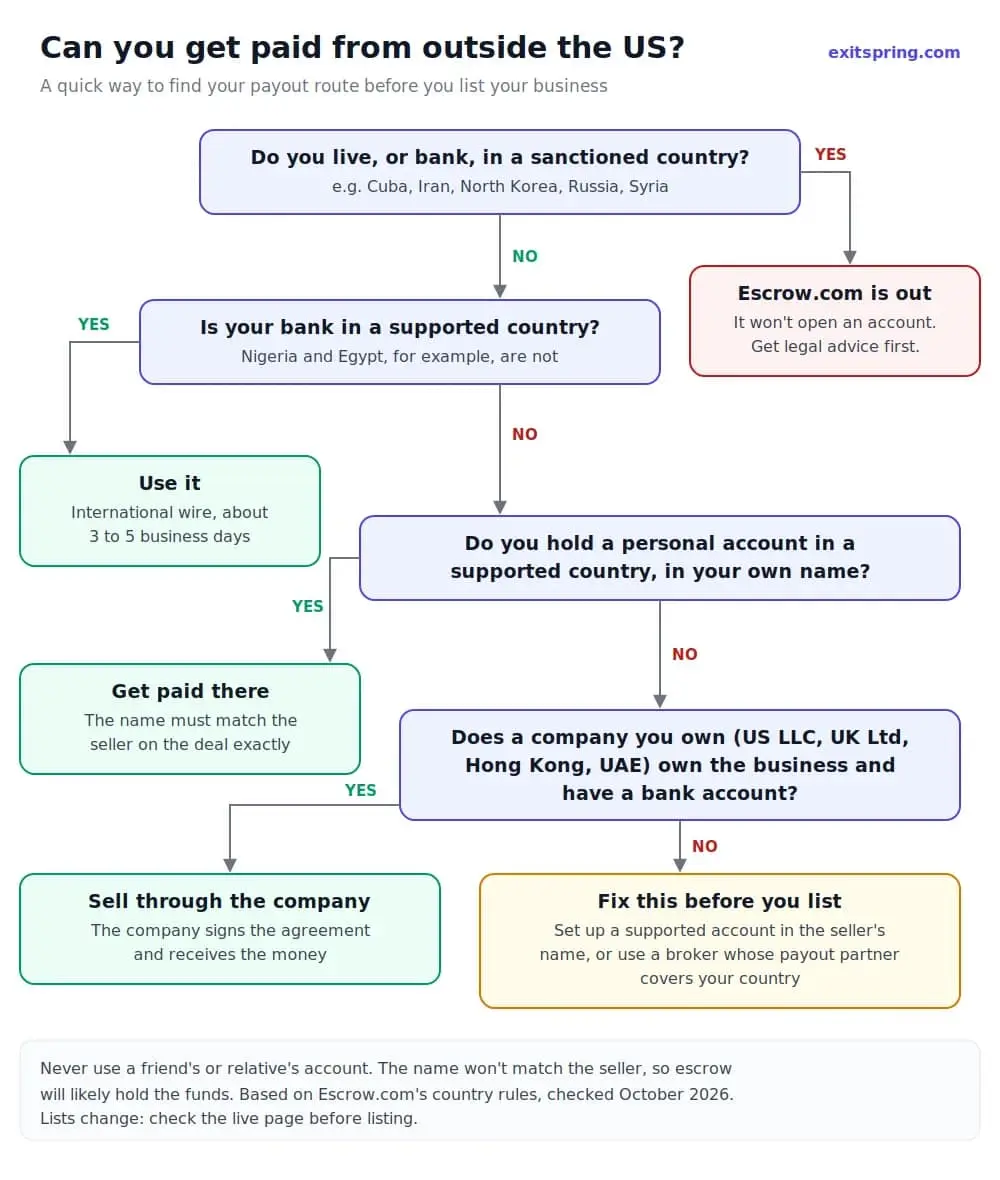
Escrow providers keep lists of countries they won't pay into or collect from. Escrow.com, which Flippa and others use to close online business deals, splits them in two.
The first group is restricted countries. If you live in one, you can still open an account, but you'll need a bank account in a supported country to send or receive money. As of October 2026 that list includes Nigeria, Egypt, Ukraine, Kazakhstan, Lebanon and Venezuela, among others.
The second group is sanctioned countries and regions: Belarus, Cuba, Iran, Myanmar, North Korea, Russia, South Sudan and Syria, plus five occupied regions of Ukraine (Crimea, Donetsk, Luhansk, Kherson and Zaporizhzhia). If you live or bank in any of them, you can't open an account at all.
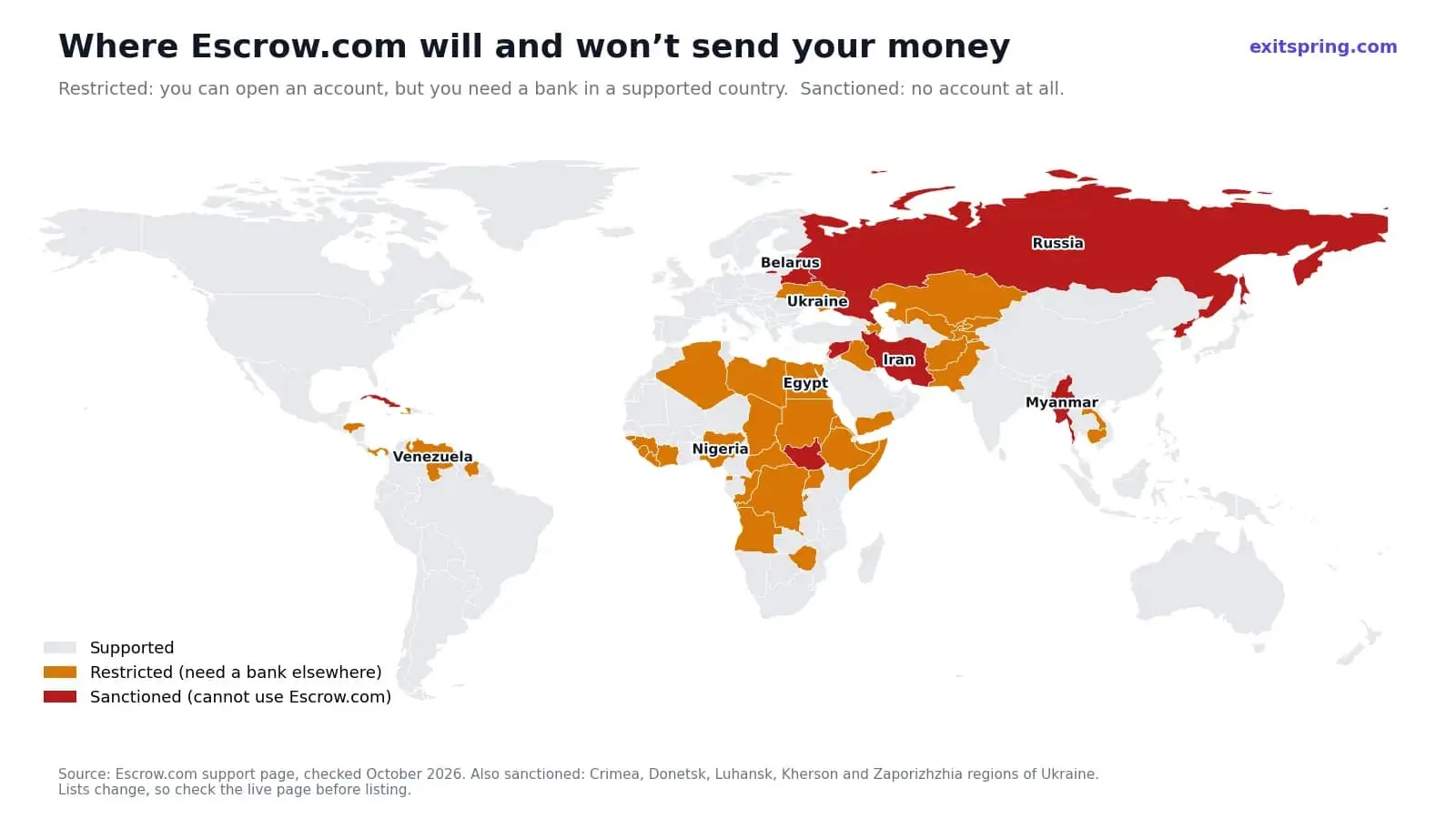
These lists move, and Escrow.com's page doesn't show when it was last updated, so check the live list on the day you list, not a screenshot someone posted in a group chat last year.
If you're in a restricted country, there are really only three ways around it:
- A personal bank account in a supported country, if you genuinely hold one, say from studying or working abroad.
- A company you own in a supported country with its own business bank account. Plenty of sellers already run things through a US LLC, a UK limited company, a Hong Kong company or a UAE free-zone company. If that company owns the business, it can be the seller.
- A marketplace or broker whose payout partner covers your country. Read the payout terms yourself rather than taking anyone's word for it.
What you shouldn't do is have the money sent to a relative's or friend's account. We get why people consider it. But the name won't match the seller on the deal, escrow will probably hold the funds, and you lose the paper trail that proves the money is yours, which you'll need later with your own bank and tax office.
Getting paid
Once escrow releases the funds, there aren't many ways for the money to reach you. Escrow.com pays sellers by wire, or by ACH (US accounts only). It only releases funds to banks, so PayPal, cards, Wise, Payoneer and similar money transfer services aren't payout options.
| How you get paid | How long after release* | The catch |
|---|---|---|
| Wire to a bank outside the US | 3 to 5 business days | Ask your bank whether it routes USD through an intermediary. Some deduct a receiving fee too |
| US domestic wire | Roughly a day | Only works if you, or your company, hold a US account in exactly the seller's name |
| ACH | Around 3 business days | US accounts only. Above $500,000, Escrow.com insists on a wire |
| Wise, Payoneer, PayPal and similar | Not available | Escrow.com only releases funds to a bank account in your name, not to money transfer services |
*Escrow.com's published estimates as of October 2026, assuming your details are right.
Escrow.com's help pages point to a few small details that hold up payouts. Three are worth checking before closing.
First, the name. Escrow.com requires the name on your bank account to match the name, or company name, on your escrow profile. If you sign the deal personally, you get paid into a personal account. If your company signs, the money goes to the company. Don't mix them.
Second, intermediary banks. A lot of banks outside the US receive dollar wires through a correspondent bank in the middle. If yours needs one and you haven't entered it, the wire can bounce back to Escrow.com, and Escrow.com says the return alone can take a week or more. A five-minute call to your bank before closing avoids the whole thing.
Third, your address. It should match what your bank has on file. Escrow.com says many banks reject a payment when the address doesn't match, and a rejection can take a week or more to process. Boring, but it happens.
What escrow costs
Escrow.com's percentage shrinks as the price goes up. The figures below come from the standard schedule that took effect on May 31, 2024, which made bigger deals noticeably dearer (escrow on a $100,000 sale used to cost $890). Put your own number into the fee calculator before you sign, since the schedule has changed before.
| Sale price | Standard escrow fee | As % of price |
|---|---|---|
| $25,000 | $600 | 2.4% |
| $50,000 | $1,200 | 2.4% |
| $100,000 | $1,900 | 1.9% |
| $250,000 | $3,800 | about 1.5% (a tier minimum kicks in) |
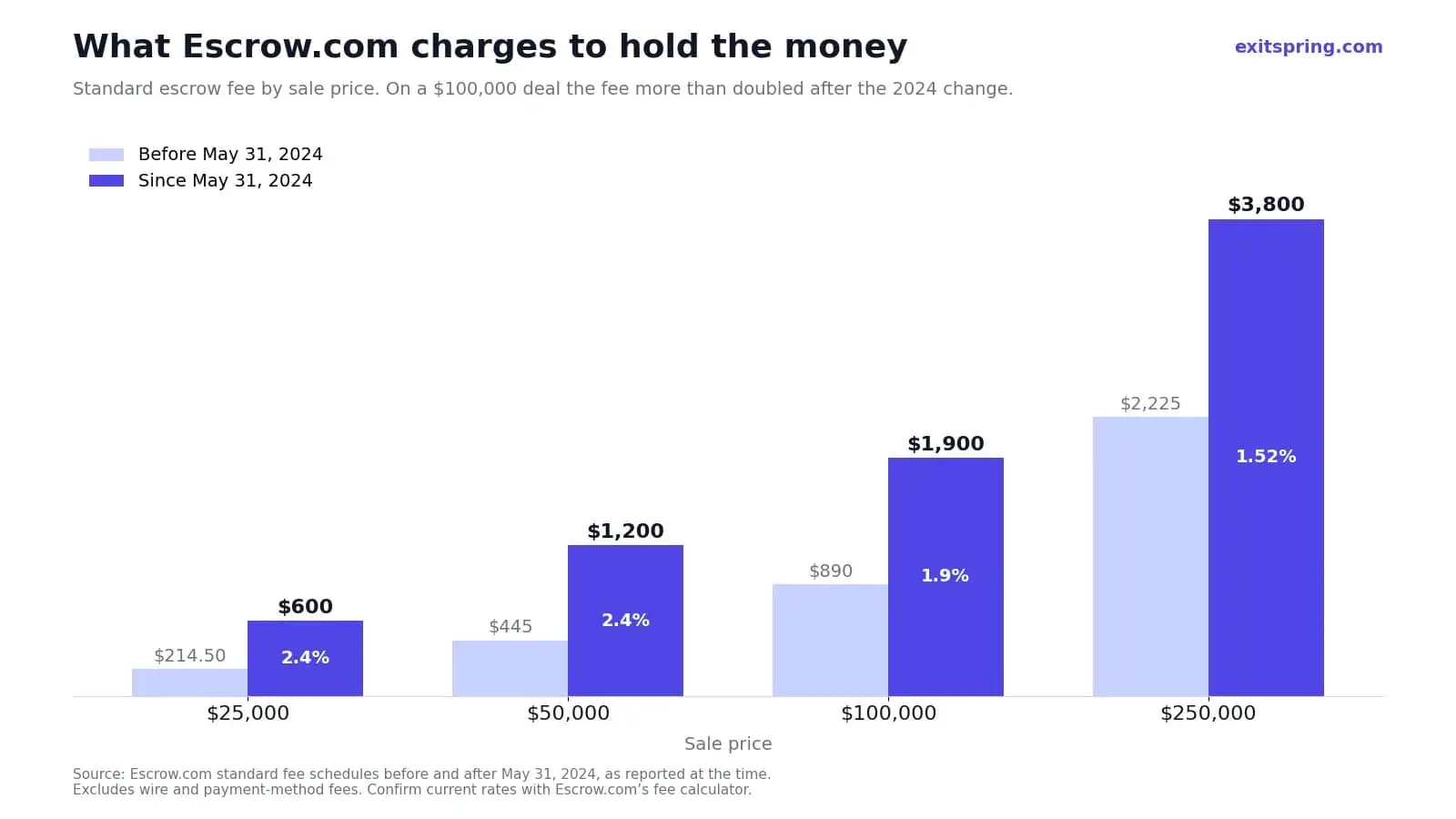
Then there's the payout itself. Escrow.com charges $20 for an outgoing international wire at the time of writing, and your bank, plus any intermediary bank, may take its own cut. Card and PayPal payments are only offered on deals up to $5,000, and they carry a processing fee on the buyer's side. One small extra: if your buyer pays by wire from a bank outside the US, Escrow.com adds $25 to the escrow fee to cover intermediary bank charges.
Many deals split the escrow fee down the middle. That's fine. Just write it into the agreement and set the escrow transaction up the same way, so nobody's arguing about $950 on closing day.
Currency
Price the deal in US dollars. It's what most buyers hold and it keeps escrow simple.
Converting into rupees, pesos, naira or whatever you spend day to day is your cost unless you negotiate otherwise, and the fee is only part of it. The bigger cost is usually the gap between the rate your bank gives you and the actual market rate. On a $100,000 payout, a rate that's a couple of percent off is real money and can easily cost more than the escrow fee.
Call your bank before closing day. Ask what rate they'll give on an incoming dollar wire, and whether you can park the dollars in a USD account and convert later. In some countries the central bank sets deadlines for converting or reporting foreign receipts, so find out if yours does. If two or three accounts could take the money, work out what would actually land in each one after fees and the exchange rate. A "free" incoming wire at a poor rate can cost you more than a $40 fee at a good one.
Selling as a person or as a company
Settle this early. It decides whose name goes on everything.
If the business has always run in your own name (your Gmail owns the channel, payouts land in your personal account), you're probably selling personally. If it runs through a company that holds the store, the seller accounts and the contracts, the company is the seller and the company gets paid.
Trouble starts when the two get mixed. A personal signature on the agreement with the money going to a company account is exactly the kind of thing that sets off extra checks.
Escrow.com also verifies the identity of every party on deals over $3,000, and says review takes up to one business day. Upload your documents when you open the transaction. Not on closing day.
What happens to Stripe, AdSense, Amazon and the rest
This is easy to forget until the buyer asks. A lot of revenue accounts are tied to the country and legal entity of whoever opened them, so when the buyer's in a different country, many of them can't just be handed over. You need a plan for how money keeps coming in after closing.
| Account | Can it go to the buyer? | How it usually works |
|---|---|---|
| Domain | Yes | Push or transfer it to the buyer's registrar account once funds are secured |
| YouTube channel | Yes, through a Brand Account | Add the buyer as an owner. They can be made primary owner after seven days |
| AdSense | No | The buyer links their own AdSense account to the channel or site |
| Stripe | Sometimes | Same country, Stripe Support walks you through an ownership change. Buyer's company abroad, they open a new account and ask Stripe to migrate the data |
| Amazon seller account | Not as a simple transfer | The usual route is a legal entity update in Seller Central, which triggers re-verification. Check with Seller Support before you sign |
| Shopify store | The store, yes | Shopify Payments has to be moved to the new owner's details through Shopify Support, and it only works in supported countries, so a buyer abroad may need a different payment provider |
| PayPal business | Generally no | The buyer connects their own |
One clause is worth adding to the purchase agreement here, which is a revenue cut-off date. Ad networks, affiliate programs and marketplaces often pay out weeks after the sales that earned the money. Without a clear line saying which earnings are yours and which are the buyer's, money in transit turns into an argument. With one, it's just bookkeeping.
If you're selling a channel, we go through the YouTube side in more detail in how YouTube channels are valued and transferred.
Taxes and paperwork
General information, not tax advice. It depends on where you live, how the deal's structured and whether there's a tax treaty involved. Talk to a qualified advisor in your home country before you sign.
The US side
You'll probably be asked for a foreign status form. A US buyer, as the payer, may ask individuals to complete Form W-8BEN and companies to complete Form W-8BEN-E. It confirms you aren't a US person, and it's also where you'd claim a lower treaty rate if one applies.
For a sale paid in cash at closing, the position is usually better than people fear. Under 26 U.S.C. § 865(d), income from a non-contingent sale of goodwill is generally sourced to the country where the goodwill was built. A business built and run from, say, Manila, with no office or staff in the US, often owes no US tax on that kind of sale. Often isn't always, though, and the details of your setup can change the answer.
Earnouts are a different story, and this one catches people out. US regulations can tax non-US sellers at 30% on US-source gains from selling goodwill, trademarks, copyrights and similar property, to the extent the payments depend on how the property performs or is used afterwards (26 CFR § 1.871-7(c)(1)(iv)). Payments linked to future sales or units sold count (26 CFR § 1.871-11).
So an earnout along the lines of "you'll get another $40,000 if revenue holds for twelve months" on a content site or brand could fall into it, and the buyer might withhold tax from each payment. A treaty between the US and your country may bring that rate down. Either way, if a buyer suggests an earnout, take it to your advisor before you agree the structure, not after.
Your side
Most countries tax residents on the sale of a business in one form or another, and how it's classified varies a lot. Your bank may also ask what a large incoming foreign payment is for, so keep the signed agreement, the escrow summary and the release confirmation somewhere you can actually find them. If the US withheld anything, your home country may give you a credit for it.
Make one folder, digital or paper, and put the signed agreement in it. Add the escrow statement and release notice, the advice slip your bank sends for the incoming wire, and copies of whatever tax forms you signed. Someone from the tax office may ask about the sale a year or two from now, and by then the PDFs will be scattered across three inboxes.
Scams aimed at sellers outside the US
Scammers like sellers who live abroad. You're unlikely to fly to another country to chase them, and they know it. Most of what they try is a variation on a few old tricks.
A common one is a fake escrow site. The buyer suggests an escrow company you've never heard of, and the site looks legitimate, sometimes suspiciously like Escrow.com. You get an email saying the funds have arrived, you hand over the business, and it turns out there was never any money. Escrow.com states plainly that it isn't affiliated with any other escrow site, and warns that fake ones often copy its design or quote its subsidiary's license details.
A close relative is the lookalike email. It seems to come from the escrow company but the address is slightly off, something like support@escrow01.com (Escrow.com's own example), and it wants you to click a link or "confirm" your details. Escrow.com warns about this kind of phishing on its fraud prevention page.
Then there's the buyer who'd rather skip escrow altogether. They'll offer a bit extra for paying you directly, or say their bank can't send money to an escrow company. Someone buying a real business with real money will use escrow.
None of the protection is clever. You choose the escrow company, not the buyer, and you type escrow.com into the address bar by hand every single time. Until your own dashboard shows the payment as secured, every login stays with you. A "paid" email proves nothing, and neither does a screenshot (they take about thirty seconds to fake). And an escrow site asking you to send money to a person or an "agent" is finished as far as you're concerned. Escrow.com lists that exact request as a fraud sign.
Terms worth putting in the agreement
Sorting out a dispute with a buyer in another country is slow and expensive, so the protection has to be in the agreement from day one. Here's what we'd push for:
- Cash at closing wherever possible. Earnouts and seller financing leave you depending on a foreign buyer after they already have the business, so keep any deferred part small.
- A precise definition of "delivered". List every asset and what counts as transferred, for example "buyer added as primary owner of the YouTube channel".
- A fixed inspection period, usually seven to fourteen days, with funds releasing automatically if there's no written objection by the end of it.
- The escrow fee split, written into both the agreement and the escrow transaction.
- A revenue cut-off date for orders, ad earnings and payouts still in transit.
- Pricing in US dollars, with an agreement on who carries conversion costs.
- A dispute process you can actually use. Arbitration with remote hearings tends to be more practical across borders than going to court.
- A limit on post-sale support, stated in hours or weeks, so release can't be held up by open-ended requests.
Common delays
| Problem | What happens | How to avoid it |
|---|---|---|
| Bank name doesn't match the seller | Escrow holds the payout for review | One legal name on the APA, escrow profile and bank account |
| Missing intermediary bank | The wire bounces back, adding a week or more | Get your bank's correspondent details for USD before closing |
| Verification documents uploaded late | Funding or release has to wait | Verify as soon as you open the transaction |
| Buyer pays from someone else's account | Escrow asks for extra checks | Ask the buyer to pay from an account in their own name |
| Restricted-country bank account | Escrow can't pay you | Set up a supported account before listing |
| Your bank's compliance review | The money arrives but sits on hold | Warn your bank ahead of time and have the APA and escrow papers ready |
| Payment accounts not planned | Revenue stops after closing and the buyer drags out acceptance | Agree the account handover and cut-off date in the APA |
Step by step
- Work out who actually owns the business (you or a company) and which accounts sit under which name.
- Check your payout path. If your bank's country isn't supported, set up a supported account in the seller's name now.
- List your payment accounts and note which ones the buyer will have to replace.
- Ask a tax advisor at home how the sale will be taxed and what records to keep.
- Get your numbers together, including twelve months of profit and loss, traffic data and proof you control each account. Our due diligence checklist shows what buyers will ask for.
- Get a realistic valuation. Here's how to value an online business.
- Sit down with the buyer and agree terms. Price and payment dates usually get settled early. It's the small stuff that blows up in closing week, so pin down the inspection window and the escrow fee split as well. Add a revenue cut-off date, a cap in hours on your post-sale help, and how a dispute would be resolved.
- Open the transaction on Escrow.com. You and the buyer should both upload ID or company documents the same day.
- Log in to Escrow.com yourself and check the status. Start moving accounts across, in the order you agreed, only once it shows the payment as secured.
- The buyer accepts and the money's released. Keep the whole paper trail.
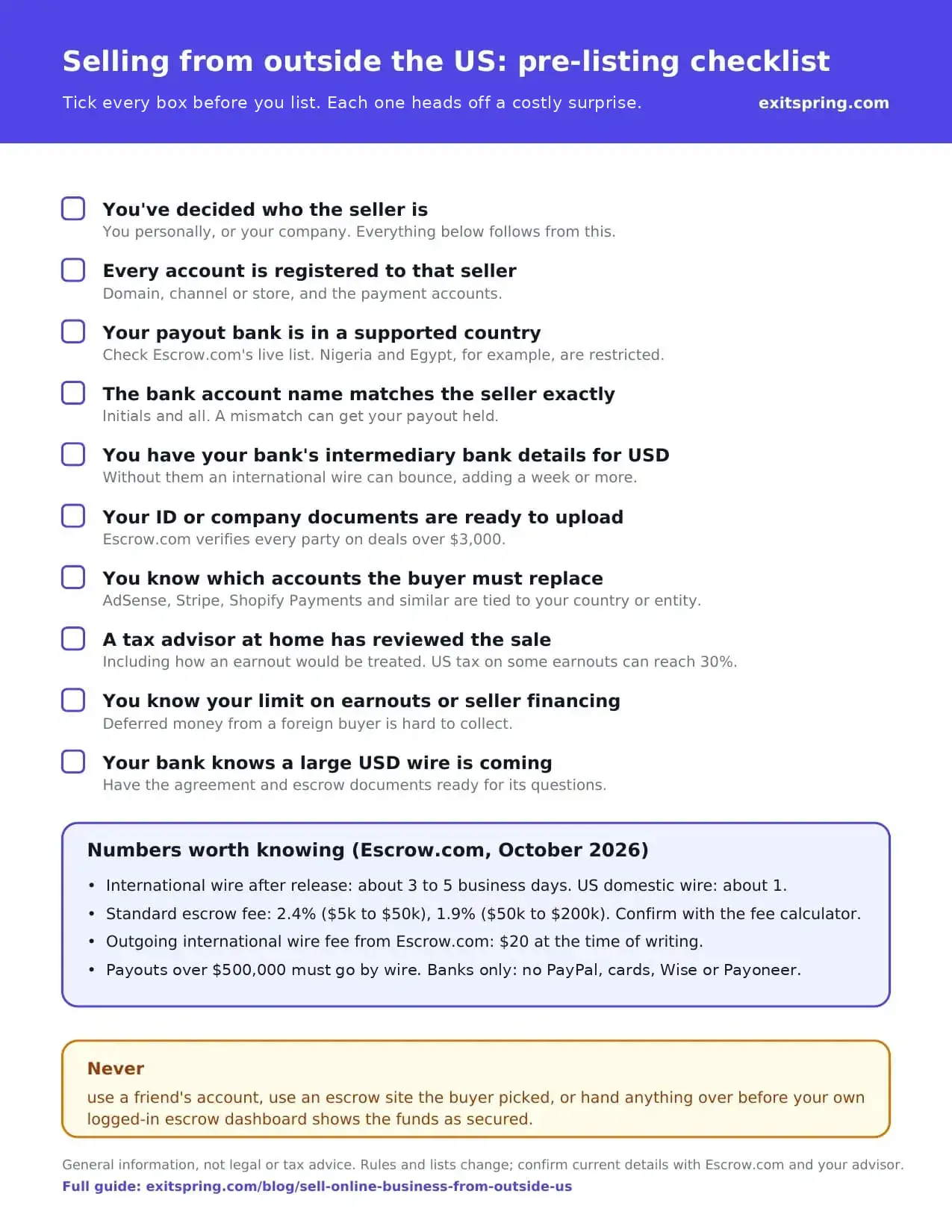
A quick self-check before listing
- You've decided who the seller is: you, or your company
- The domain, channel or store, and the payment accounts are all registered to that same seller
- Your payout bank isn't in a restricted country (Nigeria and Egypt are on Escrow.com's list, for example)
- The bank account name is spelled exactly like the seller name, initials and all
- Your bank has told you which intermediary bank, if any, handles its incoming USD wires
- A scan of your passport or company registration is ready to upload
- You've written down which accounts (AdSense, Stripe, Shopify Payments and so on) the buyer will have to replace
- A tax advisor at home has looked at how the sale will be taxed
- You know how much of the price, if any, you'd accept later as an earnout
- Your bank knows a large USD wire is on its way
If you'd rather tick it off on paper, the image below prints on a single page.
FAQ
Can someone who lives outside the US sell a website or online business to an American buyer?
Yes. Most of these deals are asset sales and everything transfers online. What you need is a payout account that your escrow provider supports, in the seller's name.
Do I need a US bank account?
No. Escrow.com wires money to banks in supported countries around the world. A US account can make things faster and a little cheaper, but you don't need one.
I live in Nigeria, Egypt or another restricted country. Can I still use Escrow.com?
You can open an account, but the money has to go to a bank account in a supported country. If you're in a sanctioned country, you can't use Escrow.com at all. Check the current list before you list, since it changes.
How much does Escrow.com charge?
It depends on the price. Since May 31, 2024 the standard rate has been 2.4% from $5,000 up to $50,000, so a $30,000 sale costs $720 to escrow. From $50,000 to $200,000 it's 1.9%. Above that the percentage keeps falling, but each band has a minimum fee. Check the calculator on Escrow.com before relying on any of this.
Can I get paid to PayPal?
Not from Escrow.com. It only pays out to bank accounts, by wire or by ACH to a US account. Wise, Payoneer and similar services aren't accepted either.
How long until the money arrives?
Escrow.com estimates three to five business days for an international wire and about one for a US domestic wire, assuming your details are right. Your own bank can add a few days on top.
Will I owe US tax?
Usually not, if the business was built outside the US and you're paid in full at closing. The exception that catches people is the earnout. Money that depends on how the business performs after the sale can be taxed at 30% in the US, although a tax treaty may cut that. Ask an advisor before you agree to one.
Can my Stripe or AdSense account go to the buyer?
AdSense, no, the buyer links their own. Stripe can change ownership within the same country through its support team. If the buyer's company is in another country, Stripe says they open a new account and request a data migration.
How do I know an escrow site is genuine?
Type the address in yourself and never use a link the buyer sends you. Escrow.com says it isn't affiliated with any other escrow site, and a site that asks you to pay an individual "agent" is a red flag.
How Exit Spring handles cross-border sales
We run Exit Spring from the US and Hong Kong, so our process is built for selling across borders.
We never hold client money. Deals close through Escrow.com, and the buyer's funds sit there until the transfer's confirmed. Before you list, we check your payout path, so a restricted-country bank problem gets solved at the start instead of on closing day. We also plan the account handover with you, including payment processors and the revenue cut-off, and run the transfer across whatever time zones are involved.
If you're outside the US and thinking about selling, request a free valuation and tell us where you and your bank are based. We'll tell you straight away whether your setup will work.
Sources
- Escrow.com: What countries / regions are not supported by Escrow.com?
- Escrow.com: How do Sellers get paid?
- Escrow.com: How long does the escrow process take?
- Escrow.com: Why is there a delay in my payment?
- Escrow.com: Disbursement options to sellers
- Escrow.com: How can I tell if an escrow site is fraudulent?
- Escrow.com: Fee calculator
- Escrow.com: Does Escrow.com have restrictions to where they can send funds?
- Escrow.com: Fraud prevention
- Stripe: Transfer a Stripe account due to a business sale or acquisition and Company acquired by a legal entity in a different country
- IRS: About Form W-8BEN and About Form W-8BEN-E
- Legal Information Institute: 26 U.S.C. § 865, 26 CFR § 1.871-7, 26 CFR § 1.871-11
Get new listings in your inbox
Fresh businesses for sale every Monday, plus practical buying and selling tips.
Unsubscribe anytime. No spam.
Keep reading
Ready to make a move?
Browse vetted online businesses or get a free valuation of yours.