
How Much Is a YouTube Channel Worth?
A YouTube channel with 400,000 subscribers can be worth less than one with 40,000. Buyers aren't paying for the audience you've built so much as the money it reliably throws off, and how much of that money will still be there once your face, your voice and your Google login are gone.
The formula fits on a napkin: monthly profit times a multiple. Agreeing on the profit figure, and then on the multiple, is where sellers and buyers end up going back and forth for weeks.
The short version
- Channels are priced on average monthly net profit, multiplied by a number that usually lands somewhere between 12 and 36.
- Subscriber count barely matters. Profit, how stable it is, and how easily it moves to a new owner matter a lot.
- Faceless channels tend to sell for higher multiples than channels built around one person on camera.
- YouTube reviews monetized channels as a whole, and since July 2025 its policy explicitly calls out "inauthentic" (mass-produced or repetitive) content, so a buyer will look hard at anything templated or mass-produced.
- Ownership moves through a Brand Account, and Google's rules add at least seven days to the handover.
How a monetized channel gets priced
Almost everyone in this market uses the same method. Take the channel's average monthly net profit over the last 6 to 12 months, then multiply it.
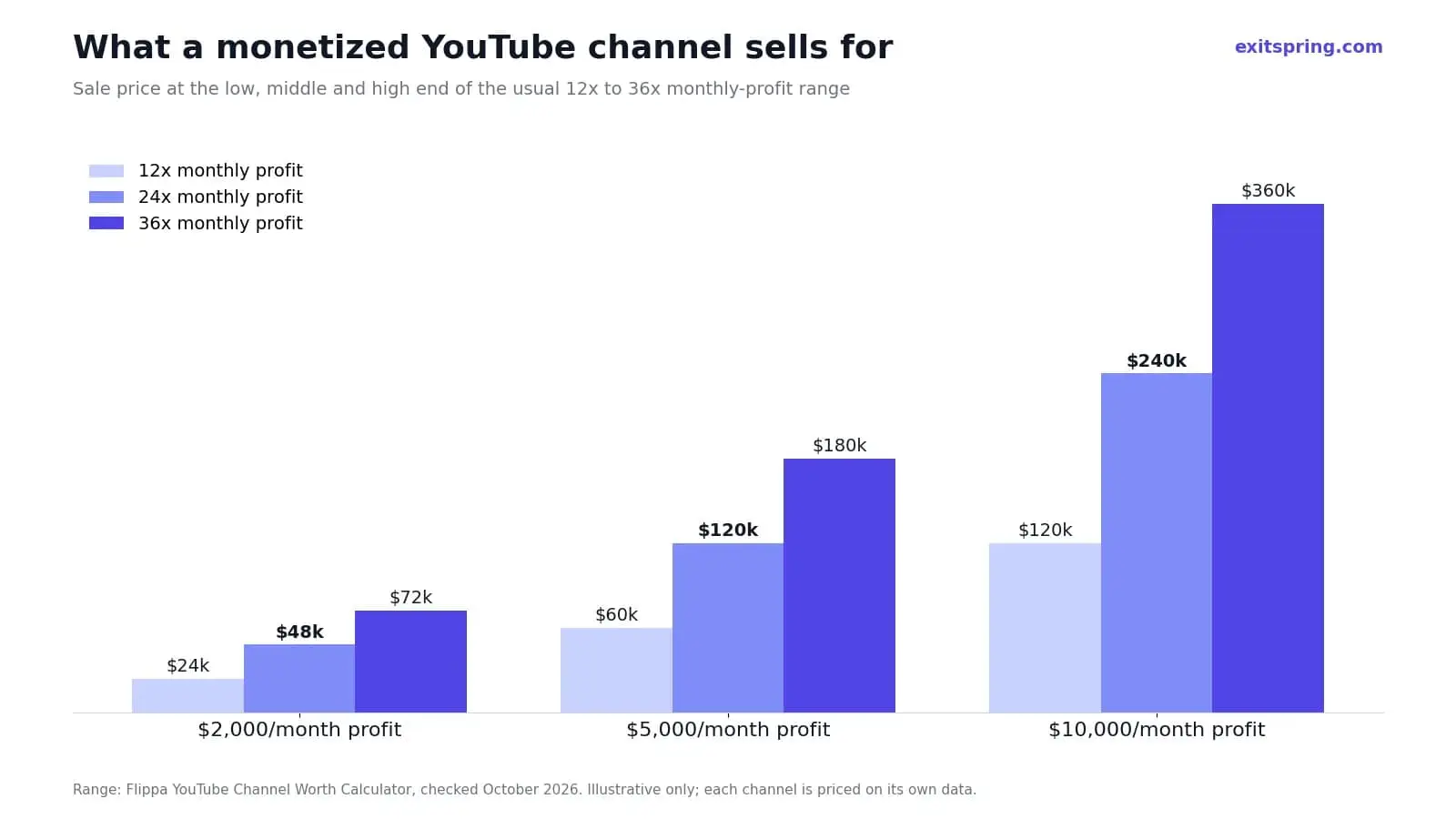
Flippa, one of the biggest marketplaces for channels, says channels typically go for 12 to 36 times monthly profit, based on the deals that have gone through its marketplace. Flippa adds that channels with recurring revenue and strong documentation can go above that range, so treat anything over 36x as the exception. Niche matters too: Flippa puts entertainment and vlog channels at 12 to 18x and evergreen channels at 24 to 36x.
The number being multiplied is profit, not revenue. If your channel brings in $8,000 a month but you pay an editor, a scriptwriter and a thumbnail designer $3,000 between them, the starting point is $5,000.
It also helps to translate the monthly figure, because website buyers and brokers often talk in annual terms:
| Monthly multiple | Same thing as an annual multiple | Typical channel |
|---|---|---|
| 12x | 1.0x yearly profit | Declining views, one income source, policy risk |
| 24x | 2.0x yearly profit | Steady, ad-funded, a bit dependent on the owner |
| 36x | 3.0x yearly profit | Growing, diversified income, runs without the seller |
So a channel clearing $5,000 a month in profit is usually a $60,000 to $180,000 asset. Where it lands inside that band is what the rest of this article is about.
Why subscriber count doesn't set the price
Subscriber counts mostly record how a channel did in the past. Plenty of channels picked up the bulk of theirs years ago and have been drifting since. Take two hypothetical channels with the same subscriber count:
| Channel A | Channel B | |
|---|---|---|
| Subscribers | 150,000 | 150,000 |
| Views, last 28 days | About 2 million | About 200,000 |
| Main audience | Around 60% US | Countries with cheaper ad rates |
| How it got its subscribers | Four years of steady uploads | One air-fryer video that went viral in 2021 |
Given the choice, a buyer would pay something like ten times more for A.
What a buyer is pricing is recent views, what each of those views earns, and whether the channel can keep making videos people watch. Subscribers mostly tell them how big the channel once was.
Where your audience lives matters more than most sellers expect. Advertisers pay far more to reach viewers in the US, Canada, the UK and Australia than in most other markets, so a buyer will open YouTube Analytics and check the geography tab before anything else.
What moves the multiple
The 12x to 36x spread exists because two channels with the same profit can carry very different risk.
| Factor | Pushes the multiple up | Drags it down |
|---|---|---|
| Who's on camera | Faceless, or a host who can be replaced | The founder's face and voice are the brand |
| Income mix | Ads plus affiliate plus digital products | 90% or more from AdSense alone |
| Trend | Views and revenue rising over 12 months | Flat or falling, or one spike propping up the average |
| View concentration | Revenue spread across hundreds of videos | Three videos bring in most of the views |
| Content style | Clearly original scripts, research and editing | Templated, repetitive or AI-assembled without real input |
| Policy record | No strikes, no monetization warnings | Recent strikes, or limited ads on many videos |
| Operations | Written process, freelancers who'll stay on | Everything lives in the seller's head |
| Age and history | Several years of consistent data | Under a year old |
None of these rows settles the price on its own. A channel that ticks most of the left-hand column gets argued about at 30x and above, while one with three or four entries on the right may not attract an offer at all.
Faceless versus personality channels
If people subscribe to watch you, whoever buys the channel inherits your back catalogue and not much else. The audience might accept a new host. Plenty don't. Sponsors are usually the first to go, since a brand that paid for your personal recommendation has no particular reason to keep paying once you've left.
Faceless channels, think explainers, documentaries, tutorials or narrated history, transfer much more cleanly because the format is the product. That's why they tend to draw the higher multiples. It isn't automatic, though. A faceless channel built on templated, AI-voiced videos can be worth less than a personality channel now, for reasons covered further down.
Income sources, ranked by how well they transfer
Not all revenue is worth the same to a buyer, even at identical monthly totals.
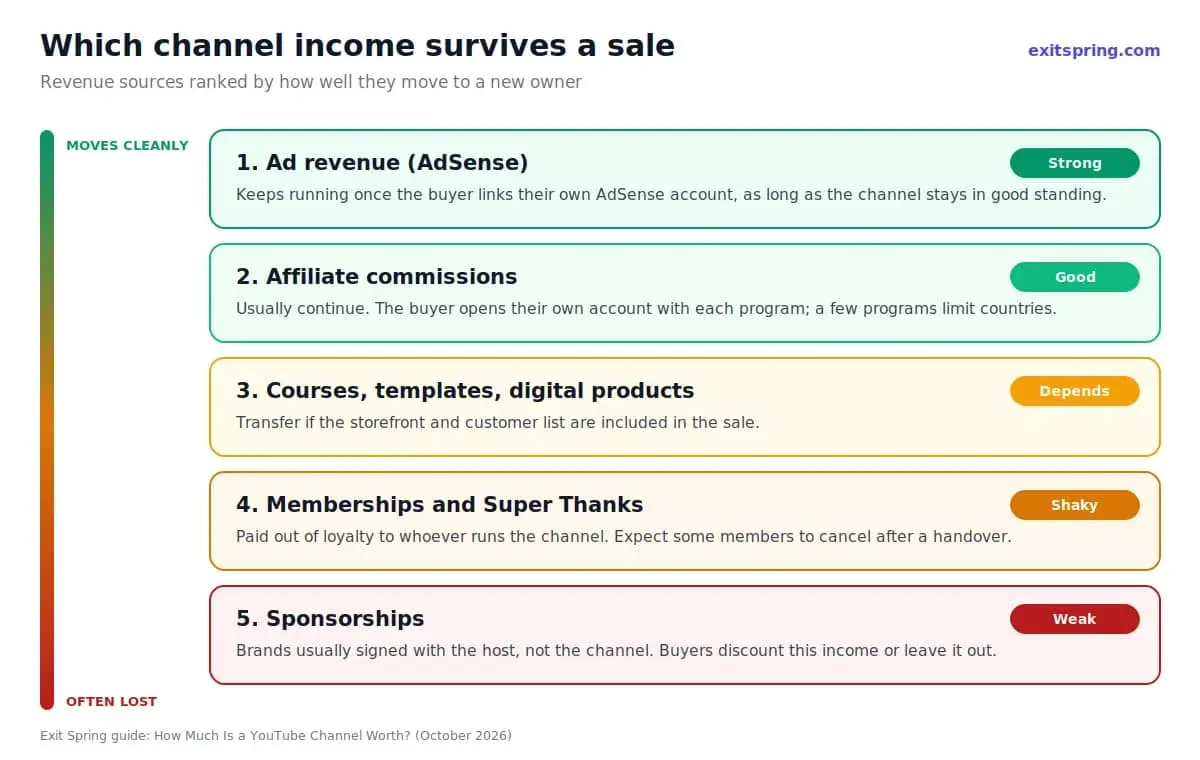
Ad revenue moves the most cleanly. As long as the channel stays in good standing, the new owner plugs in their own AdSense account and the ads carry on running as before.
Affiliate commissions usually survive a sale too. The buyer has to open their own account with each program, and a few programs are fussy about which countries they accept, so check that before you promise the income will continue.
Courses, templates and other digital products can go with the channel if the storefront and the customer list are part of the deal. Memberships and Super Thanks are shakier. People pay those out of loyalty to whoever's running things, and some of them will quietly cancel after a handover.
Sponsorships sit at the bottom. Unless a brand signed with the channel itself rather than with you, a buyer will discount that income heavily or leave it out of the valuation altogether.
A worked example
Here's how the numbers come together for a made-up history channel with narrated documentaries, no face on camera, and a mostly US and UK audience.
| Item (12-month monthly average) | Amount |
|---|---|
| AdSense | $6,100 |
| Affiliate (books, audiobook service) | $1,500 |
| Sponsorships, read by the narrator | $800 |
| Total revenue | $8,400 |
| Freelance video editor | −$1,200 |
| Scriptwriter | −$900 |
| Thumbnail designer | −$300 |
| Software and stock footage | −$100 |
| Monthly net profit | $5,900 |
A buyer starts somewhere near the middle, call it 24x, and then adjusts.
The format's faceless and the narrator is a freelancer willing to stay on, which earns a couple of points. Revenue's been creeping up for a year, another point or two. Against that, the sponsorships are read by that same narrator and the buyer can't be sure they'll continue, so they knock the $800 off before applying the multiple rather than paying a full multiple on it. And about 73% of revenue comes from AdSense, which keeps the channel exposed to any policy change.
Run it through and you might get 27x on $5,100 of "safe" profit, about $137,700, with the sponsorship income treated as a bonus the buyer picks up for free. A seller who'd simply multiplied $5,900 by 30 would be expecting $177,000. The roughly $39,000 difference is what the buyer is charging for taking on the risk.
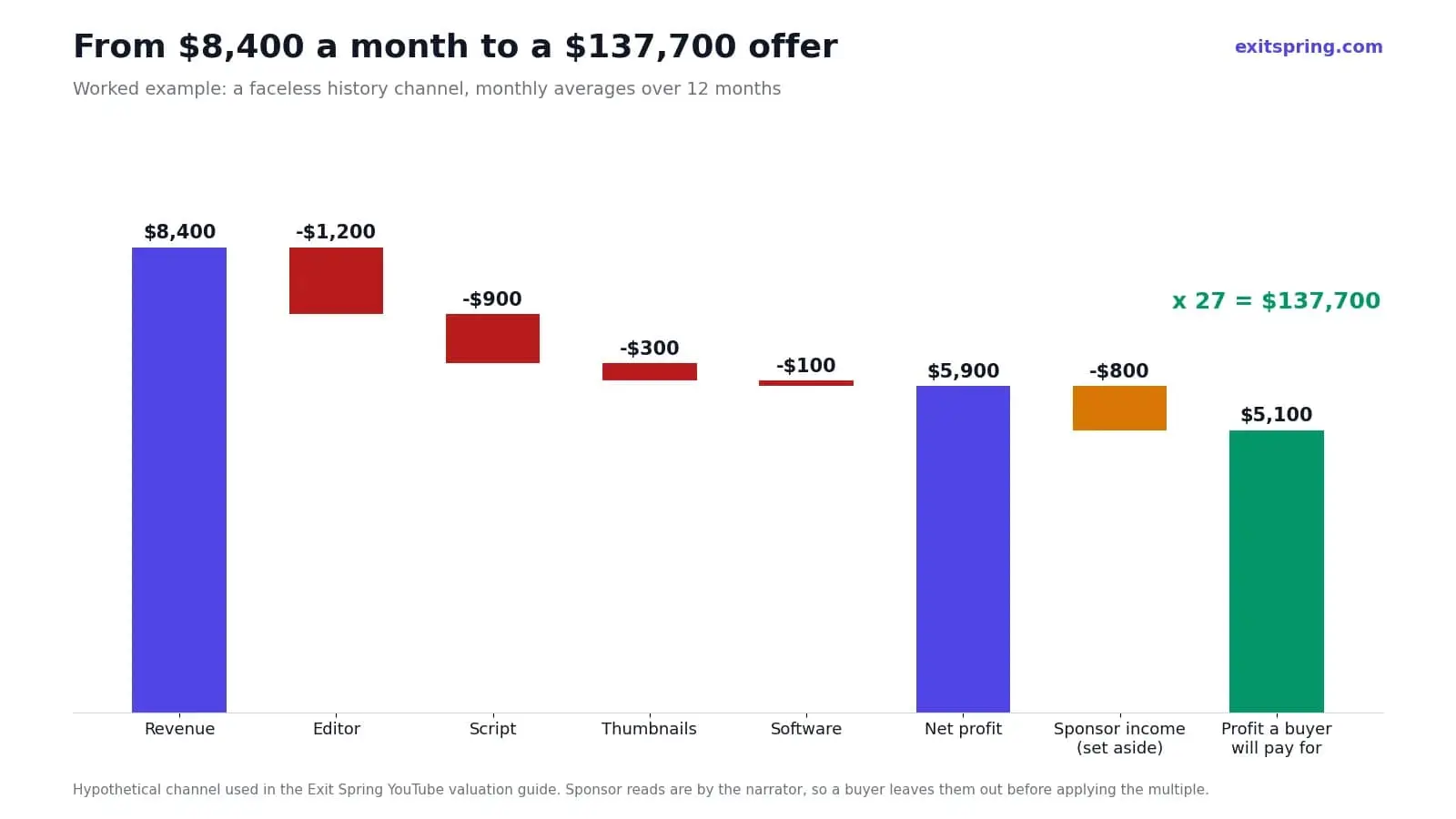
The figures here are illustrative. Your channel's real valuation depends on its own data, and we'd always look at the analytics before putting a number on anything.
The platform risks buyers ask about now
Everything a channel earns depends on rules YouTube can rewrite whenever it wants, and buyers knock a little off the price for that.
Inauthentic content
The latest rewrite landed on July 15, 2025. YouTube took its old "repetitious content" policy, renamed it "inauthentic content" and added wording about mass-produced and repetitive videos. (On the help page itself, the section now sits under the heading "Generic or Repetitive Content.") Officially, nothing new was banned. Read the examples on the help page, though, and one of them is AI-generated content made from generic templates without the creator adding their own insight. If your channel leans on AI voiceovers, expect a buyer to have read that sentence before they ever call you.
For anyone selling, the worrying part is the scope. YouTube reviews this at channel level, so if a reviewer decides the library is mass-produced, monetization can go off on every video at once, good ones included. A buyer who scrolls your uploads and finds the same thumbnail layout, the same stock voice and the same eight-minute structure three hundred times over will either pass or offer something close to 12x.
Reused content
Commentary, compilations, clips and reaction videos fall under the separate reused content policy, which looks at how much a creator has transformed other people's material. Channels in those formats need to show clear original contribution in every video, and buyers will check.
Strikes
YouTube keeps two separate tallies. Copyright strikes follow takedown requests from rights holders, while Community Guidelines strikes come from YouTube's own reviewers. Three Community Guidelines strikes in the same 90-day period, or three active copyright strikes, can get the channel terminated, leaving nothing to sell. A strike that's still live when you list will be one of the first things a buyer spots on the screen share. Community Guidelines strikes expire after 90 days, and copyright strikes expire after 90 days only if you've completed Copyright School. Some buyers will wait for a strike to expire. Most will ask for a discount, because you can't promise the next video won't pick up another.
Going quiet before you sell
This rule is easy to miss. YouTube says it may turn off monetization on channels that haven't uploaded a video or posted to the Posts tab in six months or more. If you've stopped publishing while you look for a buyer, keep something going. A channel that loses its monetization mid-sale loses most of its value with it.
How buyers check your numbers
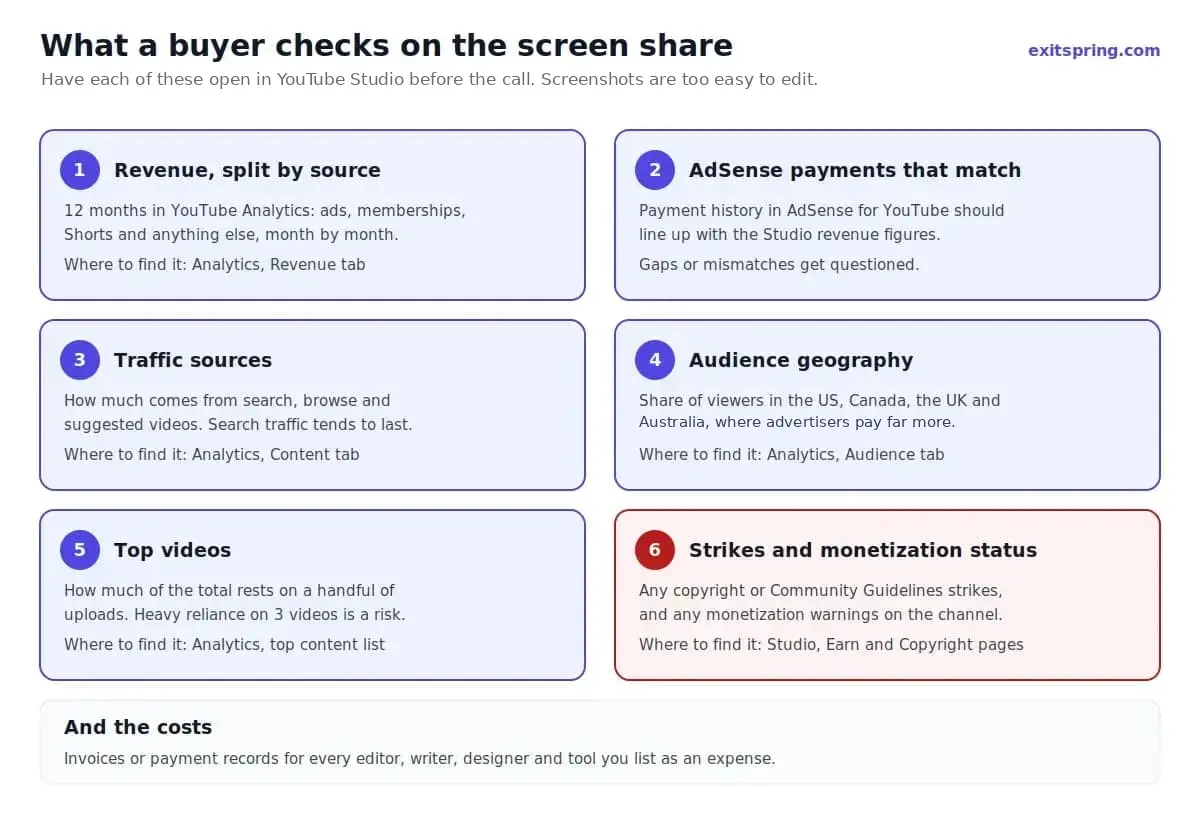
Expect any serious buyer to ask for a live screen share of YouTube Studio. Screenshots are too easy to edit, and an experienced buyer won't rely on them.
On that call they'll walk through a year of revenue in YouTube Analytics, split by source, and then compare it against your AdSense payment history to make sure the two agree. They'll look at where the views come from (search, browse or suggested), which countries the audience is in, and how much of the total rests on your top handful of videos. Most will also open the Copyright and Earn pages in Studio to see whether there are any strikes or warnings. Then come the costs. If you've listed an editor at $1,200 a month, have the invoices or payment records that prove it.
Having all of this ready before you list shortens the sale and makes your asking price easier to defend. It also helps with the wider buyer checklist that applies to any online business, which we cover in our due diligence guide.
How a channel changes hands
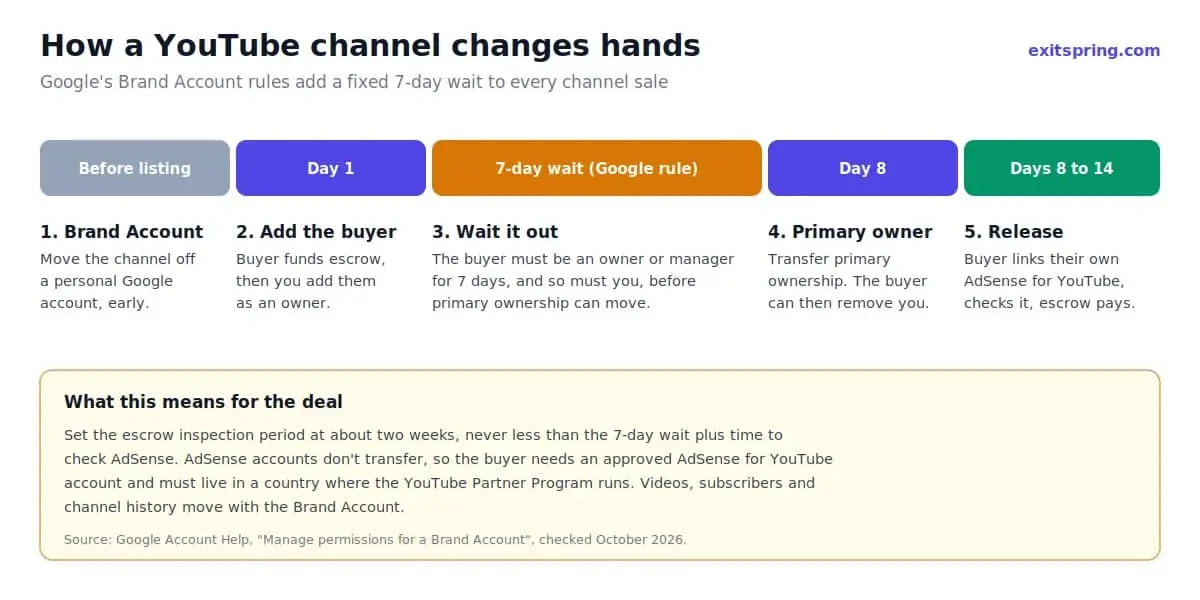
The mechanics run through Google's Brand Account system, not YouTube itself, and there's a waiting period built in.
If the channel still sits on a personal Google account, you'll need to move it to a Brand Account first. It's worth doing well before you list, because it can't be rushed at closing.
From there, you add the buyer's Google account as an owner of the Brand Account. Google won't let anyone become primary owner until they've been an owner or manager for at least seven days, and the person handing over ownership must also have been an owner for seven days or more. Once both conditions are met, you transfer primary ownership to the buyer and they can remove you.
AdSense doesn't come along. AdSense accounts can't be transferred, so the buyer links their own AdSense for YouTube account, and Flippa's channel listings typically state that the buyer must have an approved AdSense for YouTube account to link to the channel. The buyer also needs to be in a country where the YouTube Partner Program operates. That's worth confirming early with any international buyer, along with the escrow and payout questions we cover in our guide to selling an online business from outside the US.
Because of the seven-day rule, an escrow inspection period for a channel sale shouldn't be shorter than about two weeks. That gives time to add the buyer as owner, wait out the seven days, transfer primary ownership, and let the buyer confirm the new AdSense link is working before funds release.
Getting a channel ready to sell
Start on this list three to six months before you plan to list.
- Move the channel to a Brand Account now if it isn't on one already.
- Keep publishing on your normal schedule. A dip in uploads shows up in the data, and a six-month gap risks monetization.
- Go through old uploads. Anything that's mostly someone else's clips, or looks stamped out of a template, is worth setting to private before a buyer or a YouTube reviewer sees it.
- Write a short playbook for how a video gets made on your channel: where topics come from, who scripts, who edits, when it goes live. Buyers offer more for a channel they can picture running without you.
- Ask your freelancers whether they'd stay on with a new owner. Get it in writing if you can.
- Separate your income. If sponsors are booked with you personally, start pitching deals in the channel's name.
- Pull 12 months of revenue, cost and traffic data into one place before you talk to anyone.
FAQ
How much is a YouTube channel worth per subscriber?
There's no real per-subscriber price. Buyers value channels on monthly net profit, and two channels with the same subscribers can differ in value many times over depending on views, audience location and income.
Can I sell a channel that isn't monetized yet?
You can, but it'll sell as a speculative asset at a much lower price, because there's no profit to multiply. Buyers will look at view trends and how close the channel is to YouTube's thresholds of 1,000 subscribers plus either 4,000 qualified watch hours on public long-form videos in the last 12 months or 10 million qualified Shorts views in the last 90 days.
Do Shorts-heavy channels sell for less?
In most cases. A Short earns a small fraction of what a long video earns per view, and Shorts income swings more from month to month, so buyers trust it less. A library of long videos that still picks up search traffic years after upload is what they really want.
Does the buyer keep my subscribers and videos?
Yes. When primary ownership moves through the Brand Account, the channel, its videos, subscribers and history all go with it. Your AdSense account doesn't.
How long does selling a channel take?
Finding the right buyer is the slow part. Once terms are agreed, the transfer itself takes a little over a week because of Google's seven-day ownership rule, plus the escrow inspection period.
Will the channel lose monetization after the sale?
It shouldn't, as long as the buyer links an approved AdSense account and the content keeps following YouTube's policies. Keep the format consistent after the sale, because monetization depends on the channel continuing to meet those policies, not on the transfer itself.
Valuing your channel with Exit Spring
We run Exit Spring from the US and Hong Kong. Our valuations are built on the same data a buyer will check: revenue by source, traffic, audience geography and policy record, so the number we give you is one you can still defend once due diligence starts.
If you're thinking about selling, request a free valuation. We'll look at your actual analytics, adjust for the risks a buyer will see, and give you a range you can defend.
Sources
- Flippa: YouTube Channel Worth Calculator
- YouTube Help: YouTube channel monetization policies
- YouTube Help: YouTube Partner Program overview and eligibility
- Google Account Help: Manage permissions for a Brand Account
- YouTube Help: Community Guidelines strike basics on YouTube
- YouTube Help: Understand copyright strikes
- Google AdSense Help: User access FAQs
Get new listings in your inbox
Fresh businesses for sale every Monday, plus practical buying and selling tips.
Unsubscribe anytime. No spam.
Keep reading



Ready to make a move?
Browse vetted online businesses or get a free valuation of yours.