
How to Buy an Online Business With an SBA Loan in 2026: Rules, Down Payment and Requirements
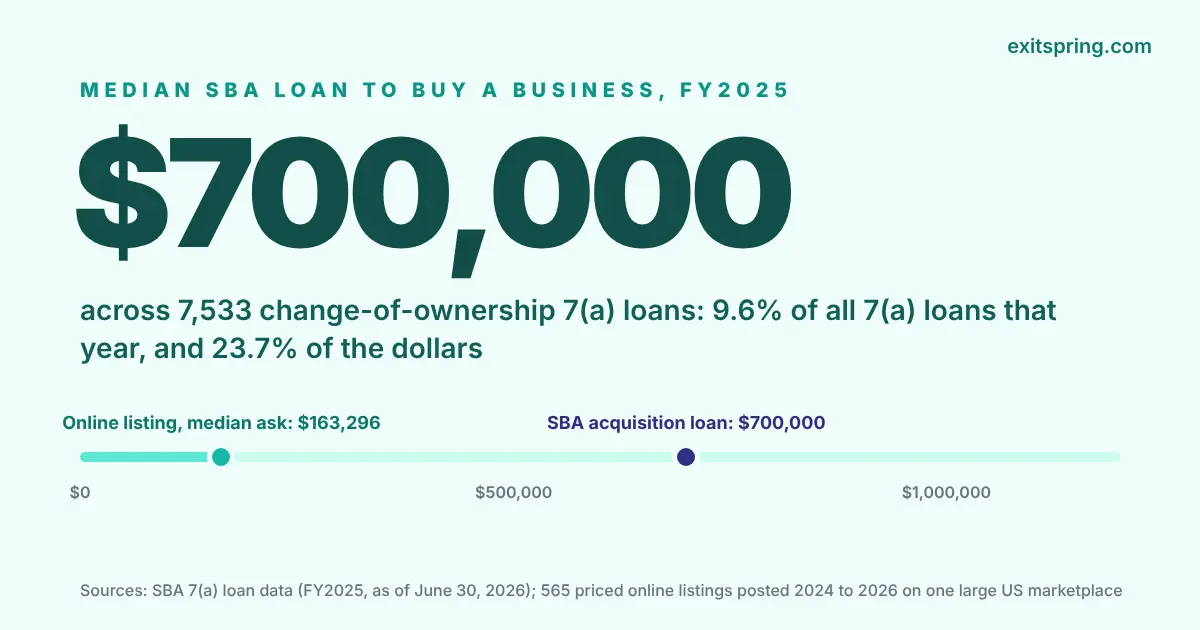
SBA lenders approved 7,533 loans to buy existing businesses in fiscal 2025, at a median of $700,000, by our count of the SBA's own loan records.
The rules for those loans changed on October 1, 2026. SBA's updated rulebook for lenders, SOP 50 10 8.1, applies to every 7(a) application given an SBA loan number on or after that date (SBA notice, August 14, 2026). It also adds a rule written for e-commerce businesses. Every rule below is checked against that text, including the technical update SBA posted on September 25, 2026.
Our own figures come from SBA's public loan-level data and from 2,855 online business listings on one of the largest US marketplaces, pulled on October 8, 2026.
Who can get an SBA loan to buy an online business?
Every owner of the buying company has to be a US citizen or US national whose main home is in the United States. SOP 50 10 8.1 puts it as "100% direct and/or indirect owners," so there is no minority exception. Green card holders lost eligibility on March 1, 2026 (SBA Policy Notice 5000-876441 PDF; Axios). Until then, an SBA notice had allowed foreign owners to hold up to 5%.
A US citizen living in Singapore is an "Ineligible Person" under the SOP's own list, as is anyone holding citizenship of China or the Hong Kong SAR. Any company in the ownership chain must be organized in the US, so a Delaware LLC owned by a Hong Kong holding company fails too. SBA also looks back six months: an ineligible owner has to be fully out before the loan number is issued.
A buyer who fails the test can still buy, with cash, a seller note or a conventional loan. Our guide for sellers outside the US covers the other side of that deal.
Rule changes
| Rule | SOP 50 10 8.1 (from October 1, 2026) | SOP 50 10 8 (June 2025 to September 2026) |
|---|---|---|
| Who can own the borrower | US citizens and nationals living in the US, 100% | Same from March 1, 2026; green card holders could own before that |
| Buyer's equity | 10% of total project cost; when an outside buyer acquires the business (SBA's "Initial Acquisition") it "cannot be reduced or eliminated" | 10% of total project cost |
| Seller note as equity | Up to half the 10%, on full standby for the whole loan | Same |
| Debt service coverage | 1.25x for an outside buyer, from the last year-end or a two-year average; 1.15x only when an existing business buys one in its own industry | 1.15x, and projections could count |
| Lender's own valuation allowed | Purchase price of $350,000 or less | Amount financed, less real estate and equipment, of $250,000 or less |
| Quality of earnings report | Required at a purchase price of $3 million or more | Not required |
| Seller staying on as consultant | Up to 24 months | Up to 12 months |
| Refinancing a seller note | After 36 months of on-time payments | After 24 months |
| Site visit | Optional for e-commerce, with the reason documented | No e-commerce exception |
SBA acquisition loans
We counted every 7(a) loan SBA marked as a change of ownership in fiscal 2025 (October 2024 to September 2025), using SBA's public 7(a) loan data, current to June 30, 2026.
| Loan size | Change-of-ownership loans | Share |
|---|---|---|
| $150,000 or less | 1,013 | 13.4% |
| $150,001 to $350,000 | 1,192 | 15.8% |
| $350,001 to $1 million | 2,569 | 34.1% |
| Over $1 million | 2,759 | 36.6% |
| Total | 7,533 loans, $8.82 billion |
Those 7,533 loans, including 665 later cancelled, were 9.6% of all fiscal 2025 7(a) loans in the same file but 23.7% of the dollars. Preferred lenders, lenders allowed to approve loans without sending them to SBA first, made 5,776 of them. SBA Express made 1,140. And 6,658 carried a variable rate, with a median starting rate of 9.5%.
The federal industry codes in SBA's data split the old "electronic shopping" code up by product in 2022, and only 19 of the 78,078 fiscal 2025 7(a) loans, one of them an acquisition loan, still carry the old electronic-shopping codes. A reliable count of SBA loans to online businesses can't be pulled from public data, so we don't give one.
Where online listings sit
Of 565 priced online listings posted on the marketplace from 2024 to 2026, the median asked $163,296, at 2.50 times seller's discretionary earnings (SDE, the profit before the owner pays themselves).
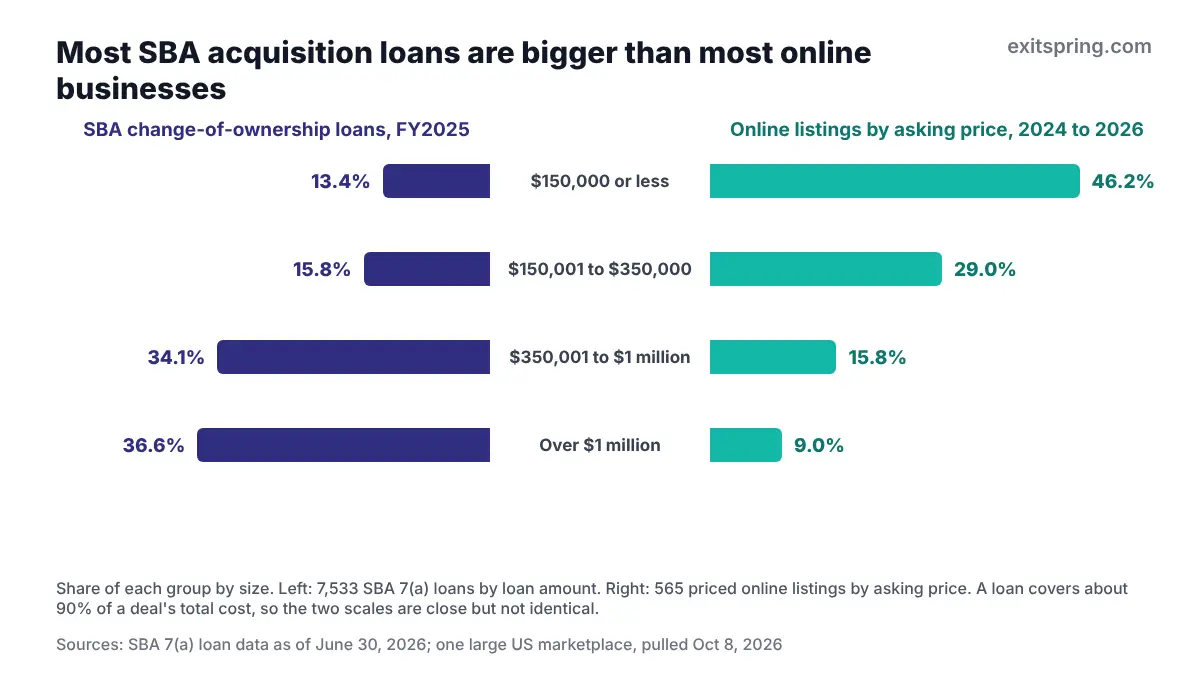
Almost half of those listings asked $150,000 or less. On the SBA side, 13.4% of acquisition loans were that small. A loan covers about 90% of a deal's total cost, so the two scales are close but not identical. Below $150,000, cash and seller financing are the usual alternatives, and our guide to seller financing and earnouts works through both.
The 1.25x test on real listings
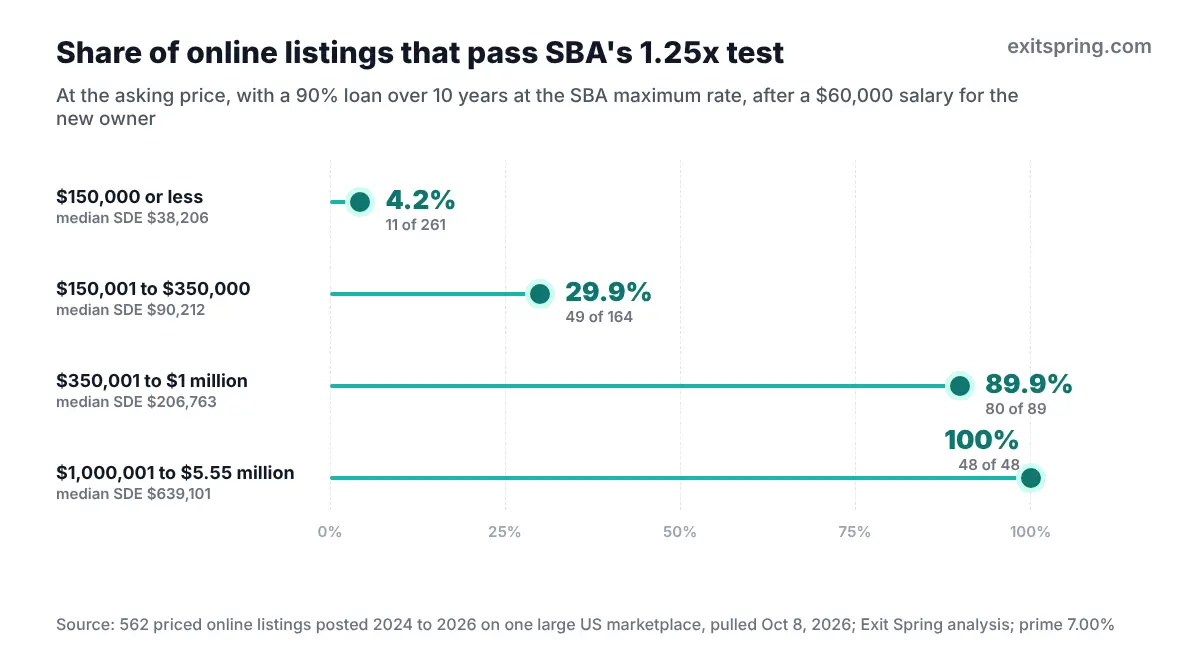
A lender divides a year of cash flow by a year of loan payments, and when an outside buyer acquires a business the answer must reach 1.25. We ran that test on 562 of the 565 listings, at the asking price, with these assumptions:
| Assumption | What we used |
|---|---|
| Loan | 90% of the asking price, 10 years, monthly payments |
| Rate | The SBA maximum for the loan size, with prime at 7.00% |
| Cash flow | Listed annual SDE, less a $60,000 salary for the new owner |
| Left out | Working capital, fees and closing costs |
| Asking price | Listings | Median asking multiple | Median SDE | Pass after a $60,000 salary |
|---|---|---|---|---|
| $150,000 or less | 261 | 2.33x | $38,206 | 11 (4.2%) |
| $150,001 to $350,000 | 164 | 2.58x | $90,212 | 49 (29.9%) |
| $350,001 to $1 million | 89 | 2.67x | $206,763 | 80 (89.9%) |
| $1,000,001 to $5.55 million | 48 | 3.08x | $639,101 | 48 (100%) |
Three listings above $5.55 million are left out, because a 90% loan on them would pass the $5 million SBA cap.
Before any salary, all 562 passed. Prices of two to three times profit leave plenty of room for loan payments. The owner's salary decides it. The median business in the $150,001 to $350,000 band earns $90,212 of SDE, which leaves about $30,000 after a $60,000 salary, and a 90% loan at the band's median asking price costs about $37,200 a year. Lenders don't use one fixed salary figure. When owner pay is adjusted, SOP 50 10 8.1 also requires a global cash flow check of the buyer's personal finances at 1:1, and lenders often credit a working spouse's income there.
How much do you need to put down?
The minimum is 10% of the total project cost: price, working capital, closing costs and the SBA fee if it is financed. When an outside buyer acquires a business, SBA won't lower it. Half of that 10% can be a seller note, but only one on full standby, meaning no principal or interest payments at all until the SBA loan is paid off. Older guides still say 24 months of standby. That was the SOP 50 10 7.1 rule, and it ended when SOP 50 10 8 took effect on June 1, 2025.
Cash has to be traceable. On most 7(a) loans the lender needs a copy of the wire or check and at least 30 days of statements from the account it came from. SOP 50 10 8.1 says a "gift letter" or promissory note on its own "is not sufficient evidence of cash injection." Gifted cash still counts once the money trail is documented.

Some lenders ask for more than 10%. Byline Bank, for one, describes down payments of "typically 10% – 15%" of the purchase price (Byline Bank). Rules for sales where the selling owner keeps a stake are different, so this guide covers full purchases only.
What the lender checks on an online business
| Step | What SBA requires | On an online business |
|---|---|---|
| Three years of numbers | Analysis based on the three most recent year-ends, plus interim statements | 35.6% of 2024 to 2026 listings had under three years of earnings history when listed |
| Tax transcripts | The seller's figures matched to IRS records through Form 4506-C or Form 8821 | A P&L showing $200,000 against a tax return showing $150,000 means the lender starts from $150,000 and adds back only what the seller documents |
| Valuation | Lender's own for a price of $350,000 or less; above that, a valuer holding an ASA, CBA, ABV, CVA or BCA credential, ordered by the lender | Usually charged to the buyer, and what the buyer pays counts toward the 10% |
| Price above valuation | The difference must be made up with equity | A $705,000 price against a $690,000 valuation means $15,000 more equity, in cash or a seller note on full standby |
| Quality of earnings | Required at a purchase price of $3 million or more, with a bank-statement "Cash Proof" | Customer concentration must be assessed |
| Add-backs | Each one justified in the credit memo | A one-off $9,000 trademark dispute needs the attorney's invoice in the file |
| Site visit | Optional for e-commerce if the lender documents why | Video walk-throughs of the Shopify admin, Stripe and ad accounts |
Platform dependence isn't in the SOP. One Amazon listing making 80% of sales, or 90% of traffic from Google search, is something each lender prices on its own. Our due diligence checklist lists the records to request, and every one of them helps a lender's case too.
Collateral and personal guarantees
Anyone owning 20% or more of the borrower signs an unlimited personal guarantee. A website has almost no hard assets, so most online acquisition loans start short of collateral. The lender takes a lien on the business's inventory and receivables, but those count at only 10% of book value.
When collateral falls short, the lender must take available equity in the guarantors' homes and investment property. It can skip a property with less than 25% equity. On standard 7(a) loans, those over $350,000 other than SBA Express, life insurance for the amount of the shortfall is required where the business depends on one owner, which describes most online businesses. On 7(a) Small and SBA Express loans it is up to the lender's own policy. Celtic Bank, one lender that markets acquisition loans for online stores, advertises "Up to 90% loan-to-cost" and terms "of up to 10 years" (Celtic Bank).
The SaaS deal (composite)
Dana, a product manager in Columbus, Ohio, offered on a scheduling SaaS for physical therapy clinics. Dana and the business are a composite we built to show the arithmetic, not a real deal. The seller asked $690,000, or 3.22 times 2025 SDE of $214,000, close to the 3.21x median ask across the 20 priced SaaS listings posted on the marketplace from 2024 to 2026. Our guide to selling a SaaS business covers the metrics a buyer of this kind of product checks.
The lender took 2025 SDE and subtracted $85,000, a market salary for the CEO role Dana would fill. That left $129,000 to cover debt. At the asking price the loan came to $684,400, and payments at 9.75% over ten years were $107,399 a year: coverage of 1.20x, short of 1.25x.
The independent valuation came in at $650,000. Dana went back to the seller with the valuation and the coverage figure, and they signed at $650,000, or 3.04 times SDE.
| Item | Amount |
|---|---|
| Purchase price | $650,000 |
| Working capital | $40,000 |
| Valuation, legal and closing costs | $15,000 |
| SBA guaranty fee, financed | $14,571 |
| Total project cost | $719,571 |
| SBA 7(a) loan | $647,600 |
| Seller note, full standby | $35,000 |
| Dana's cash | $36,971 |
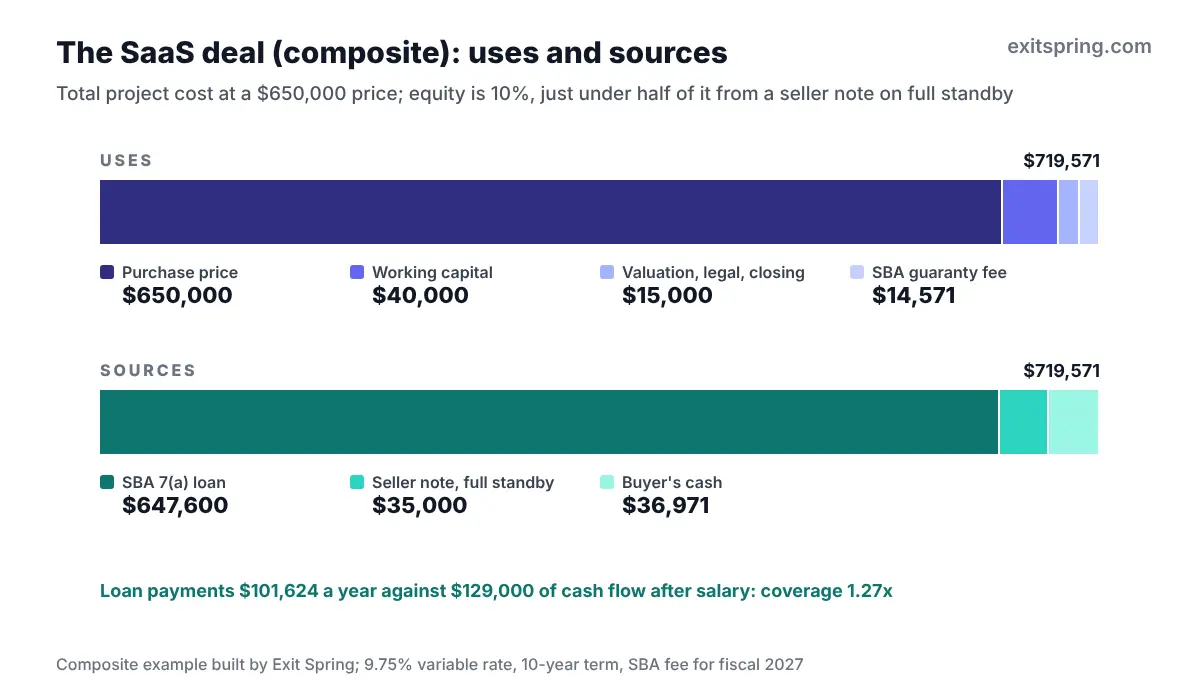
The loan costs $8,468.68 a month, or $101,624 a year, which gives coverage of 1.27x. The guaranty fee is 3% of the 75% SBA guarantees, since the loan is between $150,001 and $700,000. Dana's house carries a second lien for the collateral shortfall, and a life insurance policy names the lender. The seller signed on as a paid consultant for nine months, well inside the 24 SBA allows.
Rates and fees
Prime has been 7.00% since September 17, 2026 (FRED). The Federal Reserve raised its target range to 3.75% to 4.00% the day before (Federal Reserve), and its next meeting is October 27 and 28.
| Loan size | Highest variable rate SBA allows | Upfront guaranty fee, fiscal 2027 |
|---|---|---|
| $50,000 or less | Prime + 6.5% (13.5% today) | 2% of the guaranteed part |
| $50,001 to $150,000 | Prime + 6.0% (13.0%) | 2% |
| $150,001 to $250,000 | Prime + 6.0% (13.0%) | 3% |
| $250,001 to $350,000 | Prime + 4.5% (11.5%) | 3% |
| $350,001 to $700,000 | Prime + 3.0% (10.0%) | 3% |
| $700,001 to $5 million | Prime + 3.0% (10.0%) | 3.5% up to $1 million guaranteed, 3.75% above |
Fees are from SBA's fiscal 2027 fee notice PDF, which kept last year's tiers and waives the fee on loans of $700,000 or less to businesses in rural areas, manufacturers and some food-supply businesses. On standard 7(a) loans SBA guarantees 85% of loans up to $150,000 and 75% above that; SBA Express loans carry a 50% guaranty. The lender also pays SBA 0.55% a year on the guaranteed balance and, by SBA rule, can't pass it on to you. A loan used to buy a business can't have a balloon payment, and its amortization is capped at 10 years unless real estate is part of the deal.
How long does an SBA acquisition loan take?
Live Oak Bank, the largest 7(a) lender by dollars approved in fiscal 2025 by our count of SBA data, puts it at 60 to 90 days from application to SBA review, then 7 to 30 days from commitment letter to wired funds (Live Oak Bank). WaFd Bank gives about 60 to 90 days from a complete application to funding (WaFd Bank). Neither is an SBA rule, and a missing tax return can add weeks.
| Stage | What happens | Dana's deal |
|---|---|---|
| Letter of intent | Price, structure and an SBA financing condition | Signed in week 1 |
| Lender term sheet | Lender reviews three years of returns | Week 3 |
| Valuation and diligence | Valuer engaged, transcripts ordered, accounts reviewed | Weeks 4 to 9 |
| Approval | Credit memo, then approval under the lender's delegated authority | Week 10 |
| Closing | Purchase agreement, standby agreement, escrow | Week 12 |
Earnouts and seller help
Earnouts are banned in SBA-financed purchases. SOP 50 10 8.1 does allow a "buyer rebate," where the seller pays money back if results fall short, and that money goes toward the 7(a) principal. A seller can't stay on as an owner, officer or employee after a full sale. A consulting contract for up to 24 months is allowed, double the 12 months allowed before October 1. Live Oak's acquisition page still lists 12, which shows how slowly lender guidance catches up.
Dana's seller could also have taken a note with monthly payments. That note goes into the coverage test as debt, and total debt can't exceed the valuation. Refinancing it into an SBA loan takes 36 months of on-time payments and a payment cut of at least 10%.
When an SBA loan doesn't fit
A $95,000 newsletter with $38,000 of SDE passes the coverage test at the SBA maximum rate only if its new owner draws less than about $18,850 a year.
Lenders must also review the current year's interim statements, so a 2026 traffic drop shows up in underwriting.
The ownership rules end the conversation for a buyer living outside the US. Our buyer's guide covers cash deals, escrow and the deal documents, and our page on how to value an online business shows how a price is built before any lender sees it.
Questions buyers ask
Can I use an SBA loan to buy an Amazon FBA business?
An Amazon brand holding $120,000 of stock adds only $12,000 of collateral value, because SBA counts inventory at 10% of book. Amazon sellers aren't excluded by SOP 50 10 8.1. Concentration is the harder part: a brand with 70% of sales from one product on one marketplace will be priced by the lender, and some lenders decline. Our guide to selling an Amazon FBA business shows what buyers check in Seller Central.
What credit score do I need for an SBA acquisition loan?
No minimum score appears in SOP 50 10 8.1. SBA dropped its FICO small business score screen for small 7(a) loans on March 1, 2026. The lender reads each guarantor's credit report and writes up any problems in the credit memo. Its own score policy applies too.
Can I use an SBA loan with no money down?
A $650,000 purchase still needs about $72,000 of equity once working capital and fees are added, and at least $36,000 of it has to be cash, a gift or a qualifying personal loan rather than standby debt. Gifted cash works if the lender can trace it. Borrowed money only counts if it is repaid from outside the business, such as a personal loan paid from a spouse's salary.
How much cash should I keep after closing?
Dana's lender wanted the $40,000 of working capital inside the business and three months of personal expenses in Dana's own account. SBA sets no reserve figure of its own. The lender's global cash flow check of the buyer's personal finances must come out at 1:1 or better.
Can a seller stay on after an SBA purchase?
Dana's seller signed a nine-month consulting contract, and SOP 50 10 8.1 allows up to 24 months in total, extensions included. Keeping a stake is possible only in a partial sale where an existing owner stays on, or in a sale to an employee ownership plan, never in a full sale to an outside buyer.
Does the lender need to visit an online business?
An e-commerce business can skip the physical visit if the lender writes down why and checks the business another way, such as a video call through the Shopify admin, Stripe payouts and the ad accounts. That option appeared in SOP 50 10 8.1; the June 2025 rules had no e-commerce exception.
Is an SBA loan cheaper than seller financing?
On Dana's $647,600 loan at 9.75%, interest over ten years comes to about $369,000 if the rate never moves, plus a $14,571 guaranty fee. A seller note is usually shorter, so it costs less interest in total, but the seller has to be willing to wait for most of the price.
Buying through Exit Spring
Exit Spring is a free account for buyers. Unlocking a listing shows its URL, analytics and profit and loss, which are the same records an SBA lender asks for on day one. Browse current businesses on the marketplace or by type on our buy pages, and read how buying works. Every deal closes through Escrow.com, and Exit Spring never holds a buyer's money.
Sources
- SBA: SOP 50 10 8.1, effective October 1, 2026 (technical update published September 25, 2026); Information Notice 5000-880695; Policy Notice 5000-876441, citizenship and residency PDF; 7(a) fees for fiscal 2027 PDF
- SBA data: 7(a) loan-level FOIA data, FY2020 to present, as of June 30, 2026; our counts of change-of-ownership loans
- Code of Federal Regulations: 13 CFR Part 120
- Federal Reserve: September 16, 2026 statement; FRED: bank prime loan rate
- Axios: Trump administration bars non-citizens from small-business loans, February 3, 2026
- Lenders: Live Oak Bank; WaFd Bank; Byline Bank; Celtic Bank
- Listings data: Empire Flippers public listings, 2,855 listings pulled October 8, 2026; asking prices, not sale prices
General information as of October 26, 2026, not legal, tax or lending advice. SBA rules change through notices; confirm the current version with your lender.
Get new listings in your inbox
Fresh businesses for sale every Monday, plus practical buying and selling tips.
Unsubscribe anytime. No spam.
Keep reading
Ready to make a move?
Browse vetted online businesses or get a free valuation of yours.