
How to Sell a SaaS Business: Multiples, Retention, Code and Tax (2026)
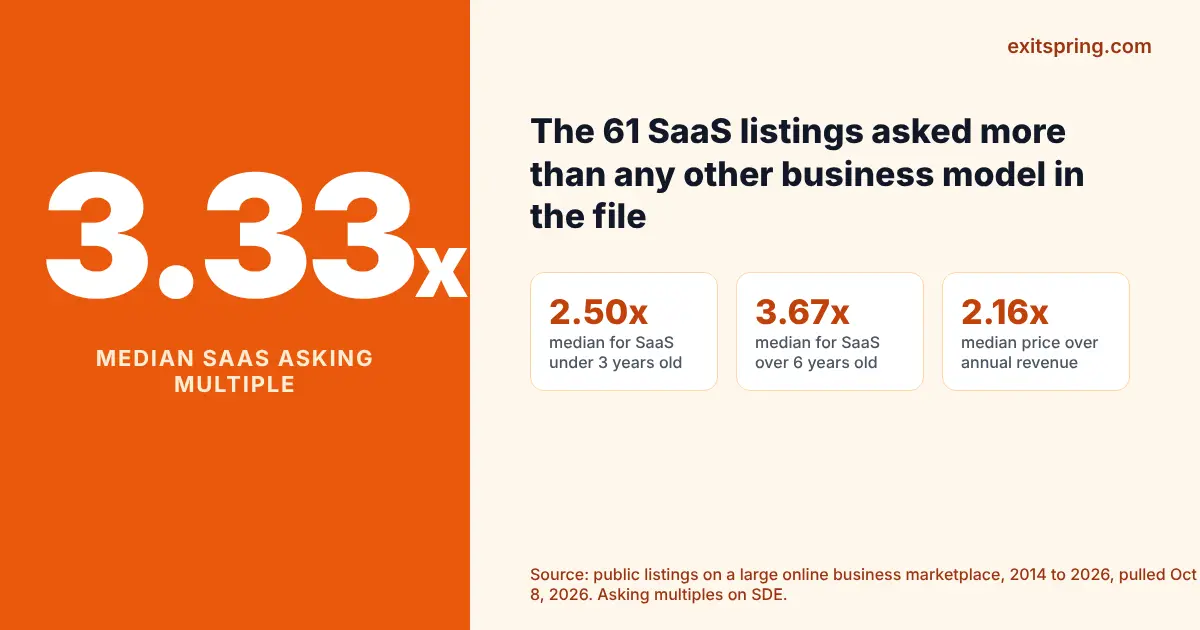
Of 2,855 online businesses listed on one large marketplace, the 61 that sell software by subscription asked a median 3.33 times their annual profit. No other business model with more than two listings asked as much. Look only at SaaS businesses less than three years old, though, and the median falls to 2.50x.
Take a booking and payments tool for dog-grooming salons. It has 512 salons paying about $78 a month each, so $40,000 of monthly recurring revenue (MRR) and $480,000 a year. After hosting, a part-time support contractor, payment fees, software and a small Google Ads budget, its founder clears $360,000 of seller's discretionary earnings (SDE) on about 12 hours a week. She formed the company as a Delaware C corporation in 2019. The business is a composite we built for this guide, and every figure about it below belongs to that composite.
SaaS asked a median 3.33x profit, the highest of any sizeable model
We pulled the listings on October 8, 2026. Most were already sold and some date back to 2014, so these are asking prices, not closing prices. Every multiple is on SDE, and a listing tagged with two models counts in both.
| Business model | Listings | Median asking multiple | Median annual profit | Owner hours a week |
|---|---|---|---|---|
| SaaS | 61 | 3.33x | $50,000 | 3 |
| Mobile and web apps | 21 | 2.80x | $51,000 | 2 |
| Display ads (content sites) | 863 | 2.70x | $26,000 | 2 |
| Amazon FBA | 794 | 2.67x | $78,000 | 5 |
| Affiliate (incl. Amazon Associates) | 1,093 | 2.67x | $25,000 | 2 |
| Ecommerce | 340 | 2.50x | $81,000 | 6 |
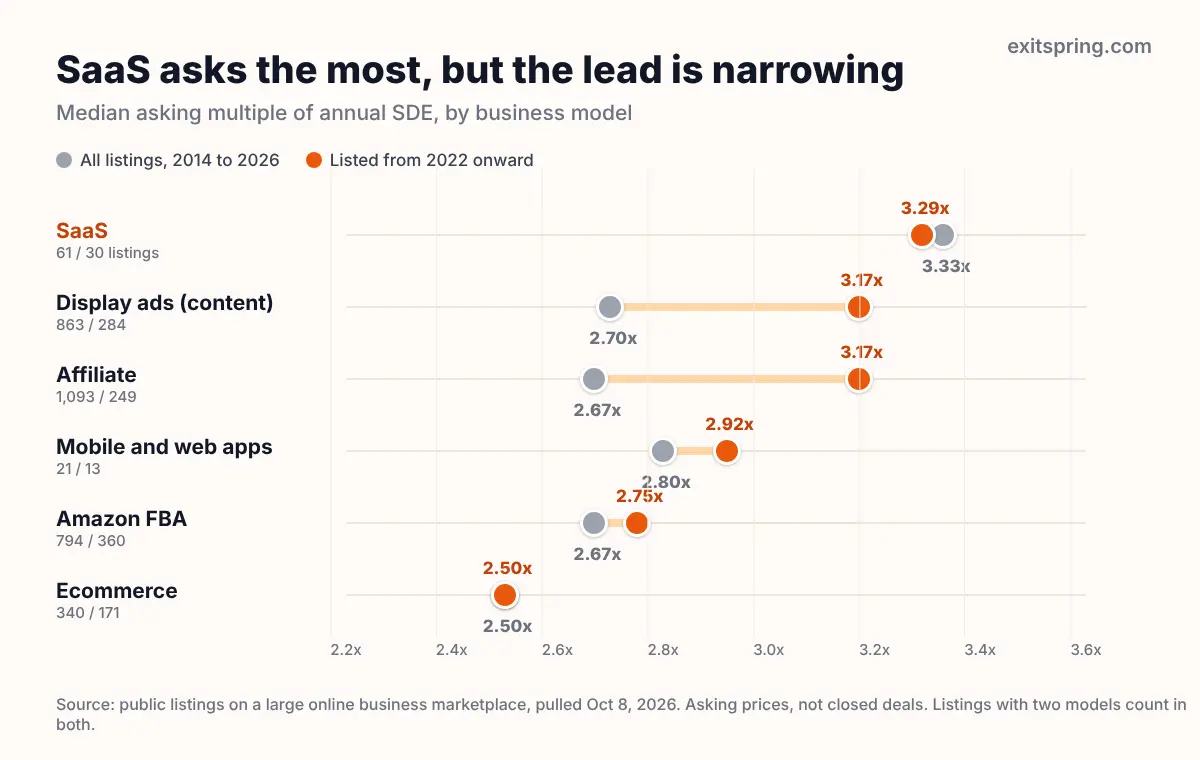
The SaaS lead shrinks on recent listings. Of the 30 SaaS businesses listed from 2022 onward, the median ask was 3.29x, against 3.17x for content sites listed over the same years. The gap between those two figures is too small to read much into with 30 listings, so we treat SaaS and strong content sites as close neighbors on price today.
| Age when listed | Listings | Median asking multiple | Middle half of asks |
|---|---|---|---|
| Under 3 years | 19 | 2.50x | 2.12x to 3.49x |
| 3 to 6 years | 18 | 3.54x | 2.83x to 4.08x |
| Over 6 years | 24 | 3.67x | 2.82x to 4.22x |
| Annual SDE | Listings | Median asking multiple |
|---|---|---|
| Under $50,000 | 30 | 3.04x |
| $50,000 to $100,000 | 12 | 3.71x |
| Over $100,000 | 19 | 2.92x |
Under about $1 million of ARR, buyers price the profit
Flippa's guide to SaaS multiples says that below $1 million of annual recurring revenue (ARR), buyers usually pay on profit, "typically anywhere from 2x–4x." Larger companies get priced on revenue, and the benchmarks for those come from the public market and from private surveys.
| Benchmark | Figure | What it measures |
|---|---|---|
| SaaS businesses on the marketplace, price to revenue | 2.16x median | Asking price over trailing revenue, 61 small SaaS listings |
| SaaS Capital, bootstrapped private companies | 4.8x run-rate revenue | Predicted multiple from its survey of 1,500+ private B2B SaaS firms, January 2025, when the public index stood at 7.0x |
| SaaS Capital Index, public B2B SaaS | 4.2x run-rate revenue | Median of 63 listed companies, September 30, 2026 |
Within that 2x to 4x profit band, a handful of facts decide where a small SaaS business lands.
| Factor | Pushes toward 4x | Pushes toward 2x | The grooming tool |
|---|---|---|---|
| Age | Six or more years of billing history | Under three years | Seven years |
| Gross retention | 90% or better | Under 80% | About 90% |
| Customer type | Businesses paying from a company card | Consumers on monthly plans | Salons, mostly two to six chairs |
| Founder time | Under 10 hours a week, documented | Founder writes the code and answers tickets | 12 hours, half of it on deploys |
| Concentration | No customer above 5% of MRR | One account above 20% | Largest chain at 2.1% |
| Platform risk | Own billing and own sign-ups | Most users arrive through one app marketplace | Google search and word of mouth |
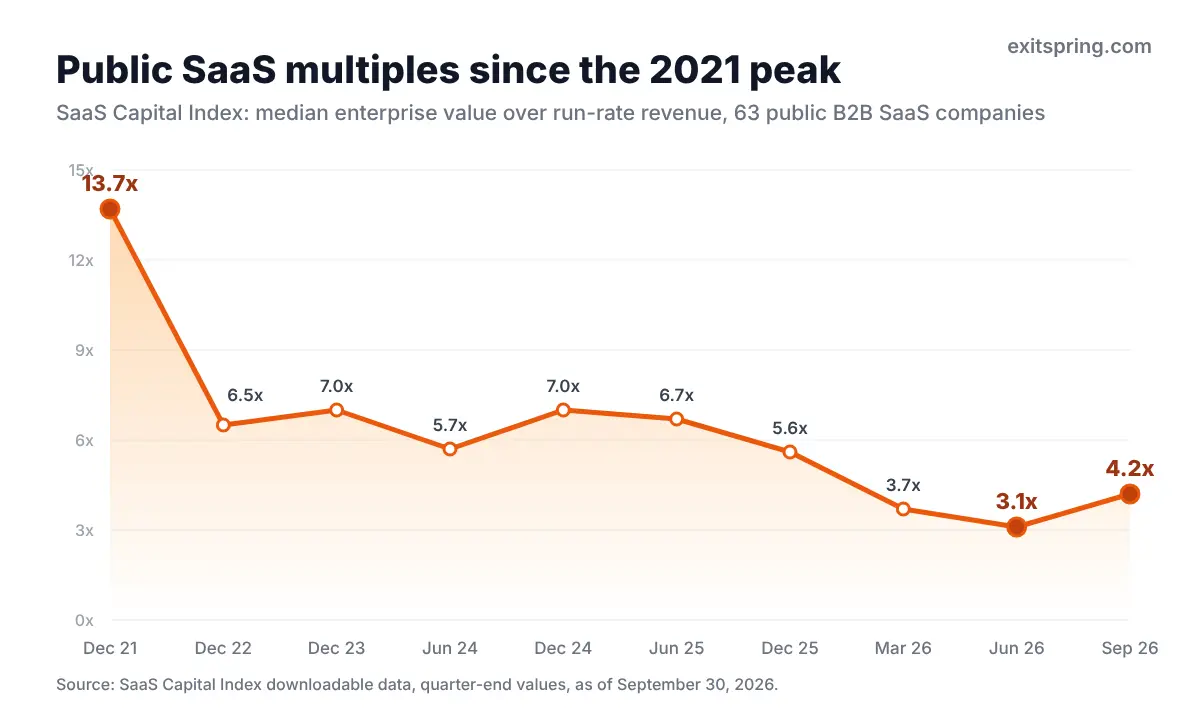
The public number is the one buyers of bigger SaaS companies watch. It fell from 13.7x at the end of 2021 to 3.1x in June 2026 before recovering to 4.2x by September.
AI products have pulled buyer attention toward software. Flippa's H1 2026 report recorded its first 14 sales of AI apps and tools at an average of $535,714, and Crunchbase counted 195 acquisitions of AI startups by venture-backed AI companies through September 29, 2026, already 14% more than in all of 2025.
Retention is the first number a SaaS buyer checks
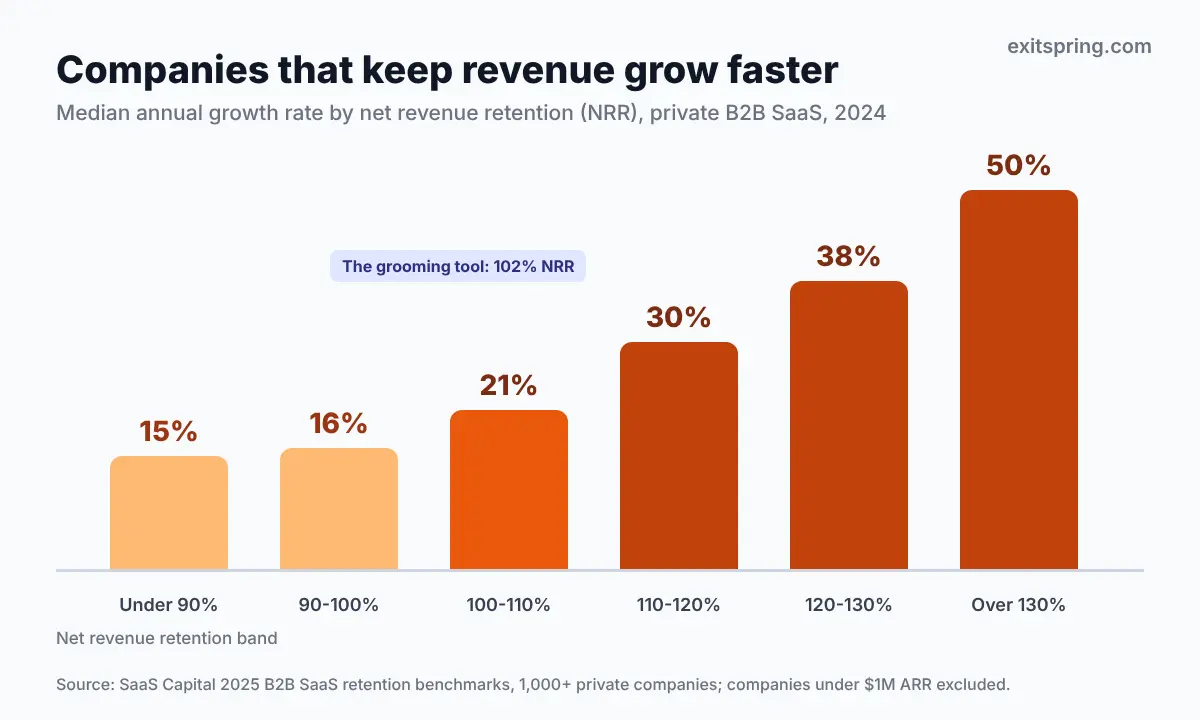
SaaS Capital's 2025 retention survey PDF of more than 1,000 private B2B companies found a median net revenue retention (NRR) of 101% and gross revenue retention (GRR) of 91%. Companies under $1 million of ARR were left out, so treat the figures as a bar to aim at, not a like-for-like comparison for a tool this size.
| Annual contract value | Median NRR | Median GRR |
|---|---|---|
| Under $12,000 | 98% | 90% |
| $12,000 to $25,000 | 103% | 91% |
| $25,000 to $50,000 | 102% | 91% |
| $50,000 to $100,000 | 104% | 90% |
| $100,000 to $250,000 | 102% | 91% |
| Over $250,000 | 106% | 95% |
The grooming tool's contract value is about $940 a year, in the bottom row. Its monthly revenue churn of 0.9% works out to about 90% gross retention over a year, and an SMS reminder add-on sold to existing salons lifts its net retention to 102%. Both sit at or just above the median for its price point.
The same survey shows why a buyer cares. Companies with NRR between 100% and 110% grew at a median 21% a year; those under 90% grew at 15%.
Buyers of larger companies add the Rule of 40, which McKinsey defines as growth rate plus free cash flow margin reaching 40% or more. In Aventis Advisors' May 2026 study of 55 public SaaS companies, those clearing it on a free cash flow basis traded at a median 4.8x revenue, against 2.7x for those that missed. The grooming tool grows 8% a year on a 75% profit margin, so it clears 40 comfortably, though at its size buyers will still price the profit.
Pricing the grooming tool (composite) at $1,152,000
| Line | Figure | Basis |
|---|---|---|
| ARR | $480,000 | 512 salons at about $78 a month |
| Costs | $120,000 | AWS $25,200, support contractor $42,000, Stripe fees $14,400, software $14,400, Google Ads $24,000 |
| SDE | $360,000 | No salary taken; 75% margin |
| First offer, asset purchase | 2.8x SDE, $1,008,000 | All cash at closing |
| Second offer, asset purchase | 3.3x SDE, $1,188,000 | From a buyer who already runs two vertical SaaS tools |
| Agreed, stock purchase | 3.2x SDE, $1,152,000 | 2.4x ARR; $1,036,800 at closing and $115,200 in escrow for 12 months |
The second buyer opened at 3.3x and asked to buy the assets. She accepted 3.2x to sell the shares instead, giving up $36,000 of headline price. The reason is in the tax section below.
The escrow is 10% of the price, the median across all escrows in private deals closed in 2025, according to SRS Acquiom's 2026 deal terms study as summarized by Fasken. That study covers more than 2,300 private-target deals closed from 2020 to 2025, most far larger than a small SaaS sale, so use it as a reference point. Our guide to seller financing and earnouts covers deferred payments in detail, and how to value an online business explains SDE line by line.
Four records to build before the first buyer call
A buyer's first week goes on reconciling numbers. Having these ready shortened the grooming tool's diligence to 19 days.
| Record | What it proves | The grooming tool's version |
|---|---|---|
| MRR bridge | Each month's new, expansion, contraction and churned revenue adds up to the closing MRR | 24 months, rebuilt from Stripe exports and tied to bank deposits |
| Cohort table | How much of each signup month's revenue survives | Rows from January 2023, showing 91% kept after 12 months for that year's salons |
| Cost ledger | Which costs the buyer inherits and which disappear with the founder | Her own laptop and a conference trip separated out as add-backs, with receipts |
| Account register | Who owns every login the business needs | 31 services listed with owner, billing card and two-factor device |
The register turned up the surprises. The iPhone app, the original domain and a transactional email service were all on her personal accounts, and each needed its own transfer plan.
What a SaaS buyer asks for in due diligence
| Check | Where it comes from | On the grooming tool |
|---|---|---|
| MRR and churn by month | Stripe billing reports, matched to bank deposits | 24 months, monthly revenue churn between 0.6% and 1.3% |
| Customer cohorts | Signups grouped by month, revenue kept after 12 months | The 2023 cohort keeps 91% of its starting revenue |
| Customer concentration | Revenue per account | Largest salon chain pays 2.1% of MRR |
| Code review | An independent developer reads the repository | Two days of review, one outdated payments library flagged |
| Open-source licenses | A software composition scan | No GPL or AGPL code in the server application |
| IP ownership | Signed assignments from everyone who wrote code | Two early freelancers had none; both signed before listing |
| Hosting and tools | Invoices and account owners | AWS and GitHub held by the company; one domain and the email service in her own name |
The full buyer's list for any online business is in our due diligence checklist.
Code written by contractors may not belong to the company
US copyright law gives ownership to the author unless the work was made for hire. Under 17 U.S.C. § 101, work done by an employee within the scope of the job counts, but a commissioned work from a contractor counts only in nine listed categories, and software isn't one of them. A transfer of copyright is valid only in a signed writing (§ 204). Amundsen Davis puts the result plainly: a "work made for hire" clause in a freelancer's contract can't fix it; the contractor has to assign the copyright.
Open-source code carries a different risk. Copyleft licenses such as the GPL and AGPL can require a company to share its own source code, and Nixon Peabody warns that non-compliance can mean "forced code disclosure, or expensive re-engineering." A scan before listing costs far less than a buyer's discovery during diligence.
Moving Stripe, the cloud and the code
In a stock sale the company keeps its own accounts, so anything registered to the company stays put. Accounts registered to the founder personally still have to move, and an asset sale moves everything.
| Account | The rule | What happens on a sale |
|---|---|---|
| Stripe, same-country buyer | Contact Stripe Support to unlock owner details, then update them | Customers and subscriptions stay on the same account |
| Stripe, buyer in another country | An account's country can't be changed | Buyer opens a new account; card data is copied but subscriptions aren't, so they're rebuilt with the next renewal date set as the billing anchor |
| Paddle | No assignment without Paddle's written consent (terms, cl. 18.3) | Ask Paddle before signing |
| AWS | Assignment needs AWS consent; the published requirements allow it without a separate agreement | Buyer changes the root login and billing details; no balance can be outstanding |
| Google Cloud | A project can migrate to another organization without downtime | The billing account stays linked until changed separately |
| GitHub | A repository transfer keeps issues, pull requests, stars and secrets | Old links redirect; Pages URLs don't |
| Cloudflare | Moving a zone means reissuing certificates and recreating DNS records | Export DNS records first |
| Apple App Store | An app with at least one version released to the App Store can transfer and keeps its ratings and reviews | TestFlight must be off; subscription apps need an app-specific shared secret |
| Google Play | Users, ratings and subscriptions transfer with the app | Orders before the transfer stay with the old account |
The grooming tool sold its shares, so Stripe, AWS and the company GitHub organization never moved. Three items did. The founder had registered the iPhone app for salon staff under her personal Apple developer account, so it went through App Store Connect's transfer. The transactional email service moved to a company login, and the original domain sat in her own registrar account until closing day.
Customer contracts and personal data
| Issue | Rule | On the grooming tool |
|---|---|---|
| Anti-assignment clause | Triggered by an asset acquisition; a stock purchase avoids it in most states (Weil) | Salons signed online terms that allowed assignment |
| Change-of-control clause | A separate trigger that a stock sale doesn't avoid | None in the salon terms; check enterprise contracts line by line |
| EU or UK customers | A processor needs the customer's written authorization before adding a sub-processor, and must give notice of new ones (GDPR Art. 28) | Applies only if a buyer later moves hosting or support tools for European salons |
Shares or assets: up to $473,000 of federal tax at stake
Her shares date from 2019, when she formed the company. Gain on qualified small business stock (QSBS) can be excluded under 26 U.S.C. § 1202, but an asset sale, or an LLC taxed as a partnership, gets none of it.
| Stock issued | Exclusion | Cap on excluded gain | Company gross assets |
|---|---|---|---|
| After July 4, 2025 (2025 changes) | 50% at 3 years, 75% at 4, 100% at 5 or more | Greater of $15 million or 10x basis | Up to $75 million |
| Sept 28, 2010 to July 4, 2025, as here | 100% after more than five years | Greater of $10 million or 10x basis | Up to $50 million |
| Route | Federal tax on near-zero basis |
|---|---|
| Asset sale at $1,188,000 | 21% corporate tax, about $249,000, then up to 23.8% on the $938,520 paid out, about $223,000: roughly $473,000 |
| Stock sale at $1,152,000, no QSBS | Up to about $274,000 at 20% plus the 3.8% net investment income tax |
| Stock sale at $1,152,000, QSBS qualifies | Potentially nothing |
She took $36,000 less to get the third row. States don't all follow the federal exclusion, and qualification turns on the type of business and how the stock was issued, so get a tax adviser's confirmation before agreeing a structure. Our guide to taxes when selling an online business covers asset-sale taxes in depth.
The founder's last 90 days
Small SaaS buyers pay for a business that runs without its founder, then ask the founder to prove it. The grooming tool's purchase agreement set out a transition the buyer could hold her to.
| Period after closing | What she owed | Why the buyer asked |
|---|---|---|
| Weeks 1 to 4 | Up to 10 hours a week, plus a recorded walkthrough of deployment and billing | Two of the three production deploys a month were still run by her |
| Months 2 and 3 | Answers by email within two business days | Edge cases in the payment-reminder logic lived only in her head |
| Two years | No competing grooming or pet-salon software | The buyer was paying for her customer relationships |
Her support contractor, who handled 70% of tickets, agreed in writing to stay on at the same rate before the letter of intent was signed. A buyer will discount a business whose only support person might leave with the founder.
Mistakes that cost SaaS founders money
| Mistake | What it cost | Illustrative example |
|---|---|---|
| Quoting MRR including annual plans paid upfront | A buyer recalculated and cut the price | One month's reported MRR included a $72,000 annual prepayment that should have counted as $6,000 |
| No IP assignments from early freelancers | Closing delayed while signatures were chased | A developer who had moved abroad took five weeks to reply |
| Hiding churn inside growth | Trust lost once the cohort table came out | 3% monthly churn behind a 4% monthly growth rate |
| Accounts in the founder's personal name | Extra transfers and a later, slower close | Apple developer, domain and Google Workspace all on a personal login |
| Agreeing to an asset sale without checking QSBS | Six figures of avoidable tax | Shares held seven years, sold as assets instead: 21% corporate tax, then up to 23.8% more on the payout |
Questions SaaS founders ask
How many times profit does a small SaaS business sell for?
On the marketplace data above, 61 SaaS listings asked a median 3.33x annual SDE, with the middle half between 2.50x and 4.00x. Flippa puts sold SaaS deals in the first half of 2026 at an average 2.47x profit and 4.06x for the top quarter. A seven-year-old tool with stable retention can argue for the upper half of that range. The grooming tool's buyer opened at 3.3x, and she accepted 3.2x in exchange for a stock sale.
Do buyers value SaaS on revenue or profit?
Under about $1 million of ARR, most small buyers pay a multiple of profit. The grooming tool's $1,152,000 price works out to 3.2x SDE and 2.4x ARR, and the buyer negotiated on the first number. Revenue multiples, like the 4.2x public index, matter more for growing companies above that size.
What churn rate scares buyers off?
A gross retention below 90% puts a company behind its peers, SaaS Capital says; that is roughly 0.9% of revenue lost each month. A tool losing 3% a month replaces about a third of its revenue every year, and buyers will price it closer to the bottom of the range.
Can I sell if my Stripe account is in another country from the buyer?
Stripe can't change an account's country, so a buyer abroad opens a new account and asks Stripe to copy customers and saved cards across. Subscriptions don't copy, so they're rebuilt in the new account with each customer's next renewal date set as the billing anchor, and the old ones cancelled before they charge.
Does the buyer need my source code before signing?
Most buyers want an independent developer to read it during due diligence, under a confidentiality agreement and usually after a letter of intent. The grooming tool's buyer paid for two days of review, which flagged one outdated payments library and nothing else.
How long does a SaaS sale take?
Expect a few months from listing to closing, and longer when IP paperwork or account transfers are untidy. Our guide to how long it takes to sell an online business breaks the timeline down stage by stage.
What happens to customers who paid for a year upfront?
The buyer takes on the obligation to serve them, so the unearned part of those payments is usually credited to the buyer at closing. A tool with $90,000 of annual plans renewed evenly through the year carries about $45,000 of unearned revenue on any given day, and that amount comes off the seller's cash at closing.
Selling your SaaS business with Exit Spring
Send us read-only access to your Stripe account and a list of everyone who has ever written code for the product. We'll come back with the multiple buyers are likely to offer, any IP assignments still missing, and whether your share structure leaves a stock sale open. Exit Spring works from the US and Hong Kong, and you can request a free valuation here.
General information as of October 2026, not legal or tax advice.
Sources
- Flippa: SaaS multiples and H1 2026 Insights Report
- SaaS Capital: SaaS Capital Index, Private SaaS company valuations and 2025 retention benchmarks PDF
- McKinsey: SaaS and the Rule of 40; Aventis Advisors: Rule of 40 in SaaS, 2026
- Crunchbase News: AI startup acquisitions, October 2026
- Fasken: Key takeaways from SRS Acquiom's 2026 study
- Stripe: Business sale or acquisition, Acquired by an entity in a different country and Self-serve data copy
- Paddle: Terms; AWS: Account assignment requirements; Google Cloud: Project migration
- GitHub: Transferring a repository; Cloudflare: Move a domain between accounts
- Apple: Overview of app transfer; Google Play: Transfer apps
- Cornell LII: 17 U.S.C. § 101, 17 U.S.C. § 204 and 26 U.S.C. § 1202
- Amundsen Davis: Paid for software but don't own it; Nixon Peabody: Open-source software in M&A; Weil: Anti-assignment workarounds; Jones Day: QSBS benefits expanded
- EUR-Lex: General Data Protection Regulation
- Empire Flippers public listings, retrieved October 8, 2026 (61 SaaS listings, asking multiples on SDE)
Get new listings in your inbox
Fresh businesses for sale every Monday, plus practical buying and selling tips.
Unsubscribe anytime. No spam.
Keep reading



Ready to make a move?
Browse vetted online businesses or get a free valuation of yours.