
Seller Financing and Earnouts: How to Structure an Online Business Sale (2026)
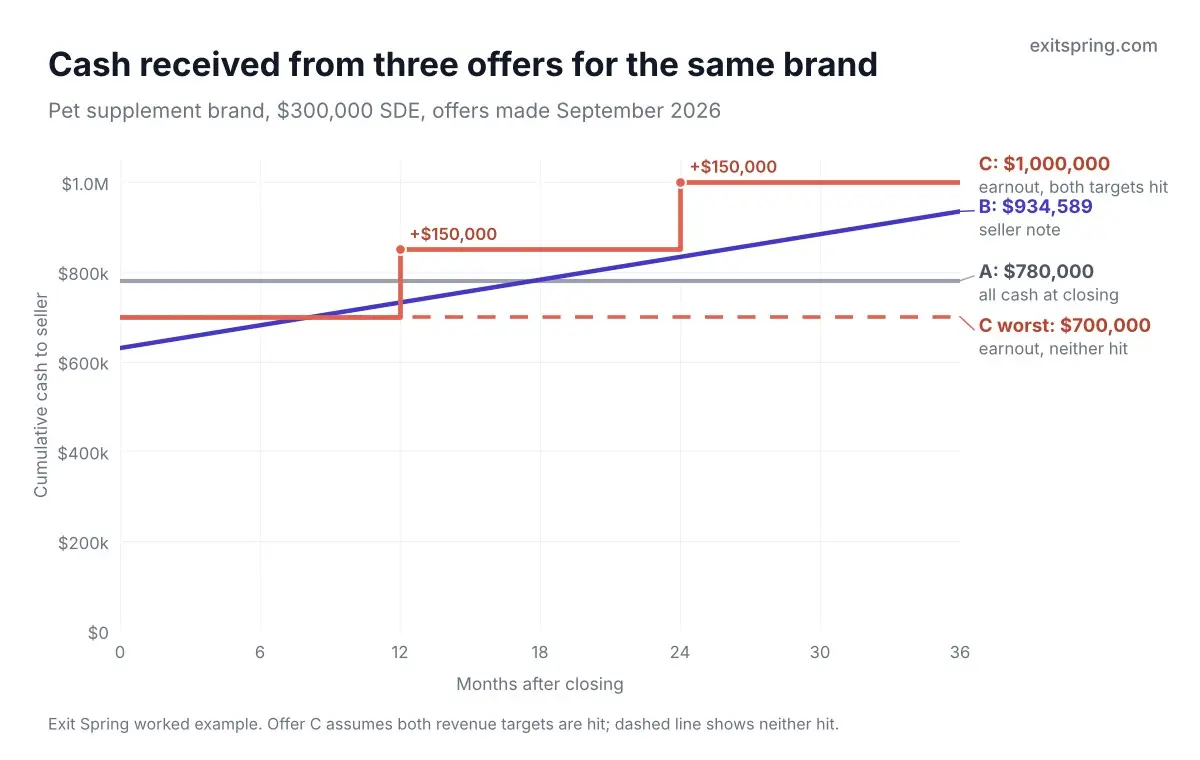
A pet supplement brand on Amazon and Shopify, earning its owner $300,000 a year, drew bids of $780,000, $900,000 and $1,000,000 in September 2026.
Three offers for one $300,000 brand
| Offer A | Offer B | Offer C | |
|---|---|---|---|
| Headline price | $780,000 | $900,000 | $1,000,000 |
| Wired at closing | $780,000 | $630,000 | $700,000 |
| Owed afterwards | Nothing | $270,000 note, 8%, 36 months | Up to $300,000 across two revenue milestones |
| Where the buyer's money came from | SBA 7(a) loan and savings | Savings plus a home equity line | A two-brand holding company |
| Headline as a multiple of SDE | 2.6x | 3.0x | 3.33x |
| Best case for the seller | $780,000 | $934,589 with interest | $1,000,000 |
| A bad but plausible case | $780,000 | $748,451, buyer stops after payment 14 | $700,000, neither target hit |
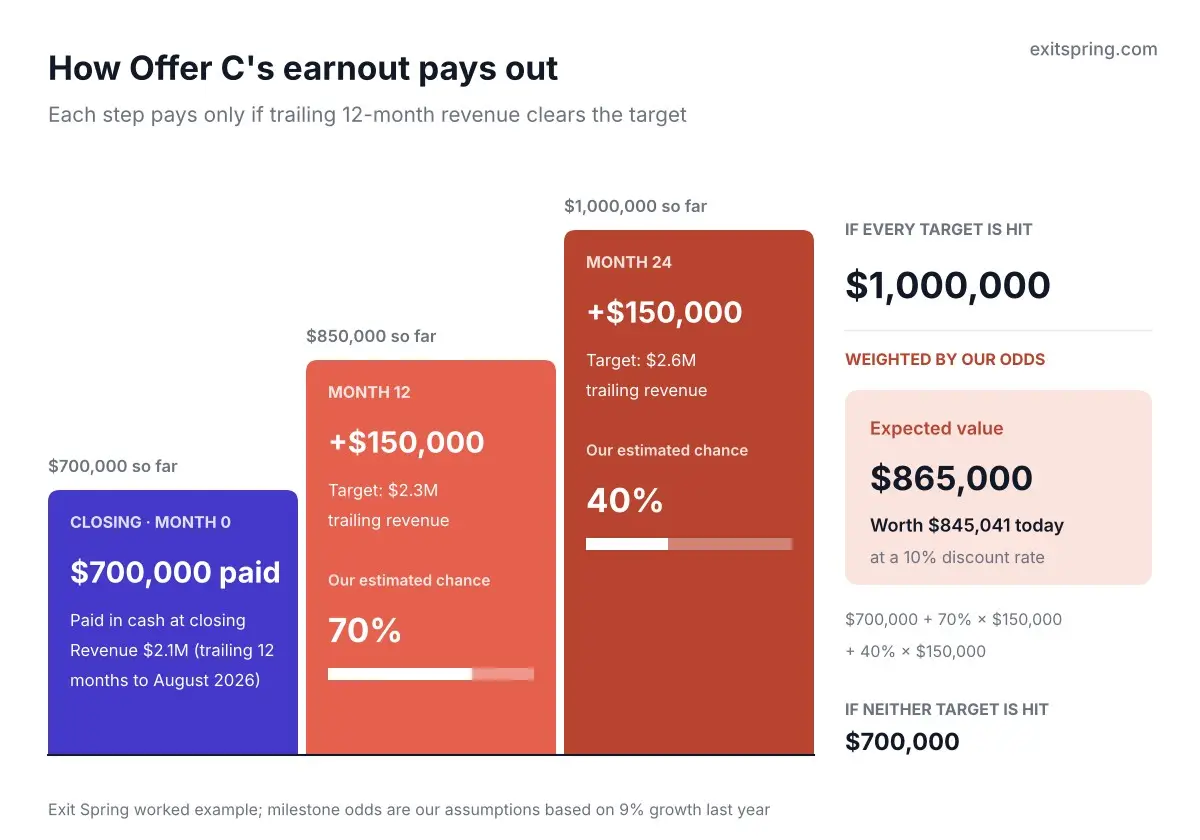
The brand and its buyers are a composite we built for this guide; every figure comes from the terms shown. Trailing revenue to August 2026 was $2.1 million. Offer C's buyer wanted $2.3 million by month 12 and $2.6 million by month 24, with $150,000 riding on each.
| Assumption we used | Figure | Basis |
|---|---|---|
| Discount rate | 10% a year | Roughly what she could earn elsewhere at similar risk |
| Odds of the month 12 target | 70% | Needs 9.5% growth; last year's was 9% |
| Odds of the month 24 target | 40% | Needs another 13% on top |
| Offer | Value today | Below the headline by |
|---|---|---|
| A, all cash | $780,000 | $0 |
| B, seller note | $892,211 | $7,789 |
| C, earnout | $845,041 | $154,959 |
We'd rank Offer B first. It pays her $112,211 more than the cash buyer, in 36 monthly instalments of $8,461 from someone she first spoke to in August. Our guide to how to value an online business covers where 2.6x to 3.3x comes from.
Seller financing vs an earnout
| Seller note | Earnout | |
|---|---|---|
| What the seller holds | A promissory note for a fixed sum | A promise of payments if targets are hit |
| Interest | Yes, at or above the IRS floor | Rarely |
| Who carries the business risk | The buyer; the debt is owed even if sales fall | The seller; a weak year cuts the payout |
| Security | UCC-1 over the assets, personal guarantee | Usually none unless negotiated |
| Typical length on an online sale | 24 to 60 months | 6 to 24 months |
| Tax for a US seller | Instalment method under section 453 | Purchase price, unless tied to staying on |
| What it signals about the buyer | Short of cash | Unsure the numbers will hold |
The counter-offer we'd have tried
Offer C's buyer had the cash for a bigger down payment and doubted the growth. A mixed structure gives both sides something.
| Offer D (our counter) | Figure |
|---|---|
| Headline price | $950,000 |
| Wired at closing | $650,000 |
| Seller note | $200,000 at 8% over 24 months, $9,045 a month, $17,091 of interest |
| Earnout | $100,000 if trailing revenue reaches $2.3 million at month 12 |
| Value today at the same 10% and 70% | $909,659 |
| Worst case | $650,000 plus whatever the note has paid |
Offer D comes out $17,448 ahead of Offer B on our assumptions, with the note paid off a year sooner. The buyer, who ran two other brands from the same warehouse in Reno, turned it down.
How Offer B was negotiated
| Date | Step | What changed |
|---|---|---|
| August 12 | First call | Buyer asked for 18 months of P&L and every Amazon payout report |
| September 2 | Opening letter of intent | $860,000: $480,000 down, $380,000 over five years at 6%, no guarantee |
| September 8 | Seller's counter | $920,000 with $650,000 down, three years at 9%, guarantees from both buyers |
| September 16 | Terms agreed | $900,000: $630,000 down, $270,000 at 8% over 36 months, both guarantees kept |
| September 30 | Closing | Escrow released $630,000; the UCC-1 was filed in Delaware the same week |
The buyers gave up a point on the rate to keep their down payment under $650,000. She took that trade with two signatures behind the remaining $270,000.
Seller notes on online businesses run one to five years
Flippa's seller financing walkthrough has a buyer put $40,000 down on a $100,000 site and pay $1,000 a month plus interest over five years, with 6% as its sample rate. Notes on stores and content sites tend to be shorter. Two or three years is common, with the first payment 30 days after closing.
Go under the IRS floors in Rev. Rul. 2026-19 PDF and part of every principal payment gets taxed as interest under section 483.
| Note term | Federal floor, October 2026 | Typical seller ask |
|---|---|---|
| Up to 3 years | 4.25% | 7% to 10% |
| 3 to 9 years | 4.61% | Usually 8% or more |
| Longer than 9 years | 5.22% | Rare on a website |
| Sale | Note | Rate and term | Monthly payment | Interest over the term |
|---|---|---|---|---|
| $150,000 Etsy printables shop | $45,000 (30%) | 8%, 24 months | $2,035 | $3,845 |
| $400,000 recipe site on Mediavine ads | $120,000 (30%) | 8%, 36 months | $3,760 | $15,373 |
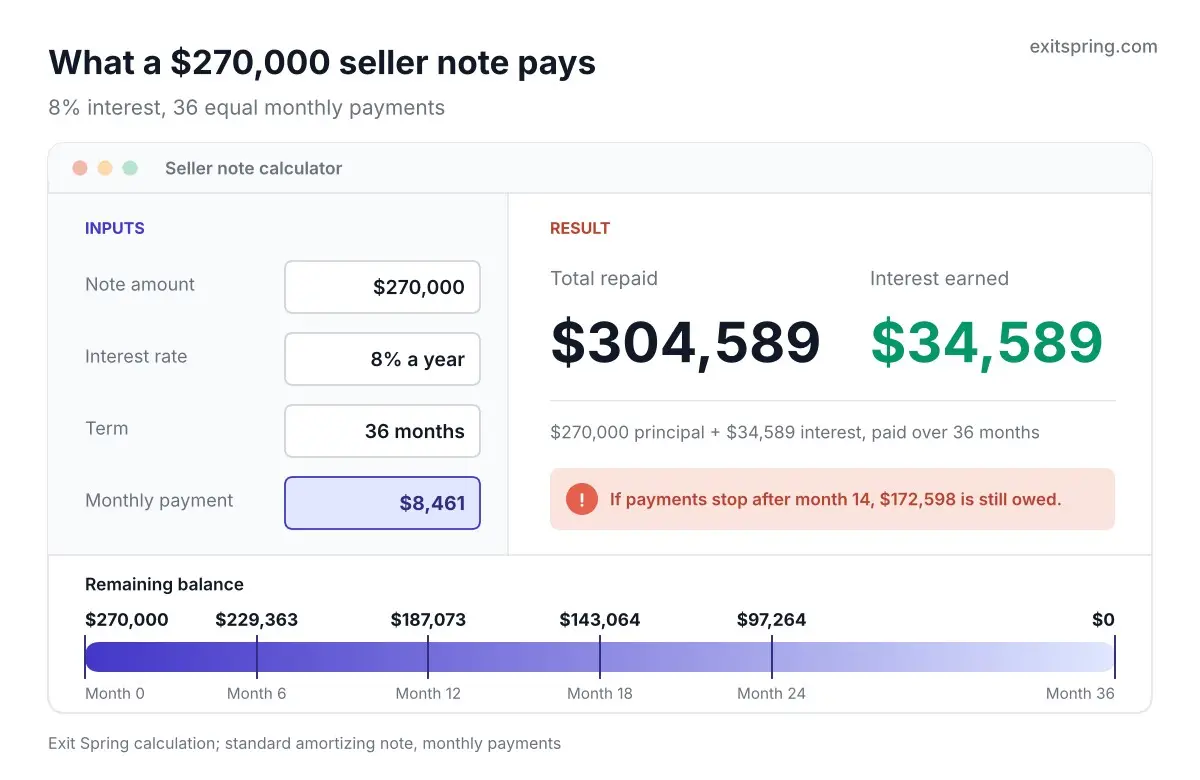
| $900,000 pet supplement brand (Offer B) | $270,000 (30%) | 8%, 36 months | $8,461 | $34,589 |
| $1.5 million B2B SaaS tool | $300,000 (20%) | 9%, 48 months | $7,466 | $58,345 |
| $3 million Amazon home goods brand | $450,000 (15%) | 9%, 60 months | $9,341 | $110,476 |
Above $1 million, an SBA lender or a fund usually supplies most of the price, and the seller's share of the financing drops to 15% or 20%.
Paperwork that makes a note collectable
Her promissory note ran to two pages. The rest of the file looked like this.
| Document or clause | Job | In the pet supplement deal |
|---|---|---|
| Security agreement | Lets the seller take back assets if payments stop | Trademark, domain, Shopify store and stock; not the Amazon account itself |
| UCC-1 | Puts that claim on public record | Filed in Delaware, where the buyer's LLC was formed, under UCC section 9-307 |
| Personal guarantee | Reaches the buyer's own assets, past the LLC | Signed by the buyer and her husband |
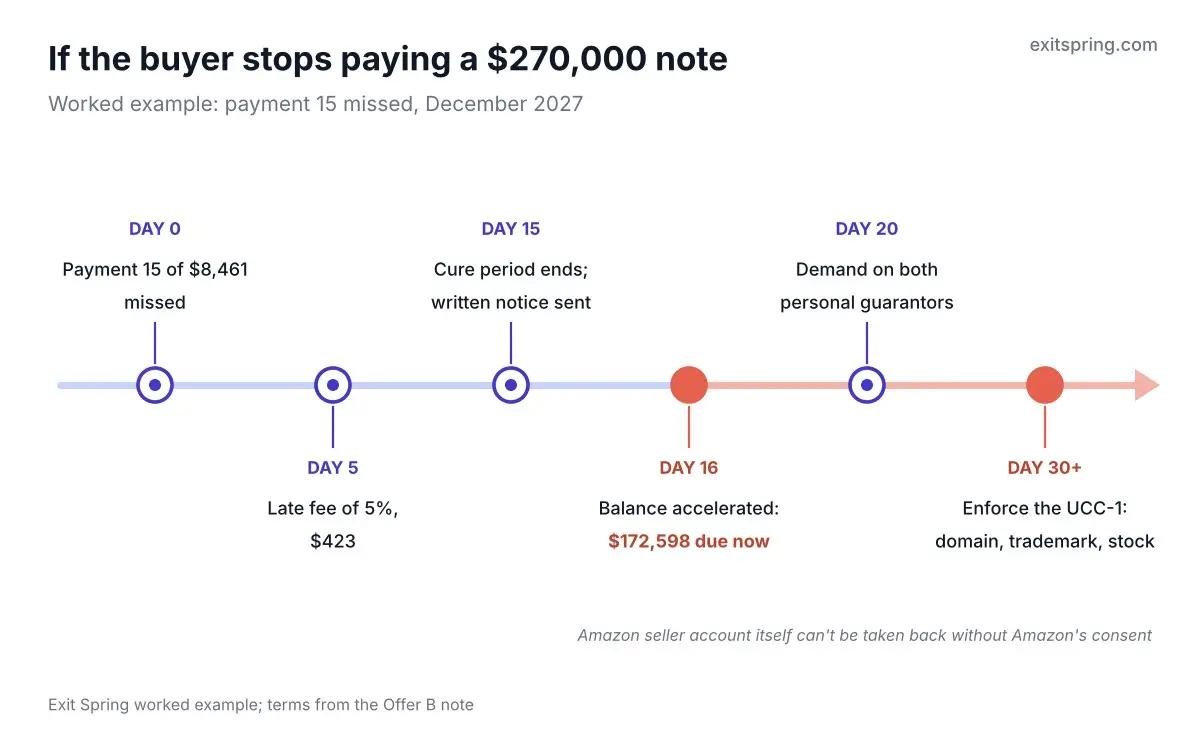
| Acceleration | Calls in the full balance after a default | 15 days to cure, then $172,598 due at once if it happens after payment 14 |
| Monthly reporting | Early warning of a slide | Amazon payout report and a P&L by the 20th |
| Negative covenants | Stops asset stripping before payoff | No sale of the brand, no new liens, ad spend kept above $15,000 a month |
| Subordination | Ranks the note behind a bank | Only needed when an SBA lender is involved |
A domain can move registrars in an afternoon. Amazon can suspend a seller account over a single listing or compliance complaint. Escrow.com has held domains for instalment buyers since at least 2011, according to DomainSherpa, and its domain holding service still runs terms of three months to five years.
If the buyer stops paying
| Day | What happens | Offer B in December 2027 |
|---|---|---|
| 0 | A payment is missed | Payment 15, $8,461, doesn't arrive |
| 5 | Late fee kicks in | 5%, or $423 |
| 15 | Cure period ends; formal notice goes out | Sent by the seller's lawyer to the LLC and both guarantors |
| 16 | Balance accelerated | $172,598 due at once |
| 20 | Guarantors asked to pay | Demand letters to the buyer and her husband |
| 30 onward | Collateral enforced under the UCC-1 | Domain, trademark and warehouse stock taken back |
| Asset | Getting it back | What we put in the deal |
|---|---|---|
| Domain | Quick if a third party holds it | Escrow.com holding until the last payment |
| Amazon seller account | Can't be pledged: Amazon's seller agreement, amended from August 24, 2026, bars transferring or pledging account rights, as EcomCrew reported | Security over the trademark, domain and stock instead |
| Shopify store | Only the store owner can transfer it (Shopify) | Monthly export of products and customers to the seller |
| Stripe subscriptions | Customer and card data can be copied only from the buyer's own Stripe account (Stripe); subscriptions must be rebuilt | MRR reported every month |
| YouTube channel | A Brand Account channel can change owners; AdSense accounts can't be transferred | Seller kept as a manager until payoff |
| Inventory at a 3PL | Physical goods, the easiest to seize | Warehouse named in the security agreement |
Mistakes that sink seller-financed deals
| Mistake | What it cost | Example |
|---|---|---|
| No UCC-1 filed | A later lender ranked ahead of the seller | A $90,000 note sitting behind a $250,000 inventory loan the buyer took out in month 4 |
| Guarantee from the buyer's LLC only | Nothing to collect once the LLC was empty | A newsletter buyer's company held $1,200 when payments stopped |
| "Net profit" left undefined | The buyer charged costs that didn't exist before | A $4,000-a-month "shared services" fee wiped out a $60,000 earnout |
| No monthly reporting | The seller heard about the slump at default | Traffic fell 70% after a March core update; the seller found out in July |
| Interest below the IRS floor | Part of the principal reclassified as interest | A 2% note on a $100,000 balance, taxed as if it carried the federal rate |
SBA counts seller money as at most half the buyer's 10%
An SBA 7(a) loan goes up to $5 million and needs 10% of the project cost from the buyer. The rules below come from SOP 50 10 8.1, Appendix 15, which covers loans numbered from October 1, 2026 and keeps the seller note rules of SOP 50 10 8 summarized by Live Oak Bank.
| SBA rule | On a $900,000 deal like Offer B |
|---|---|
| Seller note counted as buyer equity | Full standby: no principal or interest for the life of the loan, often 10 years |
| Seller money inside the 10% injection | About $45,000 at most |
| A note the buyer is paying down | Counts in debt service coverage, which must be at least 1.25x for an acquisition |
| Founder keeping 5% of the brand | Full guarantee of the buyer's bank loan for at least two years |
| Price of $3 million or more | Lender orders a quality of earnings review (Doeren Mayhew) |
Offer A's lender refused any seller note. That deal would have closed with one wire.
Earnouts were in 24% of private deals in 2025
SRS Acquiom's 2026 study covered more than 2,300 private deals closed from 2020 to 2025; Fasken published the numbers we use here.
| From the 2026 study | Figure |
|---|---|
| Deals with an earnout, 2025 | 24% |
| Same, 2024 | 22% |
| Median earnout against the closing payment, 2025 | 34% |
| Most common length | 1 to 2 years, in 38% of earnouts |
| A year or less | 23% |
| 2 to 3 years | 20% |
Online sales near $1 million usually measure over 6 to 24 months. Offer C defers an amount equal to 43% of its closing payment.
Revenue targets for founders who leave
Her handover was 60 days. Under a profit target, a buyer who hired a $9,000-a-month agency or moved stock to a dearer 3PL would shrink her first $150,000 along with the margin.
| Business sold | Earnout we'd expect to see | Measured on |
|---|---|---|
| $250,000 newsletter, 40,000 subscribers | $40,000 if paid subscribers stay above 2,600 for 6 months | Stripe payouts; see selling a newsletter |
| $600,000 content site | $75,000 if monthly ad revenue averages $18,000 in year one | Ad network statements |
| $1.2 million SaaS tool | $200,000 tied to MRR of $45,000 at month 12, founder on a consulting contract | Billing system export |
| $1 million Amazon brand (Offer C) | Two payments of $150,000 at $2.3 million and $2.6 million trailing revenue | Seller Central and Shopify |
What happened when earnouts went to court
| Case | The earnout | Result |
|---|---|---|
| Fortis v. Johnson & Johnson, Chancery, September 4, 2024 | Up to $2.35 billion on surgical robot milestones, efforts judged against J&J's priority devices | Efforts breach on the iPlatform robot and fraud on a Monarch milestone; about $1 billion awarded (Jones Day) |
| Johnson & Johnson v. Fortis, Supreme Court, January 12, 2026 | $400 million for a 510(k) clearance by the end of 2021 | $300 million of the award reversed; the contract named 510(k), and the FDA wanted De Novo clearance (Quinn Emanuel) |
| Fortis v. Medtronic, Chancery, July 29, 2024 | $100 million on insulin pen sales; buyer barred only from acting mainly to avoid payment | Thrown out at the pleading stage; the sellers didn't plead facts showing that motive (Jones Day) |
| SRS v. Alexion, Chancery, September 5, 2024 | Up to $800 million; efforts measured against similar-sized drug companies | Breach, after the new parent dropped the program for merger savings; $180.9 million awarded in June 2025 (Goodwin) |
| AM Buyer v. Argosy, Superior Court, September 3, 2024 | EBITDA earnout, independent accountant's figure binding | Accountant's number enforced; buyer ordered to pay |
Clauses we push for in an earnout
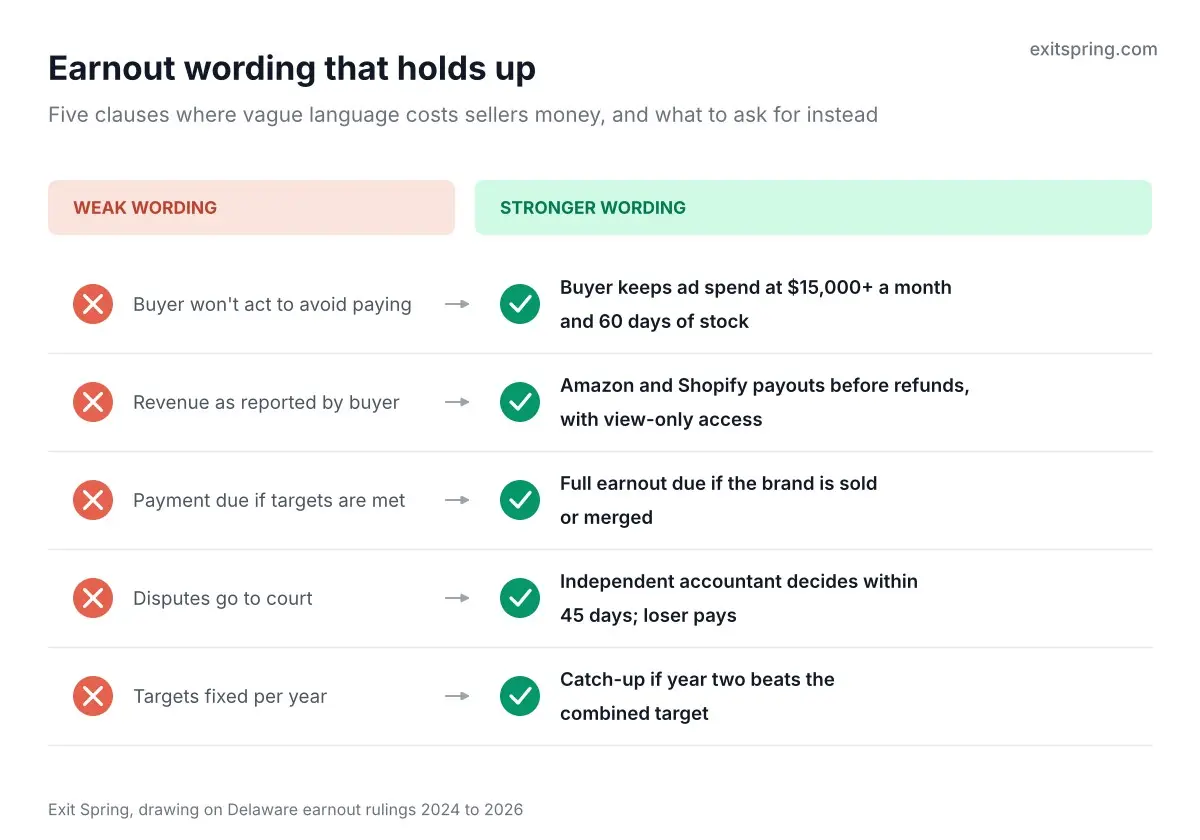
| Clause | Seller-side wording | Applied to Offer C |
|---|---|---|
| Efforts | Run the brand in the ordinary course, with spending floors written in | Ads at $15,000 a month or more; 60 days of stock on hand |
| Measurement | Formula, accounting method and data source named | Seller Central and Shopify payouts, before refunds |
| Access | Monthly figures and a read-only login | Seller Central business reports |
| Acceleration | Whole earnout due on a sale, shutdown or transfer of sales | Aggregator buys the brand in month 10; $300,000 falls due |
| Catch-up | A miss in year one can be recovered in year two | $2.25 million at month 12, $2.6 million at month 24 pays both |
| Disputes | Independent accountant, a deadline, loser pays | 45 days for a decision |
| Security | Earnout sits under the same security agreement as any note | One UCC-1 for both |
A seller note spreads the gain over four tax years
Under section 453, note principal is usually reported on the instalment method. Gain lands in the year each payment arrives, interest is ordinary income when paid, and inventory and depreciation recapture are taxed in the year of sale regardless.
| Money | Federal treatment |
|---|---|
| Offer B's $630,000 at closing | Goodwill gain in 2026, plus inventory and recapture |
| $270,000 of principal | Gain spread over 2026 to 2029 on Form 6252 |
| $34,589 of interest | Ordinary income as received |
| Earnout owed whether or not she works there | Normally purchase price, often capital gain |
| Earnout that ends if she quits | Can be taxed as compensation (RSM) |
In our tax guide, a $150,000 note on a hypothetical $600,000 Shopify sale would cut federal tax by about $6,100.
How each structure changes the closing
| Stage | All cash | Seller note | Earnout |
|---|---|---|---|
| Letter of intent | Price, date | Amount, rate, term, collateral, guarantor | Metric, targets, dates, amounts, reporting |
| Due diligence | Buyer checks the business | Seller checks the buyer's credit, bank statements and past ventures | Base-year numbers signed off by both |
| Closing day | Escrow releases funds on transfer | Down payment released; UCC-1 filed that week | Upfront payment; reporting logins created |
| Afterwards | 30 to 60 days of handover | One to five years of monthly payments | A statement at each measurement date |
Buyers work from something like our due diligence checklist. A seller lending $270,000 needs a shorter list on the buyer: two months of bank statements, a soft credit pull and any businesses they ran before.
Checks before you sign a seller note
| Check | What to ask for | A result we'd accept |
|---|---|---|
| Cash | Two months of bank statements | Down payment plus six months of running costs in the account |
| Credit | A soft credit pull, with consent | No defaults or collections in five years |
| Track record | Businesses the buyer has run | A Shopify store doing $40,000 a month, run for three years |
| Collateral | Every asset listed in the security agreement | Domain, trademark, social handles, email list, stock at the 3PL |
| Default rate | Interest after a missed payment | 12% from day 16 |
| Prepayment | Whether the buyer can pay early | Allowed, no penalty |
| Death or disability | Who pays if the buyer can't | Balance due from the estate; a term life policy assigned to the seller |
| Tax election | Instalment reporting set up with the seller's accountant | Form 6252 ready for the 2026 return |
Five deferred offers we'd turn down
| Situation | What goes wrong | Example |
|---|---|---|
| Buyer can't show the down payment | Payments depend on the store never dipping | $90,000 in savings behind a $250,000 down payment |
| Target above the best year on record | That slice of the price is unlikely to arrive | $2.9 million asked of a brand that peaked at $2.3 million in 2024 |
| Buyer will merge the brand into another | Sales stop being measurable | A supplement line folded into an aggregator's storefront |
| Buyer in another country | Collection costs more than the balance | A Hong Kong seller owed $40,000 by a buyer in Ohio; see our guide to selling from outside the US |
| Over half the price deferred | The seller is financing the purchase | $450,000 deferred on an $800,000 sale |
Terms buyers propose and what to counter with
| Buyer's opening term | Seller's counter | Difference on a $500,000 sale |
|---|---|---|
| $100,000 down, $400,000 over 5 years at 6% | $300,000 down, $200,000 over 3 years at 9% | $200,000 more on day one |
| Interest only for the first year | Amortizing from month 1 | About $60,000 of principal repaid in year one instead of none |
| No personal guarantee | Guarantee capped at the unpaid balance | A claim on the buyer's own assets |
| Earnout on EBITDA | Earnout on revenue or gross profit | The buyer's new costs stop counting against the seller |
| 36-month earnout | 12 months, or 24 with a catch-up | Fewer of the buyer's decisions inside the measuring window |
| Unsecured note | UCC-1 plus domain held in escrow | Something to take back if payments stop |
Questions sellers ask us
What does seller financing look like on a small online business?
On a $400,000 recipe site it usually means about $280,000 wired at closing and $120,000 paid to the seller monthly over two or three years. The seller keeps a security interest in the site and the domain until the final payment.
Is seller financing worth the risk?
It added $112,211 to the all-cash offer in our worked example, against three years of credit risk. We'd accept it when the buyer puts at least half the price down and signs a personal guarantee.
What rate goes on a seller note?
The pet supplement founder asked for 9% and settled at 8% on 36 months. The legal minimum that month was 4.25% for terms up to three years, set by the IRS's monthly federal rates.
How long do earnouts usually last?
38% of the earnouts in SRS Acquiom's 2026 study ran one to two years. On a Shopify store or a content site we push for 12 months, since a new owner's changes to ads, pricing or suppliers muddy the numbers after that.
Can a seller note sit alongside an SBA loan?
Half of the buyer's 10% injection can come from a seller note on full standby, meaning no payments for the life of the bank loan. On a $900,000 purchase that is $45,000 the seller may not see for 10 years.
What happens to an earnout if the buyer sells the business?
Without an acceleration clause, the new owner may owe nothing toward targets set by the old one. With it, an aggregator buying the brand in month 10 would have made all $300,000 of Offer C due that day.
Do buyers of online businesses expect seller financing?
Below $150,000, buyers usually pay in full through escrow. It comes up most between $300,000 and $2 million, where a buyer can cover a third of the price but not the whole thing, and an SBA loan is too slow or too restrictive.
What if the seller dies before the note is paid off?
Her heirs collect. Had the founder died in month 15, the remaining $172,598 would have gone to her estate, with the guarantees and the UCC-1 carried on in the estate's name.
Offer B closed on September 30 with personal guarantees from both buyers and a UCC-1 on the brand; the first $8,461 fell due 30 days later.
This article reflects contract terms and published rules as of October 2026 and is not legal or tax advice. Have a lawyer who has drafted promissory notes and earnouts read any deal with deferred payments.
To see what your business could fetch in cash, and what a structured offer might add, request a free valuation.
Sources
- IRS, Rev. Rul. 2026-19, applicable federal rates for October 2026 PDF
- Internal Revenue Code section 453 via Cornell LII
- Internal Revenue Code section 483 via Cornell LII
- Uniform Commercial Code section 9-307 via Cornell LII
- U.S. Small Business Administration, SOP 50 10 lender and development company loan programs
- SBA Information Notice 5000-880695, issuance of SOP 50 10 8.1, August 14, 2026
- Live Oak Bank, Navigating the SBA's new SOP 50 10 8
- Doeren Mayhew, SOP 50 10 8.1: what SBA lenders should be thinking about before Oct. 1, August 24, 2026
- Fasken, Key takeaways from SRS Acquiom's 2026 study, May 7, 2026
- Jones Day, Earnouts in M&A transactions: recent decisions from Delaware, April 2025
- Quinn Emanuel, Mergers and acquisitions update, May 2026
- Flippa, Why seller financing makes sense
- DomainSherpa, Buy a domain name over time in installments with Escrow.com
- Goodwin, Delaware court awards more than $180 million in Alexion earnout case, June 2025
- RSM, Earn-outs with continued employment: purchase price or compensation?
- Escrow.com, Domain name holding
- EcomCrew, Amazon's new contract terms target seller financing deals, August 16, 2026
- Stripe, Self-serve data copy
- Shopify Help Center, Transferring store ownership
- YouTube Help, Transfer channel ownership and AdSense Help, account transfers
Get new listings in your inbox
Fresh businesses for sale every Monday, plus practical buying and selling tips.
Unsubscribe anytime. No spam.
Keep reading

Ready to make a move?
Browse vetted online businesses or get a free valuation of yours.