
How to Sell a Newsletter: Valuation, Platform Transfers and the Subscriber List (2026)
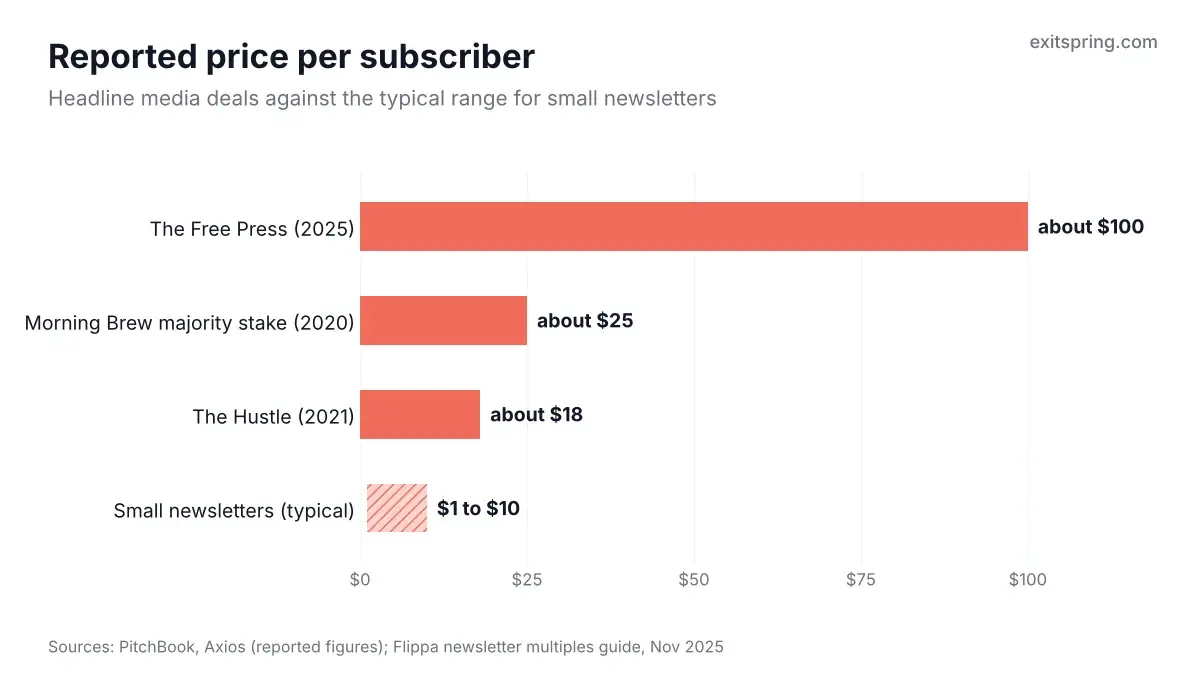
The Free Press went to Paramount Skydance for about $100 a subscriber in October 2025, while HubSpot paid about $18 a subscriber for The Hustle in 2021.
The Free Press had 170,000 people paying for it. The Hustle lived on sponsors. A 20,000-subscriber newsletter on beehiiv gets priced the same way, on who pays and how often the money comes back.
What the reported deals paid per subscriber
| Newsletter | Buyer | Year | Subscribers at the time | Reported price | Per subscriber |
|---|---|---|---|---|---|
| The Free Press | Paramount Skydance | 2025 | about 1.5 million, 170,000 paying | about $150 million | about $100 |
| Morning Brew (majority stake) | Insider Inc. | 2020 | about 3 million across its newsletters | valued at about $75 million | about $25 |
| The Hustle | HubSpot | 2021 | more than 1.5 million | about $27 million | about $18 |
| Milk Road | Bitfo | 2022 | about 250,000, ten months after launch | not disclosed | n/a |
| theSkimm | Ziff Davis | 2025 | down from 7 million to 5 million | not disclosed | n/a |
None of the buyers published a price. The figures come from Axios on Morning Brew and Axios on The Hustle, each citing people familiar with the deals, and from PitchBook's estimate for The Free Press. Morning Brew's founders kept a minority stake in 2020, and Axel Springer took full ownership in February 2025 on undisclosed terms, according to MediaPost.
Informa paid $389 million in cash for Industry Dive in 2022, a company expected to earn $34 million of EBITDA that year, according to Press Gazette. That works out to a little over 11 times EBITDA.
Buyers are still active in 2026. Hunterbrook Media bought The Bear Cave, a short-selling newsletter, in June, MediaPost reported. On October 5, Adweek reported that Morning Brew had paid cash for Express Checkout, which covers consumer packaged goods.
Small newsletters sell for $1 to $10 a subscriber
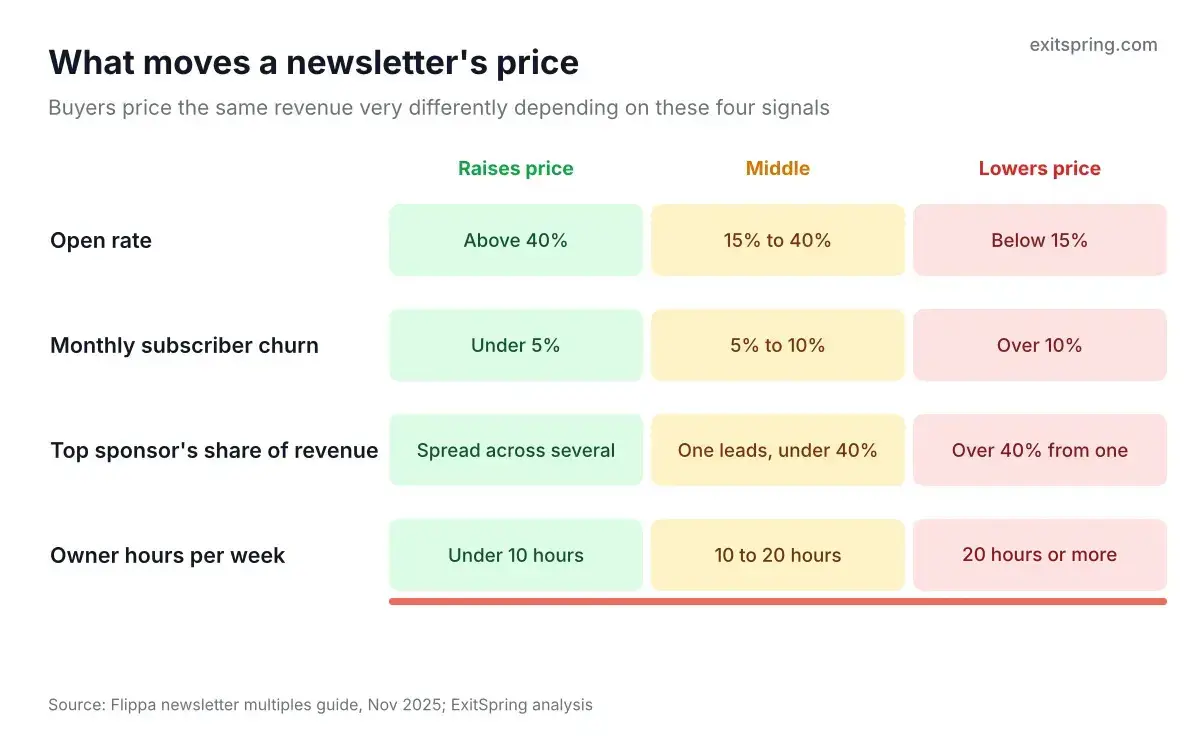
Below the million-subscriber brands, buyers are individuals, small media groups and operators with a few titles already. Flippa's November 2025 guide to newsletter multiples puts typical prices at 30 to 45 times monthly net profit, which is 2.5 to 3.75 times a year's profit, and at $1 to $10 per subscriber. Finance, crypto and enterprise software lists sit at the top of that per-subscriber range.
| What the buyer measures | Pushes the price up | Pulls the price down |
|---|---|---|
| Open rate | Above 40% | Below 15% |
| Monthly subscriber churn | Under 5% | Over 10% |
| Revenue from the biggest sponsor | Spread across several advertisers | More than 40% from one |
| Owner's time each week | Under 10 hours | 20 hours or more, often a writer who is also the brand |
Open rates have been unreliable since September 20, 2021, when Apple shipped Mail Privacy Protection with iOS 15. The feature loads tracking pixels whether or not the reader opens the email, and Apple clients accounted for 49.8% of email opens at the end of August that year, according to Litmus. A buyer who sees a 55% open rate is likely to ask for click rates by issue and the share of opens from Apple Mail. Mailchimp's own benchmark page, showing a 35.63% average open rate and 2.62% click rate across its users, carries the same warning.
For the method behind profit-based pricing, including which owner costs count as add-backs, see how to value an online business.
Paid subscribers change the arithmetic
Paramount's price works out to about $882 per paying reader of The Free Press. Sponsors can often leave on short notice. An annual subscriber has already paid for the year.
beehiiv published its State of Paid Newsletters 2026 in June, drawn from more than 2,500 newsletters on its platform. Press Gazette ran the main figures:
| Measure | beehiiv paid newsletters, 2026 |
|---|---|
| Median free-to-paid conversion | 0.62%, about six paying readers per 1,000 subscribers |
| Median price | $10 a month or $100 a year |
| Median price, investing newsletters | $27 a month |
| Monthly churn, sports newsletters | 7.76% |
| Monthly churn, AI newsletters | 13.33% |
Apply that to 30,000 subscribers: about 186 paying readers, or $22,320 a year at $10 a month. At the AI-newsletter churn rate, about 25 of them cancel each month. Buyers want the cohort report showing new sign-ups cover that.
Substack alone counted five million paid subscriptions in March 2025, up from four million about four months earlier, according to Tubefilter.
A 42,000-subscriber fintech newsletter, priced line by line
Take a hypothetical weekly newsletter on payments and banking software with 42,000 subscribers, a 38% open rate and 240 paying readers.
| Line | Monthly | Yearly |
|---|---|---|
| Sponsorship revenue, four advertisers | $5,600 | $67,200 |
| Paid tier, 240 readers at $10 | $2,400 | $28,800 |
| Total revenue | $8,000 | $96,000 |
| Platform, analytics and design tools | $400 | $4,800 |
| Freelance editor | $1,100 | $13,200 |
| Seller's discretionary earnings (SDE) | $6,500 | $78,000 |
At Flippa's 2.5 to 3.75 times annual profit, the range runs from $195,000 to $292,500. Divided by 42,000 subscribers, that is $4.64 to $6.96 each, inside the $1 to $10 band.
The biggest sponsor pays $3,600 a month, 45% of revenue and above the 40% line in the scorecard. Expect a buyer to model the first quarter without it and land nearer $195,000 to $234,000 (2.5 to 3.0 times).
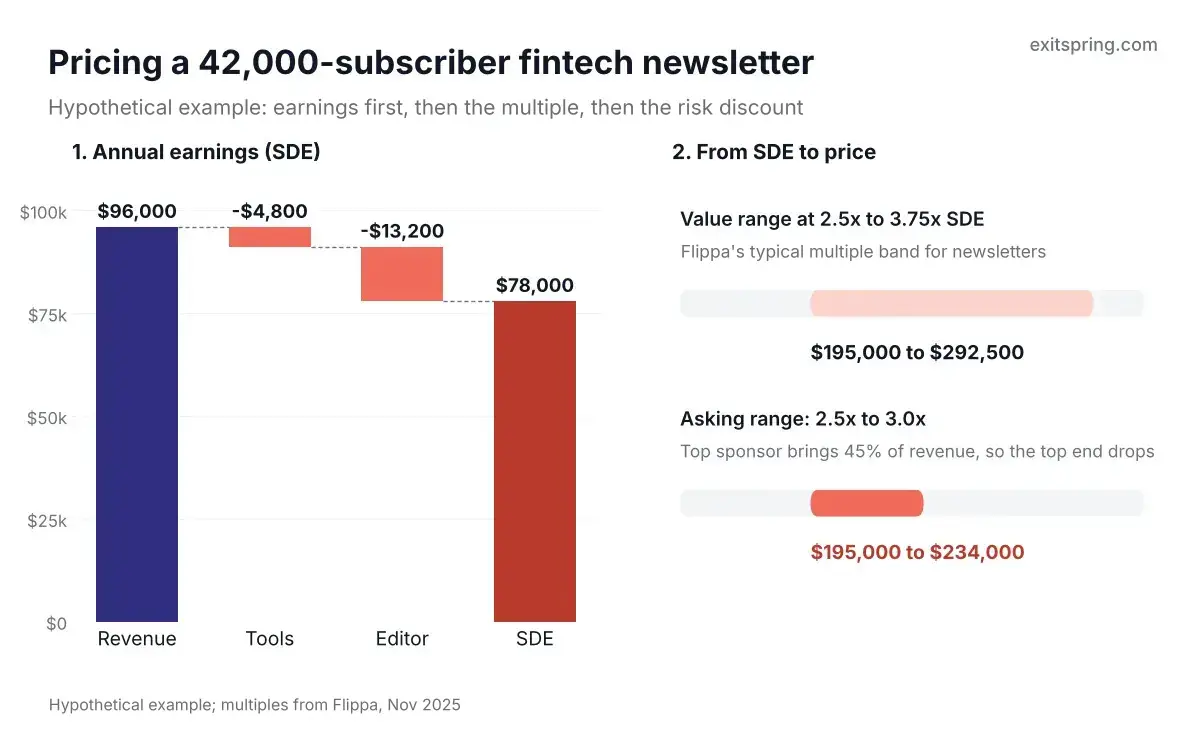
Signing a second large sponsor for six months before listing would bring the top sponsor's share under 40%. On $78,000 of profit, moving from 3.0 to 3.5 times is worth $39,000.
Moving the publication on each platform
| Platform | How ownership moves | What to check before closing |
|---|---|---|
| beehiiv | Request through support; both workspace Owners confirm in writing on one email thread | beehiiv confirms there are no unresolved paid subscriptions, Ad Network earnings or payouts first. The publication takes on the plan and limits of the buyer's workspace |
| Substack | Settings, then Danger Zone, then Transfer ownership; both sides confirm by email | The buyer's confirmation link expires after six hours. Substack requires a separate Stripe account for each publication |
| Kit (formerly ConvertKit) | The account owner changes the login email in Login Details | The Creator plan allows one team member; more need the Pro plan (formerly Creator Pro) |
| Ghost | Settings, then Staff, then Make owner | Only a staff user with the Administrator role can become owner |
| Mailchimp | The owner promotes an existing Admin to Owner | The new owner must already have accepted an Admin invite, and the old owner becomes an Admin |
Sources: beehiiv ownership transfer, Substack ownership transfer, Substack and Stripe, Kit team members, Ghost ownership and Mailchimp ownership.
Mailchimp's terms treat purchased and third-party lists as violations. Substack may hold an imported list for human review, normally within 72 hours. A buyer who exports 42,000 addresses to a CSV and uploads them to a new account can run into both, and loses the sending history and the archive on the way. Transferring the existing publication keeps all three.
Export a full copy of the list anyway, on the day before the transfer. beehiiv's export links expire after 24 hours and Kit's after five days, so save the files rather than the links.
Moving paid subscribers through Stripe
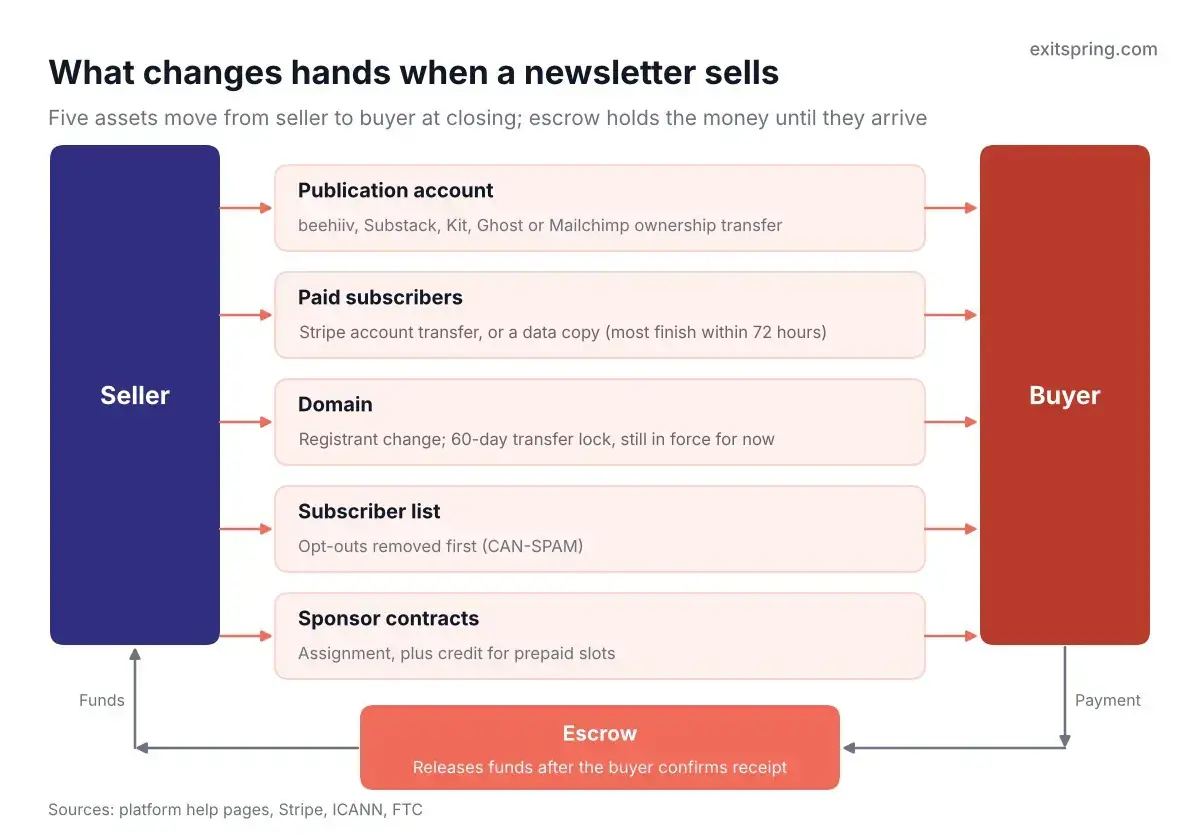
On beehiiv, Substack and Ghost, the card details and the billing schedule sit in the seller's Stripe account.
| Route | What happens | Where it fits |
|---|---|---|
| Transfer the Stripe account | The current owner makes the buyer an Administrator, then transfers ownership | A buyer in the same country taking over the seller's company or the whole account |
| Copy customer data to the buyer's Stripe | The seller shares customer and card data; the buyer's account authorizes and accepts; subscriptions are recreated on the buyer's side | A buyer abroad, or a buyer who wants a clean account. Stripe says a country can't be changed on an existing account |
Per Stripe's data copy guide, most copies finish within 72 hours, and under 10,000 customers usually takes a couple of hours. Only customer records and saved payment methods move. Charges, invoices, plans and subscriptions stay behind, so the buyer recreates the prices and each subscription, with a trial that ends on each reader's next billing date. Readers then get billed on their usual date.
On beehiiv, the paid subscriber import uses this same Stripe copy, and readers keep their current price. The seller then has to cancel billing on the old account. Skip that step and the 240 readers in the fintech example are charged twice the next month, by two different accounts.
Substack's transfer page doesn't say what happens to the Stripe account connected to the publication. Ask Substack support in writing before the deal closes, and keep the reply with the closing documents.
The domain carries a 60-day lock
Most newsletters send from their own domain, say letters.yourbrand.com, with the archive on yourbrand.com. ICANN's current Transfer Policy puts a 60-day lock on moving a domain to a new registrar after the registrant changes. Some registrars allow an opt-out, requested before the change. ICANN's Board adopted revised rules in June 2026 that drop this lock, but no effective date has been set, so the lock still applies for now.
The simplest route is usually for the buyer to become the registrant at the seller's registrar first, and to move registrars later if they want to. If the buyer insists on moving registrars at closing, the seller should ask for the opt-out before changing the registrant name.
Whether the list can legally go to the buyer
A newsletter's main asset is a list of email addresses, and in most countries those are personal data.
| Where subscribers live | What the rule says | What it means in a sale |
|---|---|---|
| United States (CAN-SPAM) | Once someone opts out, you can't sell or transfer their address, even as part of a mailing list. Every email needs a valid postal address, and opt-outs must be honored within 10 business days | Remove every unsubscribed address before handover. The FTC guide lists penalties of up to $53,088 for each email that breaks the rules |
| United Kingdom (PECR, ICO guidance) | Marketing consent must name the organisation sending the email, not "trusted partners". Consent that doesn't name you isn't valid | A signup form that named the publication, rather than the seller's company, may make the transfer easier to defend. Keep the publication name the same after the sale |
| European Union (GDPR) | A controller that receives personal data must tell people about it at the latest at the first communication. People can object to direct marketing at any time (Articles 14 and 21) | The buyer's first issue should say who now publishes the newsletter, link the new privacy notice and carry a working unsubscribe |
| Canada (CASL) | When a business is sold, the buyer is treated as having the seller's existing business relationship with its customers (section 10(12)) | This covers implied consent from paying customers, valid for two years from a purchase. Free subscribers rely on express consent, which the law doesn't expressly transfer |
| Germany (DSK resolution on asset deals, September 2024) | Email marketing by the buyer generally needs prior express consent under German unfair competition law (UWG section 7), and the existing-customer exception usually doesn't apply because the buyer didn't collect the address itself | Expect a German buyer or lawyer to ask how each address was collected and what consent was given |
Sources: FTC CAN-SPAM guide, ICO guidance on electronic mail marketing, ICO data sharing code on mergers and acquisitions, GDPR text, CASL and the DSK resolution PDF (in German). This is a summary of published rules, not legal advice.
These rules weren't written with newsletter sales in mind, so a list with many European readers is worth an hour with a data protection lawyer before signing.
Keeping the emails out of spam after the handover
Since February 2024, Gmail and Yahoo have required bulk senders to authenticate their mail and make unsubscribing easy. A newsletter that changes sending domain or platform at closing has to meet these rules from the first issue.
| Requirement | Gmail | Yahoo |
|---|---|---|
| Authentication | SPF or DKIM for all senders; SPF, DKIM and DMARC (a policy of p=none is enough) for senders of more than 5,000 messages a day | SPF and DKIM, plus DMARC of at least p=none |
| Unsubscribing | One-click unsubscribe and a visible link in marketing messages | One-click list-unsubscribe header; honor requests within two days |
| Spam complaints | Stay below 0.30%, ideally below 0.10% | Stay below 0.3% |
Sources: Google email sender guidelines and Yahoo sender best practices.
Keep the same From name, sending domain and send day for the first eight issues after the sale. A reader who gets "Payments Weekly" from a familiar address on a Tuesday is more likely to open it. The same issue from an unknown sender on a Friday is more likely to be reported. Rebrand gradually once the complaint rate has held steady for two months.
Sponsor contracts and prepaid bookings
A sponsor who has paid for six months of placements has a contract with the seller. Some of those contracts let the seller assign them to a buyer and some need the sponsor's written agreement. Read each one before the letter of intent, because a buyer will discount any revenue that can't move.
Say a sponsor paid $10,800 for 24 weekly placements from mid-August to the end of January, and the sale closes on October 1. Seventeen of those placements are still to run, so $7,650 of the cash covers issues the buyer will publish. The purchase agreement should credit that amount against the price at closing.
Introduce the buyer to the two or three largest sponsors before closing, on a call the seller sets up, and follow it with an email giving the buyer's name and the first issue they will publish.
Escrow, taxes and how long a sale takes
Newsletter sales often close through escrow. With Escrow.com, the buyer pays in, the seller hands over the publication, domain and Stripe data, and the money is released once the buyer confirms receipt. The fee percentage drops as the price rises, and the two sides can split it.
For a US seller, the IRS treats the sale of a business as a sale of each of its assets. Publication 544 says buyer and seller must use the residual method to split the price across asset classes, with goodwill and going concern value in the last class, and both must file Form 8594. A subscriber list is a customer-based intangible under section 197. How the gain is taxed depends on the seller's own situation, so agree the allocation with a tax adviser before the purchase agreement is signed.
From submission to a finished handover, a median online business sale takes about three and a half to five months, by our estimate from public marketplace listing data in how long it takes to sell an online business. A newsletter has no stock to count. The Stripe copy, the sponsor calls and the first issue under the new owner still have to fit into that window. Sellers outside the US should also read selling an online business from outside the US before choosing an escrow route.
Thirty days of preparation before you list
| Week | What to do | Why a buyer cares |
|---|---|---|
| 1 | Export 24 months of revenue by source: each sponsor, the paid tier, affiliate links | Shows which income survives a change of writer |
| 1 | Pull monthly subscriber growth, unsubscribes and click rates by issue | Clicks hold up against Apple Mail Privacy Protection, and opens don't |
| 2 | Check SPF, DKIM and DMARC on the sending domain, and the spam rate in Google Postmaster Tools | A buyer's first test is whether the newsletter lands in the inbox |
| 2 | List every sponsor contract with its end date and whether it can be assigned | A sponsor that can't move gets valued at zero |
| 3 | Write down every task you do each week and the hours it takes | Under 10 hours a week is what Flippa's guide links to premium multiples |
| 3 | Remove unsubscribed and bounced addresses, and keep the suppression file | CAN-SPAM bars transferring opted-out addresses |
| 4 | Ask your platform and Stripe how ownership moves for your account type, in writing | Answers in writing shorten the buyer's due diligence, and our due diligence checklist shows what else they will ask for |
To find out where your newsletter sits in the $1 to $10 per-subscriber range, send us your numbers for a valuation. We'll price it on its profit, its paid readers and its sponsor mix, and tell you which of the steps above would move the number most.
Sources
- Axios, Insider Inc. buys majority stake in Morning Brew, October 29, 2020
- Axios, HubSpot acquires The Hustle, February 3, 2021
- PitchBook, The Free Press acquired by Paramount Skydance, October 6, 2025
- Press Gazette, Informa buys Industry Dive, July 19, 2022
- MediaPost, Axel Springer assumes full ownership of Morning Brew, February 12, 2025
- MediaPost, Hunterbrook Media acquires The Bear Cave, June 30, 2026
- Nieman Lab, theSkimm acquired by Ziff Davis, March 20, 2025
- beehiiv, Milk Road case study
- Adweek, Morning Brew acquires Express Checkout, October 5, 2026
- Flippa, Newsletter channel multiples, November 24, 2025
- Press Gazette, beehiiv State of Paid Newsletters 2026, June 22, 2026
- Tubefilter, Substack passes five million paid subscriptions, March 12, 2025
- Litmus, Apple Mail Privacy Protection for marketers, September 20, 2021
- Mailchimp, Email marketing benchmarks
- Platform help pages: beehiiv, Substack, Kit, Ghost, Mailchimp
- Stripe, Copy customer and payment method data across accounts and Transferring a Stripe account to a buyer in another country
- ICANN, Transfer Policy and ICANN Board resolutions, June 7, 2026
- FTC, CAN-SPAM Act compliance guide
- ICO, Electronic mail marketing rules
- Government of Canada, Canada's Anti-Spam Legislation
- Datenschutzkonferenz (DSK), Resolution on asset deals PDF, September 11, 2024
- Google, Email sender guidelines and Yahoo, Sender best practices
- IRS, Publication 544 and About Form 8594
- Escrow.com, Fee calculator
Get new listings in your inbox
Fresh businesses for sale every Monday, plus practical buying and selling tips.
Unsubscribe anytime. No spam.
Keep reading

Ready to make a move?
Browse vetted online businesses or get a free valuation of yours.