
Taxes When Selling an Online Business: What Sellers Pay in 2026

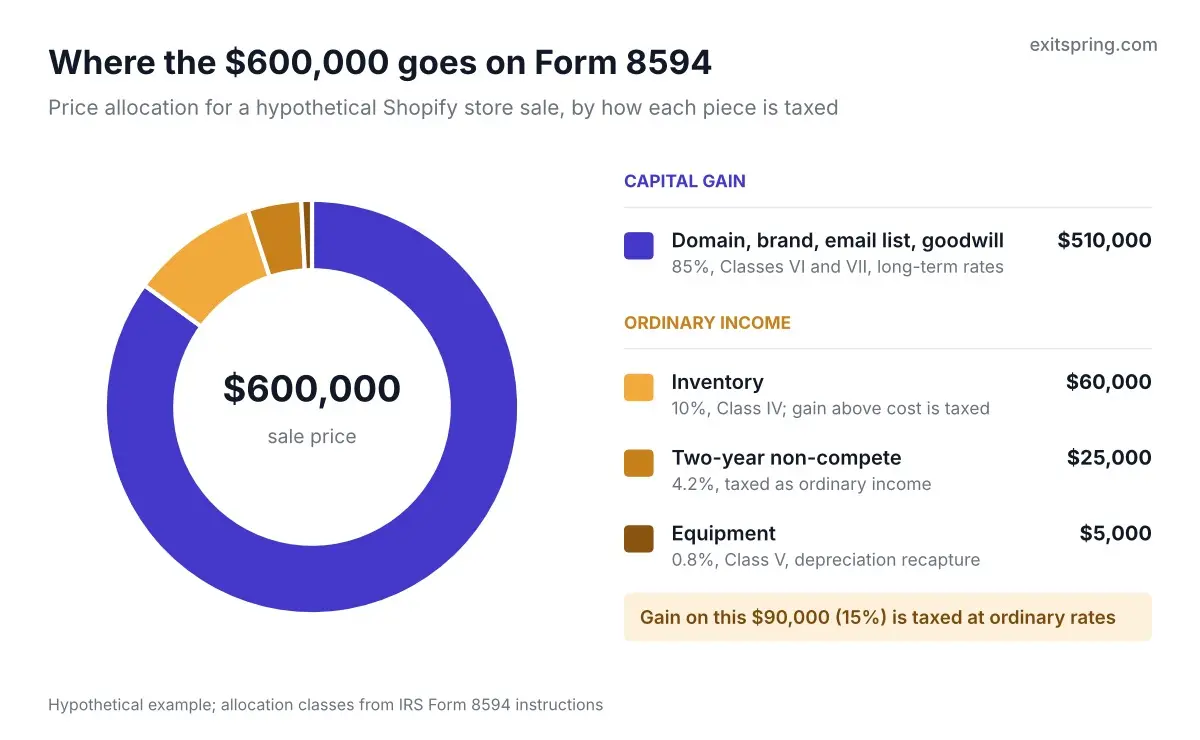
Take a hypothetical married couple in Texas who sell their Shopify store for $600,000 in 2026. With the price split as in the example below, they owe about $84,700 of federal income tax on the sale. Move the same couple to California and the state adds its own bill on top, because California charges the same rates on a capital gain as on wages.
Most of that $84,700 is decided before anyone signs. The legal form of the deal, the split of the price across asset classes, and when the money arrives each change what the seller keeps.
Most online business sales are taxed as asset sales
A buyer who pays for the assets gets to deduct the price over the following years. Under Section 197, goodwill, customer lists, trademarks and non-compete covenants bought in a sale are amortized evenly over 15 years. A buyer who takes over shares or membership interests inherits the seller's old tax basis, which for a bootstrapped store is close to zero.
| How the business is owned | What the IRS treats the sale as | Where the seller reports it |
|---|---|---|
| Sole proprietor, no entity | A sale of each business asset | Schedule D and Form 4797, plus Form 8594 |
| Single-member LLC (disregarded) | Also a sale of the assets, even if the paperwork transfers the LLC itself | Same as a sole proprietor |
| Multi-member LLC taxed as a partnership | Sellers sell partnership interests; a single buyer of all interests is treated as buying the assets (Rev. Rul. 99-6 PDF) | Schedule D; the share of the price tied to inventory can be taxed as ordinary income |
| S corporation | Asset sale by the company, or a share sale by the owners | Gain flows to owners on their K-1s |
| C corporation | Asset sale taxed at 21% inside the company, then again when cash is paid out | Form 1120, then the owners' returns |
Hall Render put the single-member LLC rule plainly in April 2026: buying 100% of a disregarded LLC is not respected as a purchase of equity for tax purposes. The seller of a one-owner Amazon FBA brand held in a Wyoming LLC files as if the inventory, the brand and the listings were sold one by one.
Form 8594 splits the price into seven classes
Buyer and seller each attach Form 8594 to their return for the year of sale. The IRS calls it the residual method: cash first, then each class in order at no more than its market value, and whatever is left becomes goodwill.
| Class | What it holds in an online business | How the seller is taxed on it |
|---|---|---|
| I | Cash in the business bank account | No gain |
| II and III | Payout balances held by Amazon or Shopify, receivables | Usually little or no gain |
| IV | Inventory in a warehouse or at Amazon | Ordinary income on any amount above cost |
| V | Laptops, cameras, packing equipment | Ordinary income up to past depreciation (section 1245 recapture) |
| VI | Domain, content, email list, trademarks, supplier contracts, the non-compete | Mostly capital gain; the non-compete, and content the seller wrote personally (section 1221), are ordinary income |
| VII | Goodwill and going concern value | Long-term capital gain if held more than a year |
The class VI and VII rows matter most for digital businesses. A content site with $14,000 of cameras and a website has almost nothing in classes I to V, so close to all of a $400,000 price lands in the bottom two rows. An FBA brand sold with $90,000 of stock at Amazon has a large class IV figure taxed at ordinary rates, which buyers and sellers often agree at landed cost.
A $6,000 editing rig expensed under Section 179 and sold with the store for $5,000 produces $5,000 of ordinary income under section 1245.
A hypothetical Texas couple's $600,000 store sale: $84,665 of federal income tax
| The example | Figure |
|---|---|
| Sellers | Married couple filing jointly, living in Texas |
| Business | Shopify store selling outdoor gear, held in a single-member LLC |
| Other income in 2026 | $120,000 |
| Sale price | $600,000 |
| 2026 standard deduction, joint filers (Rev. Proc. 2025-32 PDF) | $32,200 |
| 0% rate on long-term gains ends at | $98,900 of taxable income |
| 20% rate on long-term gains starts above | $613,700 of taxable income |
| Item | Price allocated | Seller's basis | Gain | How it is taxed |
|---|---|---|---|---|
| Inventory | $60,000 | $52,000 | $8,000 | Ordinary income |
| Equipment, fully depreciated | $5,000 | $0 | $5,000 | Ordinary income (recapture) |
| Two-year non-compete | $25,000 | $0 | $25,000 | Ordinary income |
| Domain, brand, email list, goodwill | $510,000 | $0 | $510,000 | Long-term capital gain |
| Total | $600,000 | $52,000 | $548,000 |
| Step | Amount |
|---|---|
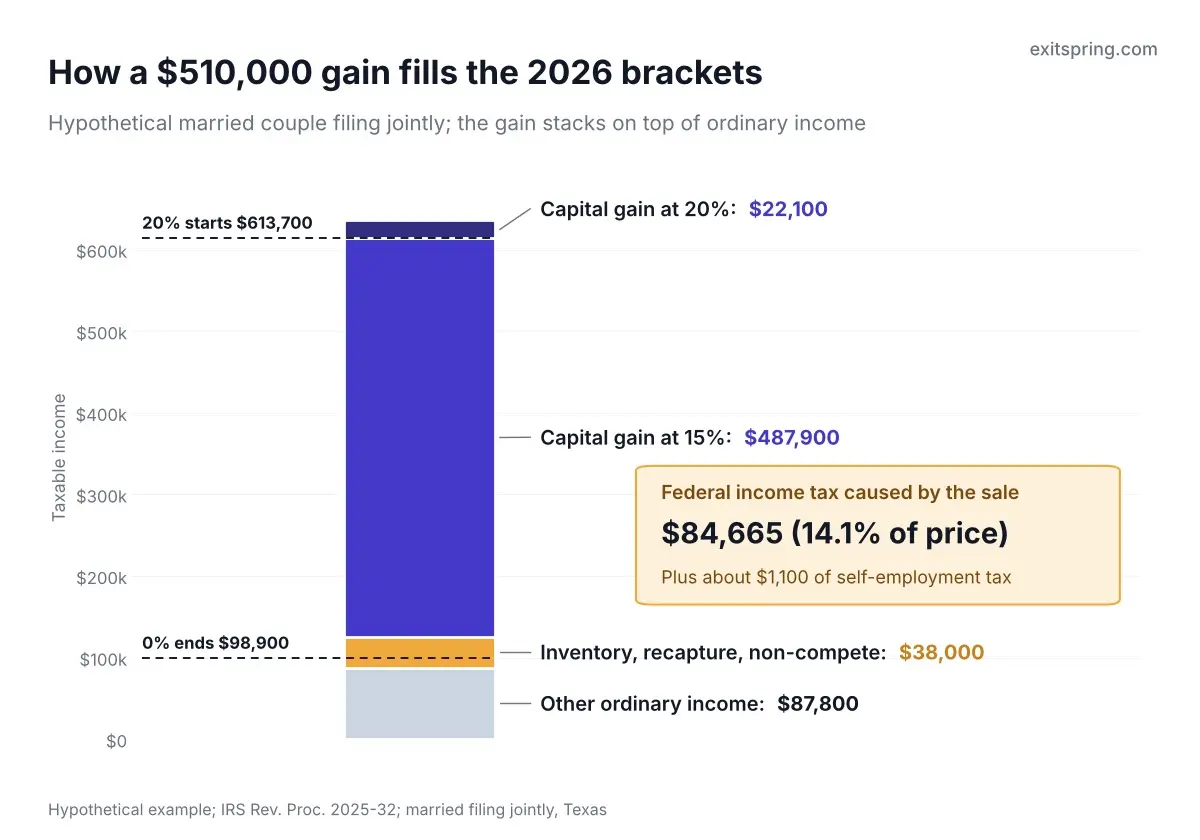
| Ordinary taxable income without the sale ($120,000 minus $32,200) | $87,800 |
| Ordinary taxable income with inventory, recapture and non-compete added | $125,800 |
| Extra ordinary income tax caused by the sale | $7,060 |
| Capital gain taxed at 15% ($125,800 up to $613,700) | $487,900, tax $73,185 |
| Capital gain taxed at 20% (above $613,700) | $22,100, tax $4,420 |
| Federal income tax caused by the sale | $84,665 |
| Share of the $600,000 price | 14.1% |
Texas has no personal income tax. The one other federal cost is self-employment tax on the $8,000 inventory gain, about $1,100, because gain on inventory counts as self-employment income for a sole owner (section 1402). The couple ran the store themselves, which keeps the gain outside the 3.8% net investment income tax. Section 1411 excludes gain on property held in a business where the owner is not passive, and the IRS Q&A on that tax treats operating income from such a business the same way.
Change one fact. If a hired manager had run the store and the couple had been passive owners, the 3.8% would apply to the part of their income above $250,000. That adds roughly $15,900 to the same sale.
The non-compete and the consulting contract are taxed at higher rates
Buyers like a non-compete, and they can amortize it over 15 years whatever its length. For the seller, payment for a non-compete is ordinary income, as The Tax Adviser explains. In the example, the $25,000 allocated to the non-compete is taxed at 22%. The same $25,000 left in goodwill would have been taxed at 15% or 20%.
| Term in the purchase agreement | What the buyer gets | What it costs the seller in tax |
|---|---|---|
| $25,000 non-compete for two years | A 15-year deduction | Taxed at ordinary rates (22% here) instead of 15% |
| $18,000 consulting fee over six months | A current business deduction | Ordinary rates plus self-employment tax |
| Earnout paid only if the founder stays 12 months | A cheaper upfront price | Risk of the earnout being treated as wages, judged partly against a normal salary (RSM) |
| Earnout tied to revenue, payable whether or not the founder stays | A cheaper upfront price | Usually more of the price, taxed as capital gain |
Seller financing could save the same couple about $6,100
Under section 453, a seller who receives part of the price in later years can usually report the gain as the cash arrives, on Form 6252. Two limits catch online sellers. Depreciation recapture is taxed in the year of sale even if no cash has been received, and inventory can't use the installment method at all.
Say the Texas couple takes $360,000 of the goodwill payment at closing and a $150,000 note paid in three yearly instalments of $50,000. The figures for 2027 to 2029 assume the same $120,000 of other income and 2026 brackets.
| Year | Capital gain reported | Federal tax on it |
|---|---|---|
| 2026 (closing year) | $360,000 | $54,000, all at 15% |
| 2027 | $50,000 | $5,835; the first $11,100 falls in the 0% band |
| 2028 | $50,000 | $5,835 |
| 2029 | $50,000 | $5,835 |
| Total | $510,000 | $71,505 |
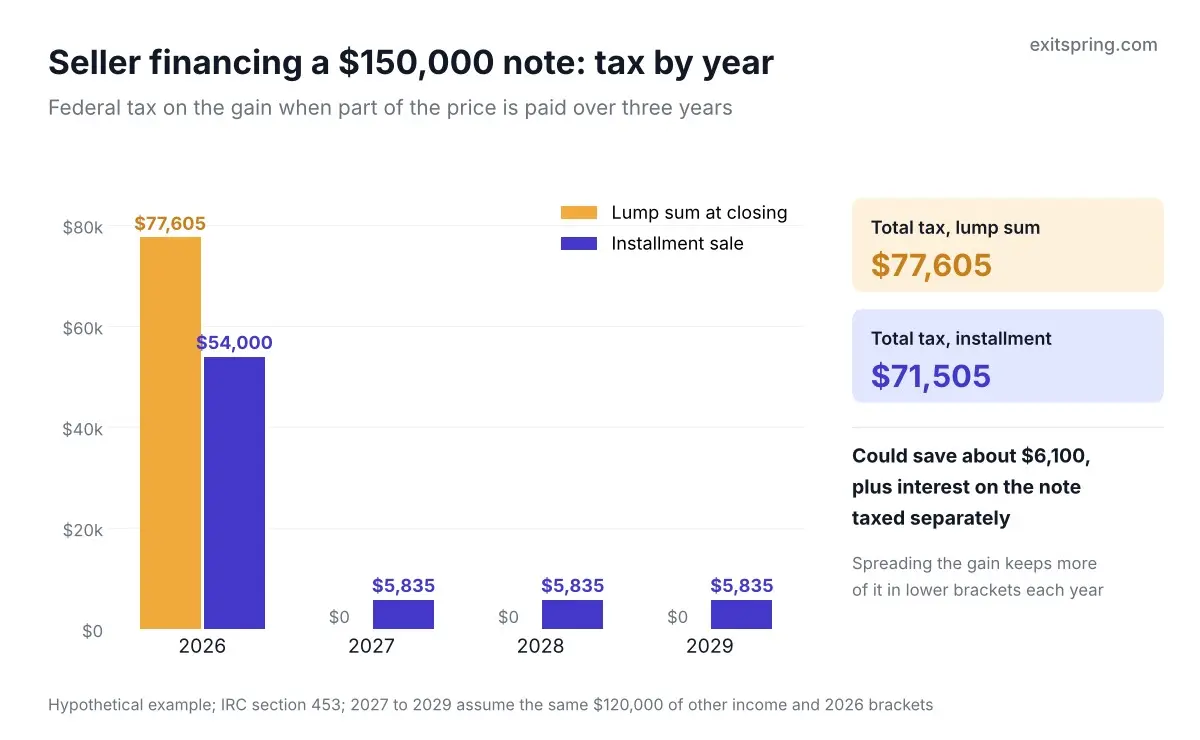
Paid in full at closing, the same gain cost $77,605. Spreading it keeps all of it out of the 20% band and lets part use the 0% band in later years, for a saving of about $6,100. Interest on the note is taxed separately as ordinary income.
| Rule | When it applies | Effect |
|---|---|---|
| Section 453A | More than $5 million of installment notes outstanding at year end | Interest charged on the deferred tax |
| Treas. Reg. 15a.453-1(c) | Earnouts with no fixed price | Basis spread over the earnout period, or over 15 years with no stated maximum or term |
| Buyer default | The buyer stops paying the note | Gain already taxed on received payments stays taxed; the seller chases the rest |
A C corporation can lose almost 40% of the gain
A C corporation that sells a store's assets owes 21% on the gain first (section 11). Paying the remaining 79% out to the owner as a dividend can add 20% plus 3.8%. On the top rates, that is about 39.8% of the gain in two layers of tax.
Buyers of small online businesses often avoid buying C corporation stock, because they inherit the company's history and its low basis. A founder who incorporated a SaaS company as a Delaware C corporation on a lawyer's advice in 2021 may end up negotiating over this gap. S corporations that converted from C corporations face a built-in gains tax on assets sold within five years of the conversion.
| C corporation shares issued after July 4, 2025, held for | Gain excluded under the One Big Beautiful Bill Act (Cooley) |
|---|---|
| 3 years | 50% |
| 4 years | 75% |
| 5 years or more | 100%, up to the greater of $15 million or ten times basis |
| Store run as an LLC | Not eligible |
State tax ranges from zero to 13.3%
| State | How it taxes the gain | Source |
|---|---|---|
| Alaska, Florida, Nevada, New Hampshire, South Dakota, Tennessee, Texas, Wyoming | No personal income tax | Tax Foundation, February 2026 |
| California | All capital gains taxed as ordinary income, top rate 13.3% | California FTB |
| Washington | 7% on long-term gains above a standard deduction ($278,000 in 2025), 9.9% on the part above $1 million | RCW 82.87.040, Washington DOR |
| Washington, family business deduction | Sales of at least 90% of a business owned five years or more, run by the seller in at least five of the last ten years, with about $10 million or less of revenue (adjusted for inflation), can be deducted | RCW 82.87.070 |
A move to Florida a month before closing does not reliably cut the bill. The state being left can still tax income from a business carried on there, and it decides for itself whether the move was real (California FTB Publication 1100).
Unpaid sales tax can follow the store to the buyer
LBMC noted in July 2026 that many states can collect a seller's unpaid sales and use tax from the buyer of the business assets.
Since the Supreme Court's decision in South Dakota v. Wayfair on June 21, 2018, states can require online sellers with no physical presence to collect sales tax once they pass a sales threshold. All 45 states with a statewide sales tax, plus Washington, DC, also make marketplaces collect the tax on orders placed through them, according to TaxCloud.
| Where the orders come from | Who collects the sales tax | What a buyer's accountant checks |
|---|---|---|
| Amazon, Walmart Marketplace, Etsy, eBay | The marketplace, in every state with a sales tax | Little to check for those orders |
| Your own Shopify or WooCommerce checkout | You, in each state where your sales passed its threshold | Which thresholds you crossed, and when you registered |
| Subscriptions and digital downloads | You, in states that tax digital goods | Whether your products are taxable in those states |
| Wholesale orders to retailers | Nobody, if you hold the retailer's resale certificate | That the certificates are on file |
A Shopify store with $1.4 million of direct sales across the US has probably passed $100,000 in several states. If it never registered, the buyer will ask for an escrow holdback or a voluntary disclosure filed before closing. Either one comes out of the seller's proceeds.
Sellers outside the US face a different set of rules
Many sellers outside the United States hold their Shopify or Amazon account through a US LLC. For a foreign owner, IRS Publication 519 sources the gain asset by asset: inventory where it is sold, goodwill in the country where the goodwill was generated, other intangibles generally by the seller's tax home, and any sale tied to a US office or fixed place of business to the US. A UK founder with a Wyoming LLC, no US staff and no US office pays tax at home, but should not assume the US takes nothing: stock held in US warehouses and goodwill built with US customers can still raise US tax questions, so the sale needs a cross-border adviser before signing.
Multi-member LLCs are different. When a foreign partner sells an interest in a partnership engaged in a US trade or business, the buyer generally must withhold 10% of the amount realized under section 1446(f), unless an exception applies (IRS partnership withholding page). Our guide to selling an online business from outside the US covers banking and escrow for these sellers.
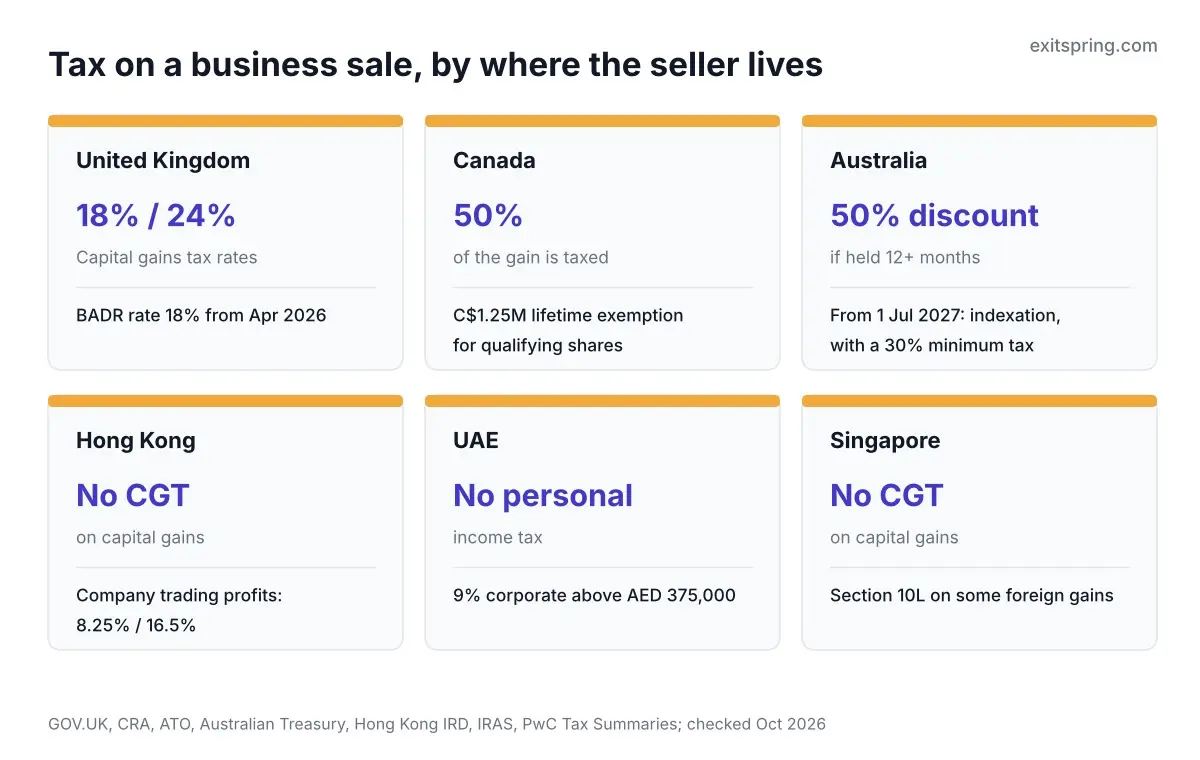
| Where the seller lives | Headline rate on the gain | Rule worth knowing in 2026 |
|---|---|---|
| United Kingdom | 18% within the basic rate band, 24% above (GOV.UK) | Business Asset Disposal Relief rose to 18% from April 6, 2026, with a £1 million lifetime limit (GOV.UK) |
| Canada | Half of the gain is taxed at the seller's normal rate | The plan to raise the inclusion rate to two-thirds was cancelled on March 21, 2025 (Prime Minister of Canada); qualifying small business shares can use a $1.25 million lifetime exemption |
| Australia | Half of the gain is taxed if the asset was held 12 months or more (ATO) | From July 1, 2027, indexation of the cost base replaces the 50% discount for gains accrued after that date, with a 30% minimum tax on those gains (Treasury; Treasury Laws Amendment (Tax Reform No. 1) Act 2026) |
| Hong Kong | No capital gains tax; trading profits pay 8.25% on the first HK$2 million and 16.5% above for companies (IRD) | Whether a sale is capital or trading depends on the facts, such as how long the business was held |
| United Arab Emirates | No personal income tax | Companies pay 9% corporate tax on profits above AED 375,000 |
| Singapore | No capital gains tax | Gains on foreign assets can be taxed under Section 10L for groups without economic substance in Singapore (IRAS PDF) |
An Australian founder deciding between a sale in June 2027 and one in August 2027 is choosing between two different tax systems. Gains that built up before July 1, 2027 keep the 50% discount under the new law, but the calculation after that date is more complicated.
Five mistakes that raise the bill
| Mistake | What happens | Example |
|---|---|---|
| Letting the buyer write the allocation alone | More of the price lands in ordinary-income rows | A buyer's draft puts $80,000 in a non-compete on a $500,000 deal |
| Selling late in the year without paying estimated tax on the gain | A possible underpayment penalty on top of the tax | A sale closing on December 18 with nothing paid on the gain by January 15 |
| Forgetting depreciation already claimed | Recapture taxed at ordinary rates in the year of sale, even on a note | A $12,000 inventory system expensed in 2024 and sold with the store |
| Ignoring state nexus on direct sales | A holdback from the price at closing | $35,000 held in escrow until state filings are cleared |
| Converting to a C corporation shortly before selling | Two layers of tax on an asset sale | A founder who incorporated in Delaware to raise money that never came |
What to do before, during and after the sale
| When | What to do | Example |
|---|---|---|
| Six months before listing | Ask an accountant to model the sale under your entity type and state | A Delaware C corporation owner learns the asset sale costs two layers of tax and prices that into the asking range |
| At the letter of intent | Agree the split between inventory, non-compete, consulting and goodwill | The Texas couple keeps the non-compete at $25,000 instead of the buyer's opening ask of $60,000 |
| At the letter of intent | Decide how much of the price can be paid later and how the note is secured | A $150,000 note with a personal guarantee from the buyer |
| At closing | Sign the allocation schedule into the purchase agreement | Both sides file Form 8594 with the same figures |
| In the quarter after closing | Pay estimated tax on the gain | Paying at least 110% of last year's tax through withholding and on-time installments avoids the penalty for anyone with prior AGI above $150,000 (section 6654) |
| With the next tax return | File Form 8594, Form 4797, Schedule D and, for seller financing, Form 6252 | A supplemental Form 8594 for the year an earnout pays; increases go from Class I upward, decreases come off Class VII first |
A sale that closes late in the year still needs its estimated tax paid by January 15. The annualized method on Form 2210, described on IRS Topic 306, lets a seller match the estimated tax to the period the gain arrived in instead of paying it evenly across the year.
The buyer will ask for the same tax returns during due diligence; our due diligence checklist lists what goes in the data room. Asking prices, and so the size of the tax bill, come from the profit multiple described in how to value an online business.
This article summarizes published rules as of October 2026 and is not tax advice. A sale large enough to matter is worth a few hours with a CPA who has handled business sales.
To see what your business would sell for before you work out the tax on it, request a free valuation.
Sources
- IRS, Instructions for Form 8594, revised November 2021, page reviewed April 30, 2026
- IRS, Rev. Proc. 2025-32 PDF and IR-2025-103, October 9, 2025
- IRS, Questions and answers on the net investment income tax
- IRS, Rev. Rul. 99-6 PDF
- IRS, Publication 519 and Partnership withholding
- IRS, Topic 306, Penalty for underpayment of estimated tax
- Internal Revenue Code via Cornell LII: section 11, 197, 453, 453A, 1221, 1245, 1374, 1402, 1411, 6654, and Treas. Reg. 15a.453-1
- Hall Render, Equity transaction or asset transaction?, April 24, 2026
- The Tax Adviser, Tax issues related to noncompete agreements, May 1, 2021
- RSM, Earn-outs with continued employment, March 23, 2019
- Cooley, The One Big Beautiful Bill Act expands QSBS benefits, July 11, 2025
- Tax Foundation, State income tax rates 2026, February 17, 2026
- California Franchise Tax Board, Capital gains and losses and Publication 1100
- Washington State Legislature, RCW 82.87.040 and RCW 82.87.070; Washington DOR, Capital gains tax
- LBMC, Tax successor liability for asset acquisitions, July 8, 2026
- South Dakota v. Wayfair, Inc., 585 U.S. 162 (via Cornell LII), June 21, 2018
- TaxCloud, Marketplace facilitator laws: multi-channel seller guide, September 22, 2026
- GOV.UK, Capital Gains Tax rates and Business Asset Disposal Relief
- Prime Minister of Canada, Cancellation of the capital gains tax increase, March 21, 2025
- Australian Taxation Office, CGT discount and Treasury, small business explainer, June 18, 2026; Treasury Laws Amendment (Tax Reform No. 1) Act 2026, Act No. 49 of 2026
- Hong Kong Inland Revenue Department, Profits Tax
- IRAS, Tax treatment of gains or losses from the sale of foreign assets PDF
Get new listings in your inbox
Fresh businesses for sale every Monday, plus practical buying and selling tips.
Unsubscribe anytime. No spam.
Keep reading



Ready to make a move?
Browse vetted online businesses or get a free valuation of yours.