
How to Sell a Shopify Store: Valuation, Transfer and Every Account That Moves (2026)
Shopify's help page on transferring store ownership puts it plainly: owners "must independently conduct all sales of their Shopify stores separately from the Shopify platform." The platform hands over the admin with one email. Finding the buyer, agreeing the price and moving the money all happen somewhere else.
Take a store selling glazed ceramic planters and plant-care kits. In the twelve months before she listed it, the store took $1,140,000 in revenue and left its owner $180,000 of seller's discretionary earnings (SDE). She works about 20 hours a week on it, holds about $73,000 of stock at cost and runs everything on the Grow plan. The store is a composite we built for this guide, and every figure about it below belongs to that composite.
Shopify stores on one large marketplace asked a median 2.42x profit
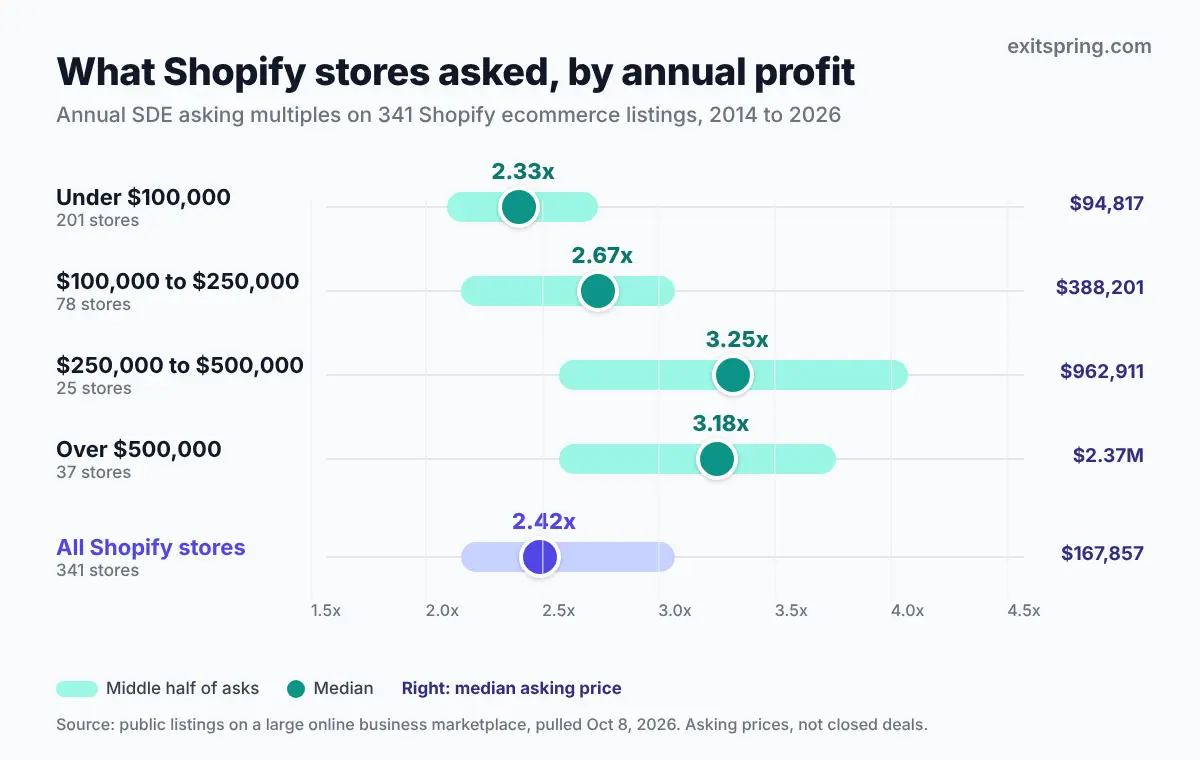
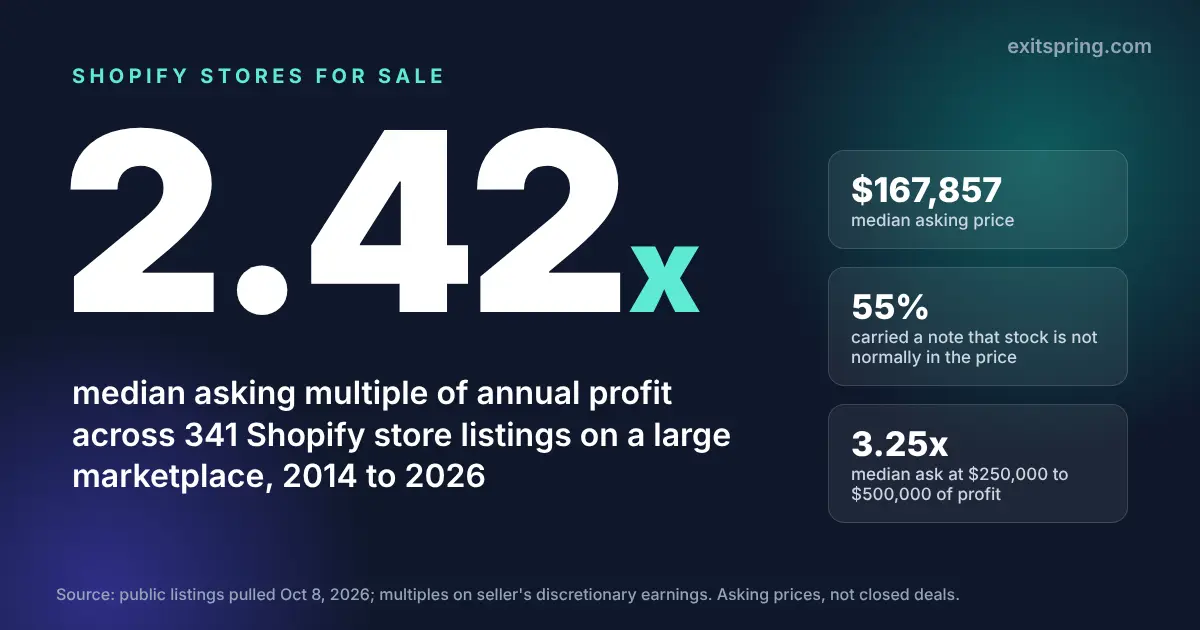
On October 8, 2026 we pulled 2,855 public listings from one of the largest online business marketplaces, most of them already sold and dating back to 2014. We kept the 341 ecommerce listings that run on, or include, a Shopify store. All are priced on SDE, and 340 carry a price, so the medians use those. These are asking multiples, and none of the 341 is a closing price.
| Annual SDE | Stores | Median asking multiple | Middle half of asks | Median asking price |
|---|---|---|---|---|
| Under $100,000 | 201 | 2.33x | 2.02x to 2.67x | $94,817 |
| $100,000 to $250,000 | 78 | 2.67x | 2.09x to 3.00x | $388,201 |
| $250,000 to $500,000 | 25 | 3.25x | 2.50x to 4.00x | $962,911 |
| Over $500,000 | 37 | 3.18x | 2.50x to 3.69x | $2,370,120 |
| All Shopify stores | 341 | 2.42x | 2.08x to 3.00x | $167,857 |
Of those 341 stores, 155 also sell through Amazon FBA. The 186 with no FBA channel asked a median 2.33x, a little under the 2.67x asked by the 797 FBA businesses in the same file. Small stores pull that figure down: 129 of the 186 make under $100,000 a year.
Flippa's 2026 Shopify valuation guide puts the average ecommerce profit multiple at 1.55x, with top-quartile businesses at 2.75x.
| Figure | What it counts | How we read it |
|---|---|---|
| 2.42x median | Asking prices on 341 Shopify listings from 2014 to 2026 | Where sellers opened, before any negotiation |
| 1.55x average | Flippa's sold ecommerce deals, first half of 2026 | Closed deals rather than asks, and a mean rather than a median |
| 2.75x top quartile | The best quarter of the same Flippa set | Closer to what a clean $180,000 store can argue for |
For the method behind these numbers, our guide to how to value an online business works through SDE line by line, and multiples by business type compares ecommerce with content, SaaS and Amazon.
The planter store prices at $441,000 plus $64,000 of stock
At $180,000 of SDE, the store sits in the $100,000 to $250,000 band, where the median ask was 2.67x. Two things pull it below that. Meta ads drive 22% of revenue, and every glazed pot comes from a single workshop in northern Portugal. Two things hold it up: 31% of orders come from repeat customers, and a 48,000-person Klaviyo list brings in 18% of sales.
| Step | Figure | Basis |
|---|---|---|
| Trailing SDE | $180,000 | Profit plus her $52,000 salary, a $6,000 car lease and $3,400 of one-off legal fees |
| Buyer's first offer | 2.3x, $414,000 | Ad dependence and one supplier |
| Her counter | 2.5x, $450,000 | Repeat rate and list revenue |
| Agreed multiple | 2.45x, $441,000 | Split once the buyer saw the supplier's signed 12-month price letter |
| Stock at landed cost | $64,000 | Counted in closing week, before escrow was funded |
| Total at closing | $505,000 | Paid through escrow |
In the same listing file, 187 of the 341 Shopify stores, or 55%, carry the marketplace's standard note that "inventory is not normally included in the list price." Buyers usually pay for it separately, typically at landed cost after a count both sides sign.

The count happens in closing week, before the buyer funds escrow. Between signing and closing she sold planters that had cost her $9,000 to land, so the stock figure fell from $73,000 to $64,000. The purchase agreement priced stock at the closing count.
Ninety days of preparation before listing
Most of what slows a Shopify sale can be fixed before a buyer ever sees the store. She started three months before the first buyer call.
| When | Action | On the planter store |
|---|---|---|
| Day 1 | Move the store email and Shopify login off a personal Gmail | A new orders@ address on the store's own domain |
| Week 1 | Cancel apps nobody uses | 23 apps down to 14; the monthly app bill fell from $1,460 to $1,050 |
| Week 2 | Put the Meta assets in a portfolio that holds nothing else | Her side-project Page moved out, so handing over the portfolio hands over only the store |
| Week 3 | Export billing, payout and transaction history | Three CSVs, which Shopify's transfer preparations suggest keeping |
| Month 2 | Get supplier terms in writing | The Portuguese workshop signed a one-page price letter |
| Month 2 | Repay Shopify Capital | The last $6,200 cleared before listing |
| Month 3 | Write down the weekly routine | An 11-page document covering restocks, ad checks and customer emails |
The app cut saves $4,920 a year. Once a full year of it shows in the trailing numbers, or the buyer accepts it as an adjustment, 2.45x turns it into about $12,000 of price for an afternoon's work.
What a buyer checks inside Shopify before signing
On the Basic plan a store has no staff accounts at all. Shopify's user limits page says users are available only on Grow and higher, with up to 5 on Grow, 15 on Advanced and unlimited on Plus. A buyer looking at a Basic store either joins a screen share or asks for collaborator access, which needs a Shopify Partner account and does not count toward the limit.
For the planter store on Grow, she added the buyer as a staff user with these store permissions and nothing else.
| Permission | What the buyer saw | What he checked |
|---|---|---|
| Home | Sales on the home page | Twelve months of revenue against the P&L |
| Orders: View | Every order since 2021 | Refund rate by product, 4.1% overall |
| Products: View cost | Unit costs | Gross margin on the top 20 SKUs |
| Analytics: Reports | All reports | Returning-customer rate and sales by channel |
| Finance: View payouts | Payout summaries | Deposits matched to her bank statements |
| Gift cards: View | Open balances | $3,850 of unredeemed cards, a liability he inherits |
She left off Approve app charges and the billing permissions, and kept back Request customer data, which Shopify lists among its sensitive permissions along with editing billing payment methods. The rest of the buyer's list, from supplier contracts to ad history, follows our due diligence checklist.
Shopify's transfer is one email; the blockers come before it
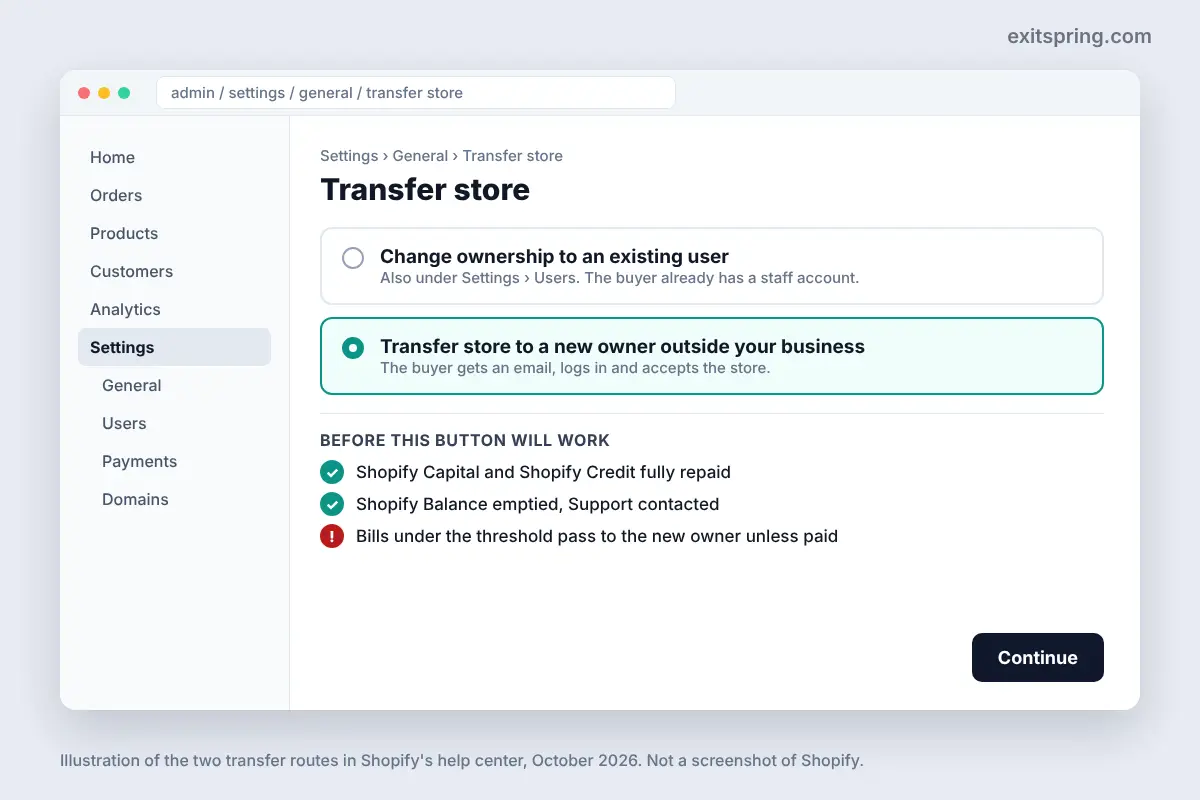
Only the current owner can start a transfer, and a store has one owner at a time. Shopify's change or transfer ownership page gives two routes on non-Plus plans.
| Route | Where | When to use it |
|---|---|---|
| Change ownership to an existing user | Settings > Users | The buyer already has a staff account, as on the planter store |
| Transfer to someone outside the store | Settings > General > Transfer store > Manage | Basic-plan stores, or a buyer you never added as staff |
On the Settings > General route, the buyer gets an email, clicks Get started, logs in and accepts the store, and Shopify then emails the seller. The transfer can be cancelled only while it is still pending.
Two things stop it outright and a third passes a cost to the buyer. All three need sorting weeks before closing.
| Issue | Shopify's rule | On the planter store |
|---|---|---|
| Shopify Capital or Shopify Credit | The store can't be transferred while either is in use | A $40,000 Capital advance, repaid from sales; she cleared the last $6,200 in August |
| Shopify Balance | The account must be emptied and Support contacted | Not used |
| Unpaid bills | Any bill under the threshold passes to the new owner | $212 of app charges; she paid it and took the invoice |
Collaborators can't receive ownership at all. A buyer who only ever had collaborator access goes through the Settings > General route.
Once the buyer accepts, Shopify removes her owner permissions. Staff keep their store permissions, so the freelancer who edits product photos stays on, and the buyer decides later whether to remove her.
Shopify Payments doesn't move with the keys
Shopify Payments sits on top of the store under its own terms. Those terms require the account holder to notify Shopify within three days of any change in control or ownership, or any sale of 25% or more of total assets. The account can't be assigned without Shopify's written consent.
In practice, the buyer's business details replace the seller's through Shopify Support. Shopify's Payments settings page says a change of legal entity name, tax ID or business type creates a new legal entity on the account.
| What changes | What Shopify does | What we'd put in the agreement |
|---|---|---|
| Bank account | Pauses payouts for 3 to 5 business days after an edit | A revenue cut-off at midnight on closing day |
| Payouts already scheduled | Sends them to the old bank account | Those payouts belong to the seller, or the agreement says otherwise |
| Editing banking details | The editor must verify the old bank account first | The seller stays on a call to supply it |
| Reserves | Held against chargebacks, refunds and disputes; can't be assigned | Reserved funds settled between the parties at release |
| Chargebacks on old orders | Recovered from the account holder | The seller refunds the buyer for disputes on pre-closing orders, capped at 90 days |
Shopify Payments runs in 41 supported countries, and South Africa, India and Nigeria aren't among them. A Johannesburg company buying the planter store would switch checkout to a third-party provider and run live test orders during the inspection week. For a seller based abroad, the escrow and payout side is in our guide to selling an online business from outside the US.
Accounts that live outside Shopify
Facebook ads, the email platform, the merchant feed and the domain registration all sit outside the Shopify transfer, each with a rule of its own.
| Account | Can ownership change? | What the planter store did |
|---|---|---|
| Meta ad account | No; it stays in the business portfolio that owns it | She added the buyer to the whole portfolio with full access, then removed herself |
| Meta Pixel (dataset) | No; it can be shared with a partner's portfolio | Stayed inside the portfolio, so no sharing was needed |
| Facebook Page and Instagram | The seller removes them from her portfolio and the buyer adds them | Not needed once the portfolio changed hands |
| Klaviyo | Yes, by the current Owner only | Buyer added as Admin, made Owner; she dropped to Admin and left |
| Google Ads and Merchant Center | Yes, via admin access then removal | She checked the site verification wasn't tied to her login first |
| PayPal | No assignment without PayPal's written consent | The buyer connected his own business account |
| Domain | Ownership has to be transferred to the buyer | Handed over inside Shopify on closing day |
| Theme | The license stays with the store it was bought for | Stayed put; it can't be copied to the buyer's other store |
| Reviews app | The data stays with the app on the store | 2,140 Judge.me reviews, exported to CSV as a backup |
The domain has a trap. If the buyer later moves a .com to another registrar, Shopify's domain page says it can't go for 60 days after a change of contact details. Updating the contact info on closing day starts that clock. Imported reviews can lose their verified badge; Judge.me, for one, says imported reviews won't be verified. A buyer who plans to switch apps should expect the 2,140 reviews to look different afterwards.
Trademark, customer list and sales tax
The brand name was registered at the USPTO. Assigning it to the buyer's company goes through the USPTO's Assignment Center, and the fee schedule charges $40 to record the first mark on a document and $25 for each further mark. Had the mark still been an intent-to-use application, 15 U.S.C. § 1060 would bar assigning it before an amendment to allege use or a statement of use is filed, unless it went to a successor to the ongoing business.
The 48,000 Klaviyo contacts and 21,000 Shopify customer records go with the business. For businesses large enough to be covered, California's privacy law says that is not a "sale" of personal information when it moves as part of an acquisition, but the buyer has to honor existing opt-outs and give notice before using the data in a way materially inconsistent with what customers were promised (Cal. Civ. Code §§ 1798.120(a)(2) and 1798.140(ad)(2)(C) PDF). The FTC went further in May 2015, urging that any buyer of RadioShack's customer data honor its privacy policy and get consent before materially different uses.
Sales tax is the buyer's worry first and the seller's second. Several states make the buyer liable for the seller's unpaid sales tax, typically up to the purchase price, unless the buyer gets a clearance or withholds money.
| State | Rule for the buyer | Lead time |
|---|---|---|
| California | Liable up to the price without a CDTFA clearance or withholding (CDTFA manual PDF) | CDTFA has 60 days after a written request |
| Texas | Must withhold unless the seller produces a Comptroller receipt or a Certificate of No Tax Due is issued on a joint request (Publication 98-117) | Usually 10 business days, up to 90 with an audit |
| New York | Must file Form AU-196.10 (TB-ST-70) | At least 10 days before paying or taking the assets |
The planter store collected sales tax in nine states, Texas among them. A Texas permit can't be transferred from one business to another, and other states work the same way, so the buyer's company applied for its own nine permits two weeks before closing. Both sides then file Form 8594 with their tax returns, putting the $64,000 of planters in Class IV and the goodwill in Class VII; the seller's tax bill is worked through in our guide to taxes when selling an online business.
Closing week, day by day
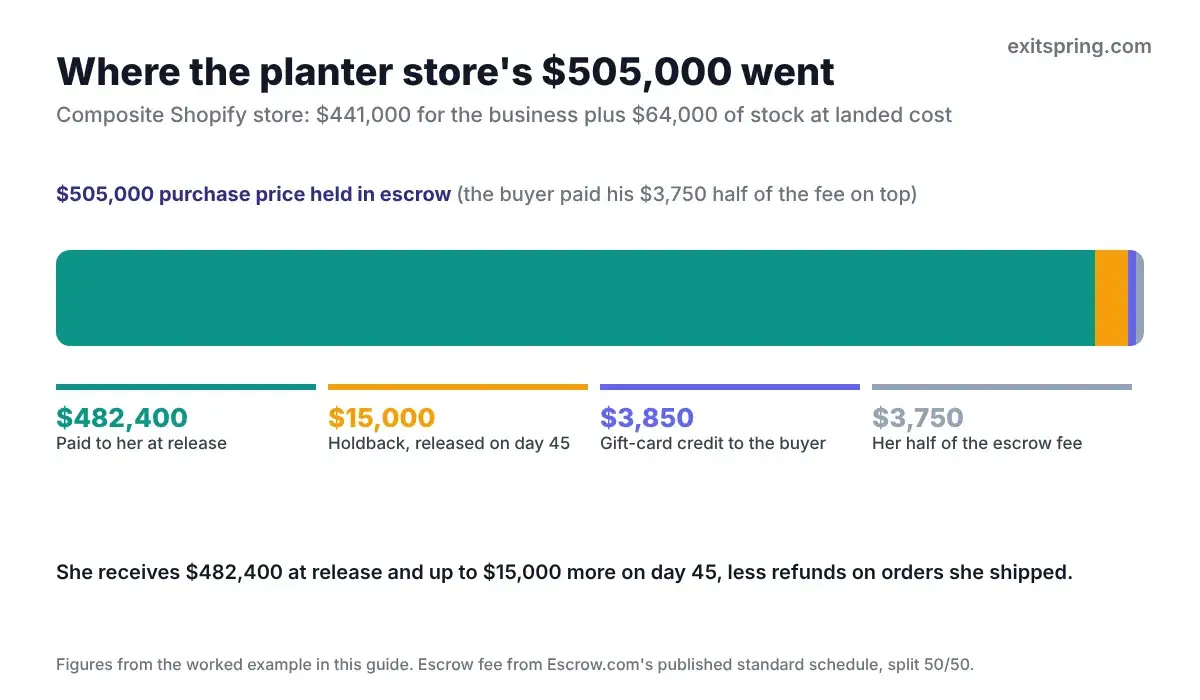
The planter store closed on a Thursday. On Escrow.com's general published schedule, the standard fee for a $505,000 transaction is $7,500, the minimum in its $500,000 to $1 million band; she and the buyer split it. Our guide to how long it takes to sell an online business covers the months before this week.
| Day | Step | Detail |
|---|---|---|
| Monday | Stock count | $64,000 at landed cost, signed by both |
| Tuesday | Escrow funded | Buyer wires $508,750 to Escrow.com, the $505,000 plus his half of the fee; she confirms the payment in her own login |
| Wednesday | Outside accounts | Meta portfolio, Klaviyo and Google admin access added for the buyer |
| Thursday 9 a.m. | Shopify transfer | Settings > Users > change ownership; buyer accepts within the hour |
| Thursday noon | Payments and domain | Buyer contacts Support with his company details; domain contacts updated |
| Thursday to the next Thursday | Inspection | Buyer runs test orders through his new payment setup |
| Following Friday | Release | Escrow pays her $482,400: the $505,000 less her $3,750 half of the fee, a $3,850 gift-card credit and a $15,000 holdback |
| Day 45 after release | Holdback | The $15,000, less any refunds on her orders, goes to her |
The buyer also asked for a $25,000 holdback, kept in escrow for 60 days after release, to cover refunds and chargebacks on orders she had shipped. She agreed to $15,000 for 45 days, close to four months of refunds at her 4.1% rate. Holdbacks, earnouts and seller notes change what you actually take home, and our guide to seller financing and earnouts prices each of them.
Five mistakes that cost Shopify sellers money
| Mistake | What it cost | Illustrative example |
|---|---|---|
| Leaving Shopify Capital open | Transfer blocked on closing day | A $90,000 store waited 11 days while the seller repaid $14,000 |
| Quoting the price "including stock" | Thousands handed over for free | $64,000 of planters nearly went into the $441,000 instead of being paid for at cost on top |
| Leaving app charges unpaid | Small bills the buyer deducts with a margin | A candle store's $480 of app bills became a $750 credit at release |
| No revenue cut-off | Payouts in transit argued over | A skincare store's two days of Shopify Payments deposits, $11,400, claimed by both sides |
| Handing over the Meta login only | Ad history and the pixel left behind | A new ad account started with no data and spent $3,000 relearning |
Questions Shopify sellers ask
Can I sell my store through Shopify itself?
There has been no listing tool inside Shopify for several years. Its help page says sales must happen "separately from the Shopify platform" and points owners to third-party marketplaces such as Flippa. The only part Shopify handles is the ownership transfer once the buyer has paid.
How long does the Shopify part of the handover take?
The ownership transfer took the planter store's buyer under an hour to accept. A domain moved to another Shopify store can take up to 24 hours, and a bank change pauses Shopify Payments payouts for 3 to 5 business days. Most sales still take months from listing to close, almost all of it spent before this step.
Do my orders, customers and products stay with the store?
The whole admin changes hands, so the planter store's 21,000 customer records, five years of orders and 140 products stayed exactly where they were. What doesn't follow is anything tied to the seller's identity: the Shopify Payments business details, her bank account, her PayPal and her own Shopify login.
What is a $100,000-a-year Shopify store worth?
A store making about $100,000 sits on the line between two bands in the listing data above: 2.33x just under it and 2.67x from $100,000 up, or roughly $233,000 to $267,000 before stock. Flippa's average for sold ecommerce deals in the first half of 2026 is 1.55x, a mean of closing multiples.
Can a buyer outside the US take over a US store?
A buyer whose company sits in one of Shopify Payments' 41 supported countries can contact Support to put his business details on the account, which creates a new legal entity and goes through verification; a different country may mean setting Payments up again. A buyer from elsewhere needs a third-party payment provider set up and tested with live orders before the inspection period ends.
What happens to unredeemed gift cards?
They stay live and the buyer has to honor them. The planter store had $3,850 outstanding, credited to the buyer out of escrow at release. Count them under Gift cards in the admin before you agree terms, along with any store credit.
My store is on the Basic plan. Does that change anything?
Basic allows no staff accounts, so the buyer can't be added as a user for due diligence or for the Settings > Users route. On a $39-a-month Basic store, the buyer reviews the numbers on a screen share or as a collaborator, and the seller transfers ownership from Settings > General instead. Upgrading for one month to Grow, at $105, also works if the buyer wants his own login.
Selling your Shopify store with Exit Spring
Exit Spring runs from the US and Hong Kong. We value the store on its own Shopify reports, plan the Payments and Meta handovers before listing, and run the closing week through Escrow.com. To see what your store could fetch, request a free valuation.
This article reflects Shopify, Meta, Klaviyo, Google and USPTO rules as published in October 2026 and is not legal or tax advice.
Sources
- Shopify Help Center: Change or transfer ownership
- Shopify Help Center: User limits by plan, Store permissions and Sensitive permissions
- Shopify Help Center: Configuring Shopify Payments and Supported countries
- Shopify: Shopify Payments terms of service
- Shopify Help Center: Transferring Shopify domains
- Meta Business Help Center: Ad accounts in a business portfolio and Datasets
- Klaviyo Help Center: How to transfer account ownership
- Google Ads Help: Transfer ownership of a Google product
- USPTO: Fee schedule; Cornell LII: 15 U.S.C. § 1060
- California Privacy Protection Agency: CCPA statute text PDF; FTC: RadioShack letter, May 2015
- CDTFA: Compliance Policy and Procedures Manual, chapter 6 PDF; Texas Comptroller: Publication 98-117 and Buying or selling a business; New York: TB-ST-70 bulk sales
- Escrow.com: Fee calculator
- Flippa: Shopify store valuation in 2026
- Empire Flippers public listings, retrieved October 8, 2026 (341 Shopify ecommerce listings, asking multiples on SDE)
Get new listings in your inbox
Fresh businesses for sale every Monday, plus practical buying and selling tips.
Unsubscribe anytime. No spam.
Keep reading


Ready to make a move?
Browse vetted online businesses or get a free valuation of yours.