
The Asset Purchase Agreement for an Online Business in 2026: Clauses, Schedules and Closing
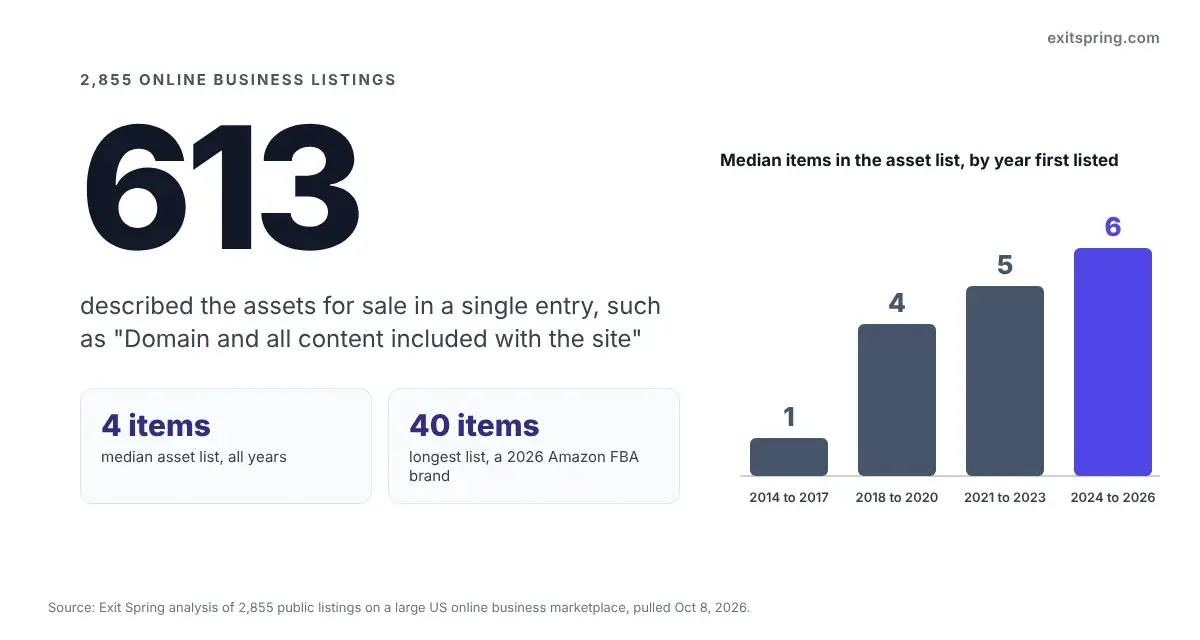
Of 2,855 online business listings on one of the largest US marketplaces, pulled October 8, 2026, 613 described the assets for sale in a single entry, and the median listing named four items.
The contract that replaces a listing's asset list when a sale closes is called an asset purchase agreement, or APA. This guide is general information as of November 2026, not legal advice.
What is an asset purchase agreement?
An asset purchase agreement is a contract in which a buyer purchases named assets of a business, such as its domain, store, trademark and inventory, and generally takes on only the liabilities the contract lists. The seller keeps the legal entity, its bank accounts and its history.
| Asset purchase | Share (stock) purchase | |
|---|---|---|
| What changes hands | Assets named in a schedule | The company itself |
| Liabilities | Those the agreement lists as assumed | All of the company's, known or not |
| Accounts and contracts | Each one is transferred or assigned | Stay with the company |
| Buyer's tax basis | The price, allocated across the assets on IRS Form 8594 | The company's existing basis in most cases |
| Main document | Asset purchase agreement | Share or stock purchase agreement |
In the American Bar Association's 2025 Private Target M&A Deal Points Study, which covers 139 agreements for deals of $25 million to $900 million, 21% were asset purchases, according to K&L Gates' December 19, 2025 summary. The listings in our data describe assets. Ten of the 2,855 used the word "entity" or "corporation" in the asset list. Eight of those told the buyer to have a legal entity of its own, and a 2016 listing offered "everything except the corporation itself."
What does an asset purchase agreement include?
An asset purchase agreement includes about a dozen sections, starting with the parties and the purchased assets and ending with indemnification and governing law. The asset list and the seller's disclosures usually sit in schedules at the back. Fernhollow Tea, the composite example in the right-hand column, is a $232,000 sale of a Shopify tea store.
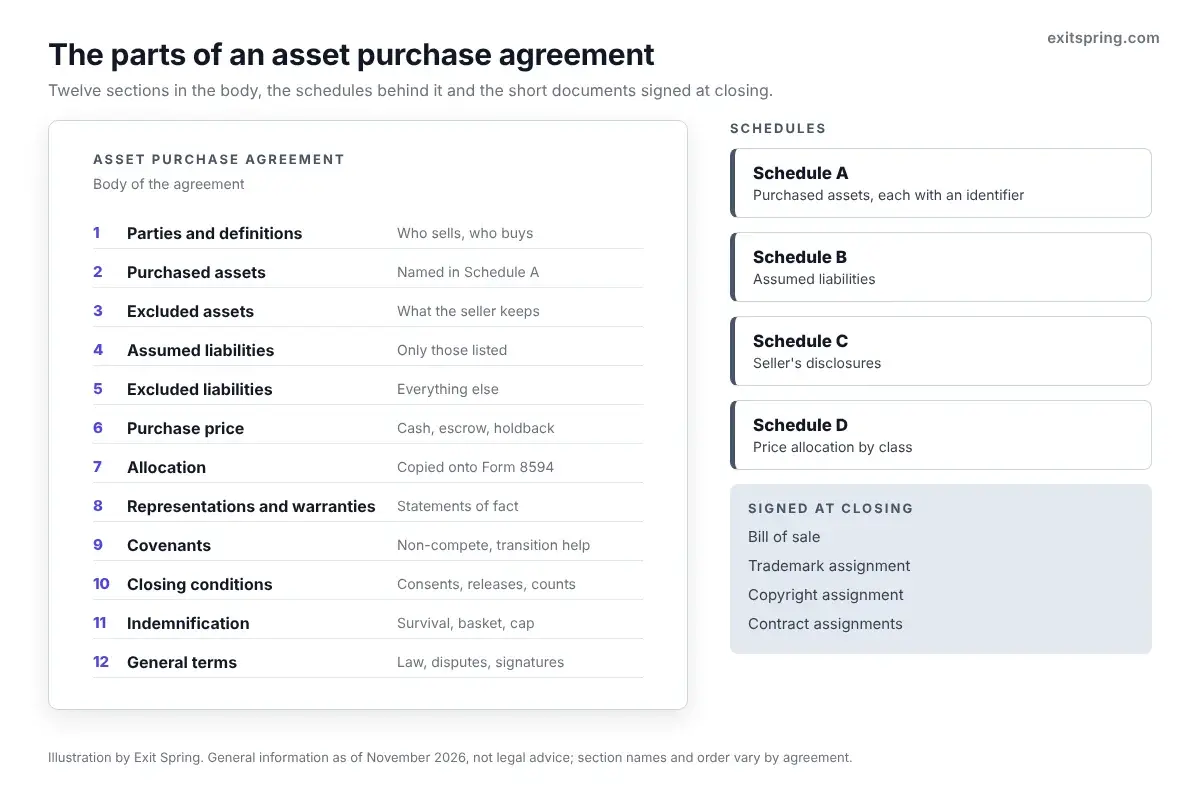
| Section | What it settles | Fernhollow Tea (composite) |
|---|---|---|
| Parties and definitions | Who is selling, who is buying, and what terms like "Business" and "Closing" mean | A New York LLC sells to a Delaware LLC |
| Purchased assets | Everything the buyer gets, by name and identifier | The Shopify store, one domain, one US trademark registration, a 14,200-subscriber email list |
| Excluded assets | What the seller keeps | Cash, the seller's bank accounts and the LLC itself |
| Assumed liabilities | Obligations the buyer agrees to take | Unshipped orders and gift cards outstanding at closing |
| Excluded liabilities | Everything else, which stays with the seller | Taxes and supplier charges for goods delivered before closing |
| Purchase price | Amount, timing, escrow and any holdback or seller note | $232,000 plus inventory at cost; $23,200 held back for 12 months |
| Allocation | How the price is split for tax | A schedule that both sides copy onto Form 8594 |
| Representations and warranties | Statements of fact each side stands behind | The financial statements are accurate; the seller owns the trademark |
| Covenants | Promises about conduct after signing and after closing | 45 days of transition help; a three-year non-compete |
| Closing conditions and deliverables | What must happen and what is handed over at closing | Tax release received; bill of sale and trademark assignment signed |
| Indemnification | Who pays if a statement proves untrue, for how long and up to how much | 12-month survival, $2,500 deductible, $46,400 cap |
| General terms | Governing law, disputes, notices and signatures | New York law; signed electronically |
Our guide to the confidential information memorandum covers the document a buyer reads before any of this is drafted, and buying an online business places the APA among the other deal documents.
What 2,855 listings named as the assets for sale
| Asset named in the listing's asset list | Listings | Share of 2,855 |
|---|---|---|
| Domain | 2,507 | 88% |
| Social media accounts | 1,835 | 64% |
| Email list | 988 | 35% |
| Trademark | 728 | 25% |
| Amazon seller account or Brand Registry | 723 | 25% |
| Supplier or manufacturer relationships | 652 | 23% |
| Employees, contractors or freelancers | 396 | 14% |
| Standard operating procedures | 405 | 14% |
| Source code or a code repository | 52 | 2% |
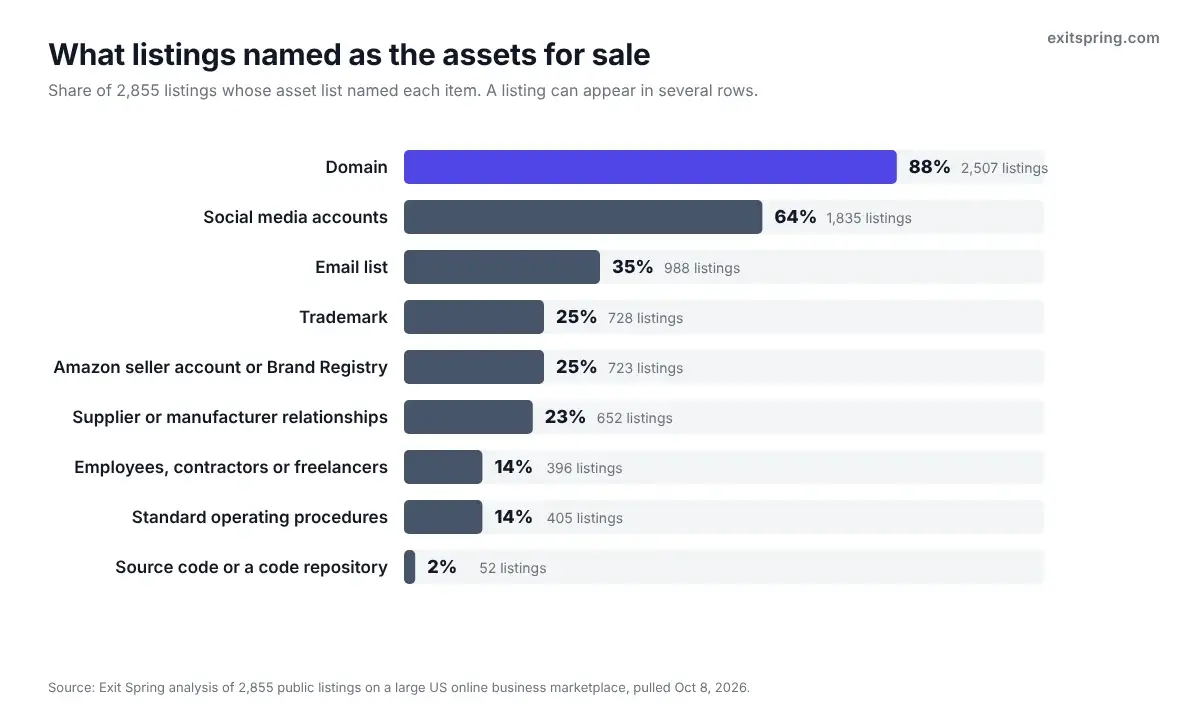
We searched each listing's asset list for the words in the left column and close variants, such as platform names for social media accounts. A listing counts once per row, and one listing can appear in several rows.
Asset lists grew longer over the 13 years in the data.
| Year first listed | Listings | Median items in the asset list | Named a trademark | Named an email list | Named staff or contractors |
|---|---|---|---|---|---|
| 2014 to 2017 | 599 | 1 | 2% | 12% | 1% |
| 2018 to 2020 | 856 | 4 | 21% | 29% | 7% |
| 2021 to 2023 | 832 | 5 | 33% | 48% | 19% |
| 2024 to 2026 | 568 | 6 | 47% | 46% | 30% |
Of the 613 single-entry asset lists, 492 came from listings dated 2014 to 2017. A typical one from 2015 read "Domain and all content included with the site." The longest list in the data, an Amazon FBA brand listed in 2026, ran to 40 items.
Amazon FBA listings carried the most detail. Of 797 of them, 695 named an Amazon seller account and 628 named a trademark. Another 459 mentioned inventory, nearly all to say it was priced separately.
Fernhollow Tea's asset schedule (composite) listed seven groups of assets.
| Fernhollow Tea's asset schedule (composite) | Entry |
|---|---|
| Domain | One .com domain, with the registrar named |
| Trademark | The US registration for the brand name, by registration number |
| Content | 214 product photos, 38 blog posts and the store theme |
| Store | The Shopify store, by store name and owner email |
| Email list | 14,200 subscribers on the closing date |
| Inventory | 1,930 tins and pouches across 46 products, $18,400 at landed cost |
| Supplier agreements | Two supply agreements, each by name and date |
| Transfer rule (general information as of November 2026, not legal advice) | Source |
|---|---|
| A registered trademark is assignable with the goodwill of the business, by a signed written instrument | 15 U.S.C. § 1060 |
| A trademark assignment is void against a later purchaser who pays value without notice unless it is recorded with the USPTO within three months or before that later purchase | 15 U.S.C. § 1060 |
| A transfer of copyright ownership is not valid unless it is in writing and signed by the owner | 17 U.S.C. § 204(a) |
Representations, warranties and indemnification
A representation is a statement of fact made in the agreement, such as "the Seller owns the domain." A warranty is a promise that the statement is true. Indemnification is one side's duty to cover the other's losses if a statement proves untrue or a liability it kept lands on the other side.
| Term | Meaning | Fernhollow Tea (composite) |
|---|---|---|
| Survival period | How long after closing a claim can be made | 12 months for general statements |
| Cap | The most the seller can owe for general claims | $46,400, or 20% of the price |
| Deductible basket | Losses the buyer absorbs before any claim is paid, with only the excess recoverable | $2,500 |
| First-dollar basket | A threshold after which the whole loss is recoverable | Not used |
| Holdback or indemnity escrow | Part of the price kept aside to pay claims | $23,200, or 10% of the price |
| Knowledge qualifier | Limits a statement to what the seller knew or, in most agreements, should have known after reasonable inquiry | "To the Seller's knowledge, no supplier intends to end its relationship" |
| Disclosure schedule | The seller's list of exceptions to its statements | A pending chargeback of $310 |
Published deal studies cover companies far larger than a typical online business. They still show which terms lawyers treat as standard.
| Term in large private deals | Figure | Source |
|---|---|---|
| Knowledge defined to include what the seller should have known after due inquiry | 90% of agreements | ABA 2025 study, per Goulston & Storrs, May 6, 2026 |
| Indemnification stated as the exclusive remedy | 89%, with a fraud exception in 85% of those | ABA 2025 study, per Goulston & Storrs |
| Agreement silent on claims for problems the buyer knew about before closing | 69% | ABA 2025 study, per Goulston & Storrs |
| Median indemnification escrow | 10% of deal value in 2025, from 9% in 2024 | SRS Acquiom 2026 study, per Fasken |
| Type of basket in 2025 deals | First-dollar 40%, deductible 32%, none 28% | SRS Acquiom 2026 study, per Fasken |
| Deals with an earnout | 24% in 2025 | SRS Acquiom 2026 study, per Fasken |
The SRS Acquiom study covers more than 2,300 private acquisitions that closed from 2020 through 2025, worth $569 billion in total. Our guide to seller financing and earnouts explains the earnout terms a smaller deal uses.
Which liabilities can follow the assets?
An asset buyer generally takes only the liabilities the agreement lists, but liens on the assets, successor-liability rules and some state tax rules can reach the buyer anyway. In New York, a buyer of business assets from a seller required to collect sales tax may be held liable for the seller's unpaid sales and use taxes unless the buyer notifies the Tax Department at least 10 days before paying or taking possession.
| New York bulk sale step (Tax Bulletin TB-ST-70, page updated October 16, 2026) | Rule |
|---|---|
| What counts | A sale, transfer or assignment of business assets, in whole or in part, by a person required to collect sales tax, outside the ordinary course of business |
| Buyer's notice | Form AU-196.10, at least 10 days before paying for or taking possession of the assets, whichever comes first |
| Department's first reply | Within 5 business days, either a release (Form AU-197.1) or a notice of claim (Form AU-196.2) |
| After a notice of claim | The buyer holds the price in escrow, and the Department states any tax due within 90 days of receiving the buyer's notice |
| If the buyer skips the notice | The buyer may be held liable for the seller's unpaid sales and use taxes |
| Intangible assets | The bulletin's definition of business assets includes intangibles such as goodwill |
Other states have their own versions, and many have none. A buyer's lawyer checks the seller's home state and every state where the seller collected sales tax.
Non-compete and transition support
The Federal Trade Commission announced on September 5, 2025 that it had voted 3-1 to take steps to dismiss its appeals and accept the court ruling that set aside its Non-Compete Clause Rule, so no federal rule bans non-competes. State law governs. California, which voids most non-competes, lets a person who sells the goodwill of a business agree not to run a similar business in a specified geographic area where the sold business operated, for as long as the buyer carries on a like business there (Business and Professions Code § 16601).
| Seller support offered in the listing | Listings | Share of the 2,727 that stated a period |
|---|---|---|
| 30 days or less | 1,969 | 72% |
| 31 to 60 days | 444 | 16% |
| 61 to 90 days | 224 | 8% |
| More than 90 days | 90 | 3% |
Sixteen of the 2,855 listings mentioned a non-compete anywhere in their text. One seller who owned a second site in the same niche offered to sign a 10-year non-compete for specific products.
Price, escrow and allocation
| Payment term | What the agreement states | Example |
|---|---|---|
| Cash at closing | The amount released from escrow once the buyer confirms the handover | $227,200, including inventory |
| Holdback | The amount kept aside, the period and the release conditions | $23,200 for 12 months |
| Inventory | The valuation method and the date of the count | Landed cost on the closing date; 462 listings in our data said inventory was not normally included in the list price |
| Seller note or earnout | Amount, interest, schedule and what counts as default | None in the Fernhollow deal |
| Escrow fee | Who pays | Escrow.com's standard rate is 1.5% from $200,000.01 to $500,000, with a $3,800 minimum |
The tax code treats a sale of assets that make up a trade or business as an "applicable asset acquisition." Buyer and seller generally each file Form 8594 with the return for the year of the sale, and a written allocation agreed between them binds both unless the IRS finds it is not appropriate (26 U.S.C. § 1060; IRS Instructions for Form 8594).
| Form 8594 class | What goes in it | Typical online business item |
|---|---|---|
| I | Cash and general deposit accounts | Rarely sold |
| II | Actively traded personal property, certificates of deposit and foreign currency | Rarely sold |
| III | Debt instruments, including accounts receivable | Receivables, if sold |
| IV | Stock in trade and inventory | Product inventory |
| V | Assets not in another class, such as equipment | A label printer, camera gear |
| VI | Section 197 intangibles other than goodwill and going concern value | Trademark, customer list, non-compete |
| VII | Goodwill and going concern value | The rest of the price |
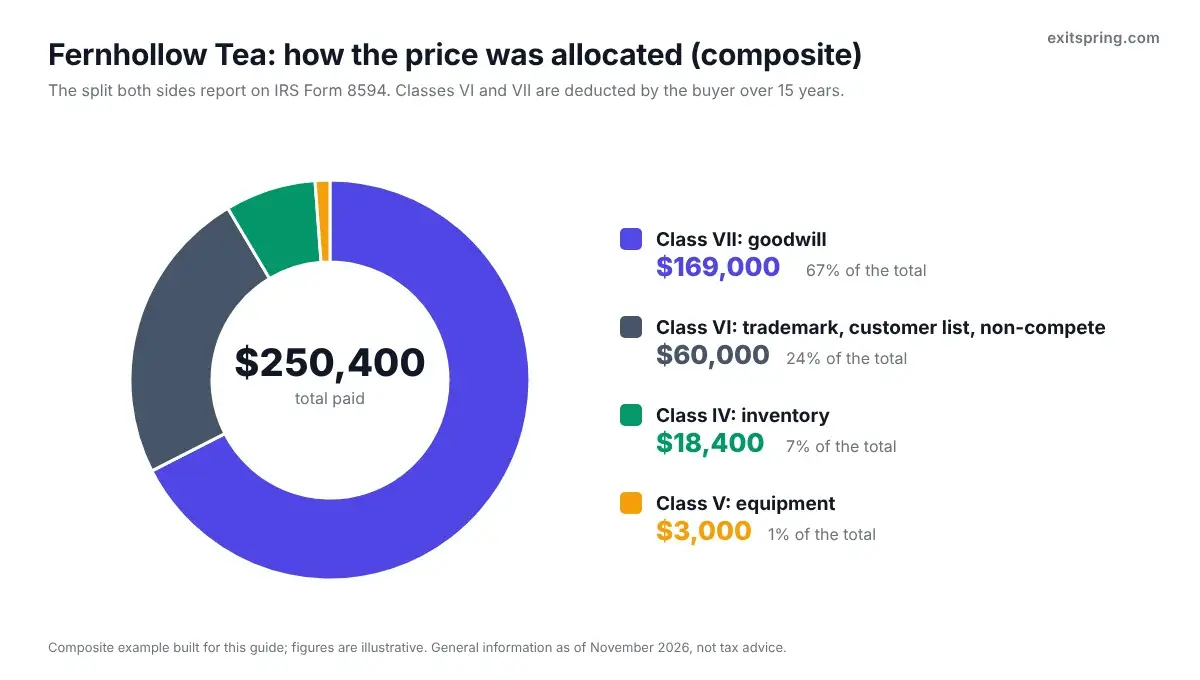
Our guide to taxes when selling an online business explains why the seller and the buyer often want different splits.
Conditions that listings attach to a sale
| Note in the listing's asset list | Listings | What the APA does with it |
|---|---|---|
| Inventory not normally included in the list price | 462 | Sets the inventory price and the count date |
| The buyer needs, or is advised to have, an approved AdSense account | 117 | Makes the buyer's ad account a condition of closing |
| A VAT registration is mentioned | 42 | States who holds which registrations on the closing date |
| The buyer needs a legal entity to take over the Stripe account | 8 | Names the buying entity and where it is formed |
Each of these is a line in a listing. An APA turns it into a condition with a date and a consequence if the date is missed.
How do you sign and close an asset purchase agreement?
Signing and closing an asset purchase agreement runs from a letter of intent through due diligence, drafting and signing to the closing handover and the filings afterward. An APA can be signed electronically. Under the federal E-SIGN Act, a contract can't be denied legal effect only because an electronic signature was used to form it (15 U.S.C. § 7001).
| Step | What happens | Fernhollow Tea (composite) |
|---|---|---|
| Letter of intent | Price, structure and exclusivity are agreed, mostly non-binding | Signed August 3, 2026 |
| Due diligence | The buyer checks the facts the representations will cover | Four weeks, using our due diligence checklist |
| Drafting | One side's lawyer writes the first draft and the other marks it up | Buyer's lawyer drafts; two rounds of changes |
| Signing | Both sides sign the APA; closing can be the same day or later | Signed September 14, 2026 |
| Pre-closing steps | Notices, consents and counts | New York bulk sale notice delivered September 15 |
| Closing | Money moves to escrow and the transfer documents are signed | September 28, 2026 |
| Inspection | The buyer confirms the accounts and assets arrived | Seven days |
| After closing | Recordings and tax forms | Trademark assignment recorded October 6; Form 8594 with each side's 2026 return |
The closing documents are short. A bill of sale transfers the tangible assets. Separate assignments cover the trademark, the copyrights, the contracts and the liabilities the buyer assumes.
Fernhollow Tea: a $232,000 asset purchase (composite)
Marcus agreed to pay $232,000, plus inventory at cost, for the assets of Fernhollow Tea (a composite built for this guide).

| Fernhollow Tea (composite) | Step |
|---|---|
| August 3, 2026 | Letter of intent signed at $232,000 plus inventory |
| August 3 to 31, 2026 | Due diligence |
| September 14, 2026 | Asset purchase agreement signed |
| September 15, 2026 | Marcus delivers Form AU-196.10 to the New York Tax Department |
| September 22, 2026 | The Department's release, Form AU-197.1, arrives |
| September 28, 2026 | Closing; inventory counted at $18,400; $250,400 paid into escrow |
| October 5, 2026 | Inspection period ends; $227,200 released to Ruth and $23,200 held back |
| October 6, 2026 | Trademark assignment recorded with the USPTO |
| January 12, 2027 | Marcus finds $4,100 of refunds owed on orders placed before closing, which the financial statements had left out |
| January 2027 | Marcus claims $1,600 from the holdback, the amount above the $2,500 deductible |
| September 28, 2027 | Survival period ends; the remaining $21,600 is released to Ruth |
| Fernhollow Tea (composite) | Figure |
|---|---|
| Seller | Ruth's New York LLC, formed in 2020 and registered for New York sales tax |
| Yearly profit | $80,000 |
| Price for the business, 2.9 times yearly profit | $232,000 |
| Inventory at landed cost | $18,400 |
| Total paid | $250,400 |
| Holdback, 10% of the price | $23,200 |
| Cap on general claims, 20% of the price | $46,400 |
| Deductible basket | $2,500 |
| Escrow fee, split evenly | $3,800 |
| Allocated to Class IV, inventory | $18,400 |
| Allocated to Class V, equipment | $3,000 |
| Allocated to Class VI, trademark, customer list and non-compete | $60,000 |
| Allocated to Class VII, goodwill | $169,000 |
| Marcus's deduction on Classes VI and VII in each full year, over 15 years | $15,267 |
The missing refunds breached Ruth's statement that the financial statements were accurate. Marcus paid the customers and recovered $1,600 of the $4,100. Claims for fraud, and for liabilities the seller kept, usually sit outside the deductible and the cap.
Exit Spring lists online businesses with verified financials on its marketplace, and owners can get a free valuation. Our guides to selling an ecommerce business and buying a SaaS business show how the asset list differs by model.
How we researched this
| Step | What we did |
|---|---|
| Source | 2,855 public listings from one large US marketplace, pulled October 8, 2026: 2,679 sold and 176 for sale |
| Asset lists | Word searches in each listing's list of assets included in the sale |
| Support periods | The longest period in days, weeks or months stated in each listing's support offer; 2,727 listings stated one |
| Legal sources | Statutes, IRS instructions, a state tax bulletin and law-firm summaries of two deal studies, all linked below |
| Limits | A listing's asset list is a summary written for buyers, not the schedule of a signed agreement; the feed has no signed agreements |
Frequently asked questions
Is an asset purchase agreement legally binding?
Fernhollow Tea's agreement (composite) was signed on September 14, 2026 and bound both sides from that day, two weeks before the money moved. A letter of intent is usually non-binding except for terms such as exclusivity and confidentiality. A signed APA is a contract, and a side that walks away without a right to do so under the agreement, such as an unmet closing condition, can be sued for breach.
Who drafts the asset purchase agreement?
Marcus's lawyer wrote the first draft of the Fernhollow Tea agreement (composite) and sent it to Ruth's lawyer on September 2, 2026. It came back twice with changes before the September 14 signing. Flippa's guide to the APA, updated December 18, 2025, tells buyers and sellers to get help from a trained legal professional.
Does the buyer take on the seller's debts in an asset purchase?
Marcus took on two liabilities at Fernhollow Tea (composite): unshipped orders and outstanding gift cards. Everything else stayed with the seller under the agreement. State tax law can still reach a buyer. New York may hold a buyer liable for the seller's unpaid sales tax if Form AU-196.10 isn't filed 10 days ahead.
What is the difference between a bill of sale and an asset purchase agreement?
Fernhollow Tea's closing (composite) used one bill of sale, one trademark assignment, one copyright assignment and one assignment and assumption agreement, all signed on September 28, 2026. A bill of sale is a short document that transfers ownership of the assets at closing. The asset purchase agreement is the full contract, with the price, the representations and the indemnification terms.
How long do the seller's promises last after closing?
Fernhollow Tea's general representations (composite) survived 12 months, to September 28, 2027. In the ABA's 2025 study of large private deals, 41% of agreements had no survival of representations, up from 30%, per K&L Gates. In the same study, 63% of agreements referred to representations and warranties insurance.
What is Form 8594?
Ruth's copy of Form 8594 (composite) shows $169,000 in Class VII, and Marcus's copy shows the same figure. The form is the IRS's Asset Acquisition Statement, and each side attaches it to the tax return for the year of the sale. A form that is wrong or late without reasonable cause can draw penalties, according to the IRS instructions.
Do I need an asset purchase agreement to buy a small website?
Of the 2,855 listings in our data, 613 described their assets in a single entry, and 360 of the 2,670 sold listings with a price and a positive profit asked under $25,000. A short APA still names the domain, the accounts, the price and what the seller promises. Without it, a buyer has an escrow record and little else.
Sources
- Internal Revenue Service, Instructions for Form 8594, Asset Acquisition Statement
- Legal Information Institute, 26 U.S.C. § 1060, Special allocation rules for certain asset acquisitions and 26 U.S.C. § 197
- Legal Information Institute, 15 U.S.C. § 1060, Assignment
- Legal Information Institute, 17 U.S.C. § 204, Execution of transfers of copyright ownership
- Legal Information Institute, 15 U.S.C. § 7001, General rule of validity
- New York State Department of Taxation and Finance, Bulk Sales, Tax Bulletin TB-ST-70, updated October 16, 2026
- Federal Trade Commission, Federal Trade Commission Files to Accede to Vacatur of Non-Compete Clause Rule, September 5, 2025
- Justia, California Business and Professions Code § 16601
- K&L Gates, 2025 ABA Private Target Mergers & Acquisitions Deal Points Study, December 19, 2025
- Goulston & Storrs, 2025 ABA Private Target M&A Deal Points Study: What's Market?, May 6, 2026
- Fasken, Private M&A deal trends to watch: key takeaways from SRS Acquiom's 2026 study, May 2026
- SRS Acquiom, 2026 M&A Deal Terms Study: key findings
- Escrow.com, Fee calculator
- Flippa, What is an asset purchase agreement?, updated December 18, 2025
- Empire Flippers public marketplace listings, pulled October 8, 2026 (Exit Spring analysis)
Get new listings in your inbox
Fresh businesses for sale every Monday, plus practical buying and selling tips.
Unsubscribe anytime. No spam.
Keep reading
How to Buy a SaaS Business in 2026: Prices, Churn, Code and Due Diligence
Turnkey Online Businesses in 2026: What They Cost, What Hands-Off Leaves Out and How to Buy One

How to Sell a Digital Marketing or SEO Agency in 2026: Multiples, Client Contracts and Handover
Ready to make a move?
Browse vetted online businesses or get a free valuation of yours.