
Confidential Information Memorandum (CIM): What It Is and What Goes in One for an Online Business
A confidential information memorandum (CIM) is the full sale document a seller releases only after a buyer signs a nondisclosure agreement, and corporate CIMs run from 30 to more than 150 pages, according to Financial Edge Training's May 2025 guide.
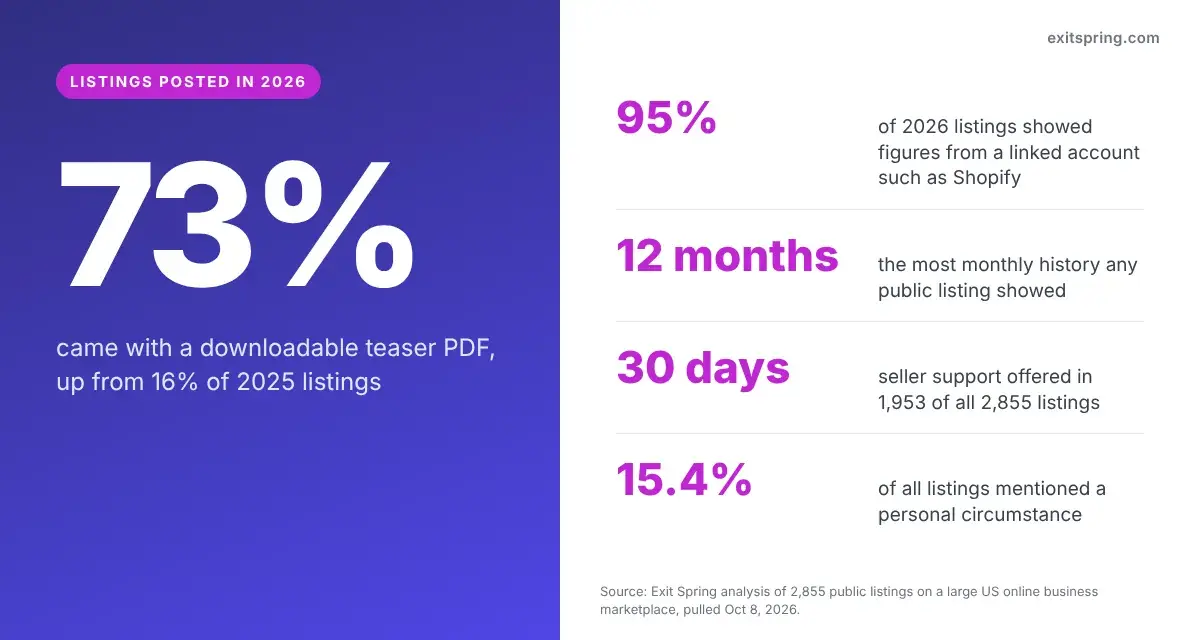
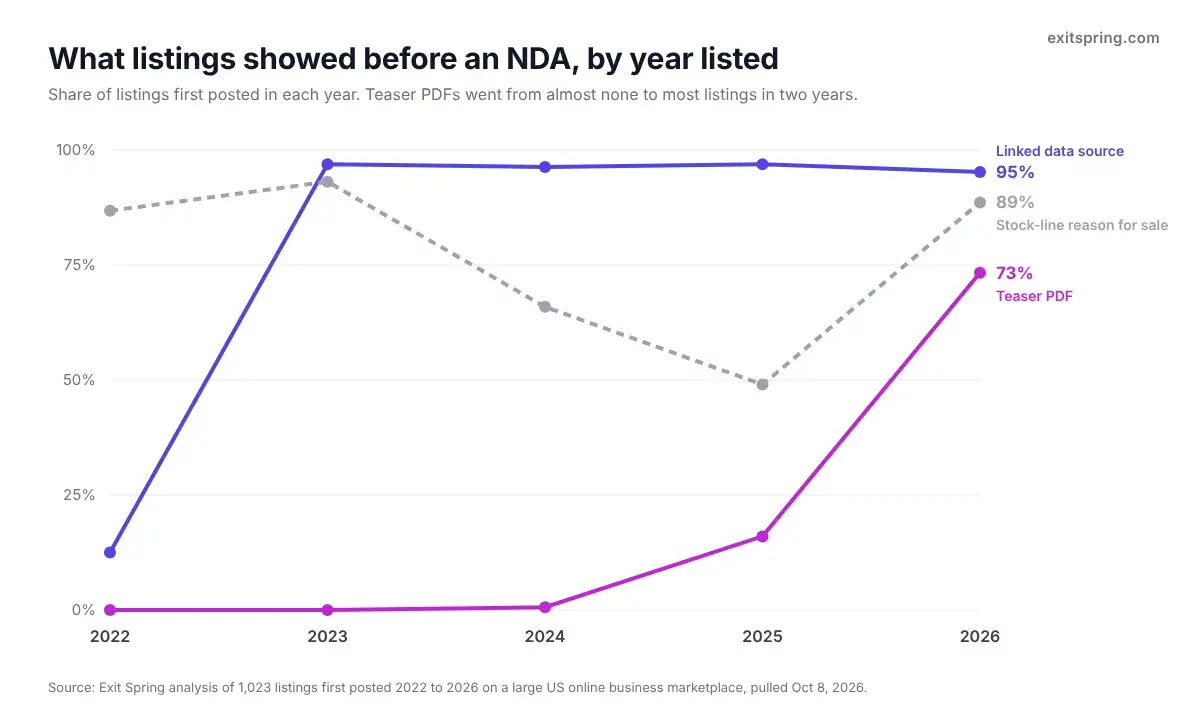
On one of the largest US online business marketplaces, 154 of the 210 businesses listed in 2026 came with a downloadable teaser PDF, up from 31 of 194 in 2025, in the 2,855 public listings we pulled on October 8, 2026. The CIM is the much longer document a buyer gets after that teaser and an NDA.
What is a confidential information memorandum?
A confidential information memorandum is the document that tells a qualified buyer everything needed to decide whether to make an offer: what the business sells, where its customers come from, what it earns and what the buyer would take over. A CIM is shared under a nondisclosure agreement (NDA) and is not a contract. The Corporate Finance Institute's CIM guide, modified May 2026, says plainly that a CIM "is NOT a legally binding contract."
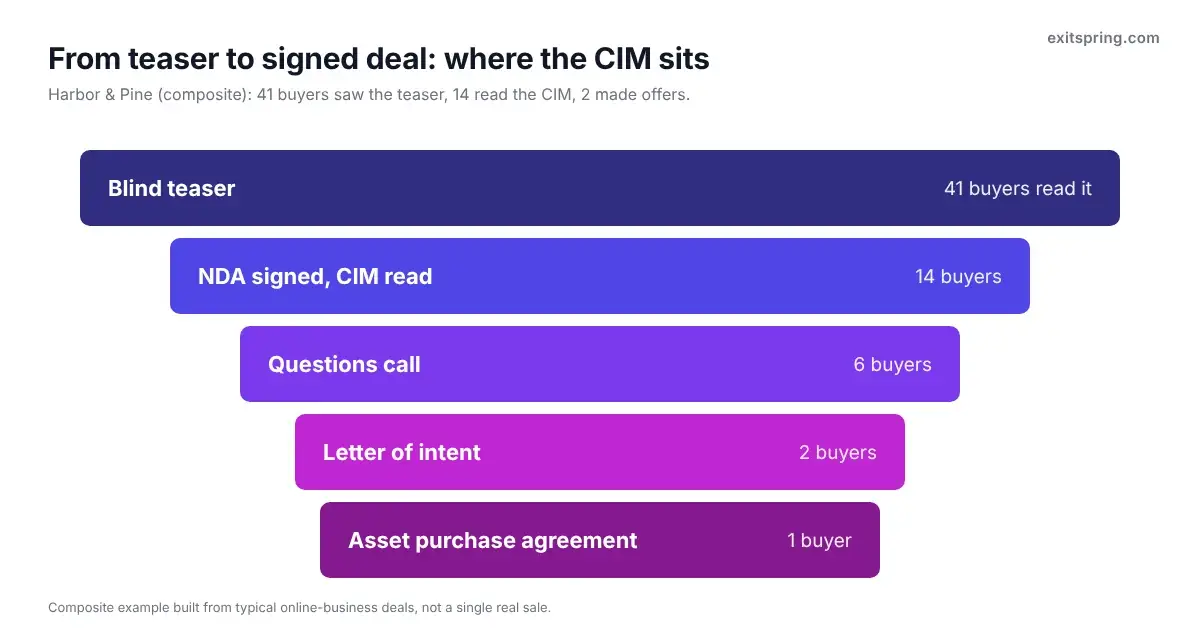
In a small online business sale the CIM sits in the middle of a fixed run of documents. A one- or two-page teaser goes out first without the business name. Interested buyers sign the NDA, read the CIM, ask questions on a call, and then send a letter of intent (LOI).
| Deal document | When the buyer sees it | What it names | Binding? |
|---|---|---|---|
| Blind teaser | First contact, before any NDA | Category, revenue, SDE and often the price, with no brand name | No |
| NDA | Before the CIM is released | Confidentiality, an employee non-solicit (often 18 to 24 months) and a return-or-destroy clause | Yes |
| CIM | After the NDA is signed | The brand, its accounts, suppliers and monthly results | No |
| Letter of intent | After the buyer's questions are answered | Price, structure, an exclusivity window | Mostly no, apart from exclusivity and confidentiality |
| Asset purchase agreement | After due diligence | Every asset, the seller's representations, closing terms | Yes |
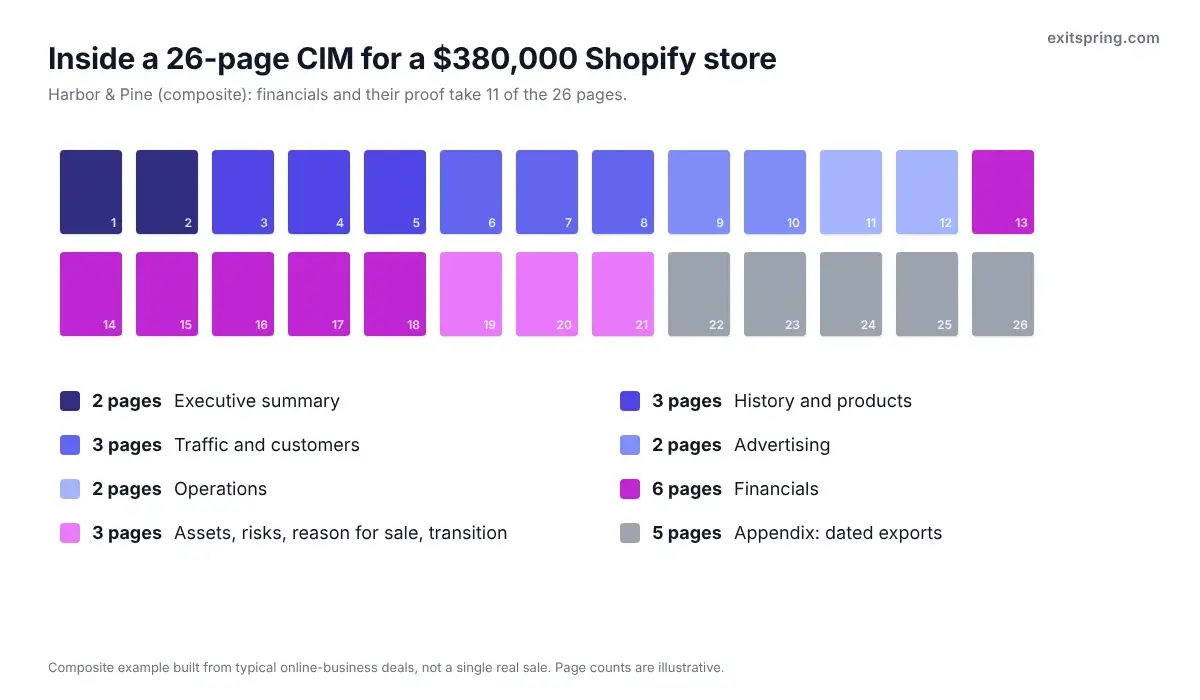
The Business Development Bank of Canada's glossary puts drafting time at two to four weeks and describes a CIM as "several dozen pages" long. Most of that time goes into the financials and the proof behind them, which is where online-business CIMs differ from the corporate templates that rank for this term.
What goes in a CIM for an online business?
An online business CIM covers the same ground as a corporate one, plus the platform evidence a remote buyer can't get by walking the shop floor. Buyers of a Shopify store, a SaaS product or a content site expect monthly figures, traffic sources, ad account history, an owner-hours estimate and an exact list of accounts that will change hands.
| CIM section | What an online-business buyer looks for | Harbor & Pine's version (composite) |
|---|---|---|
| Executive summary | Revenue, SDE, owner hours and asking price on one page | $612,000 revenue, $148,000 SDE, 6 hours a week, asking $380,000 |
| History | Founding date and the month of the first sale | Launched on Shopify in March 2019 |
| Products | SKU count and the share of revenue from the top sellers | 14 SKUs; the three best sellers bring in 61% of revenue |
| Traffic and customers | Channel split from Google Analytics 4, Search Console clicks, email list, repeat purchase rate | 38% organic search, 21% email, 27,400 subscribers, 34% of orders from returning customers |
| Advertising | Monthly spend and return on ad spend (ROAS) by account | $4,100 a month on Meta at a 3.1 ROAS, no Google Ads since 2024 |
| Operations | Suppliers, fulfillment, standard operating procedures, contractors | A third-party warehouse in Ohio, two suppliers, 23 written procedures |
| Financials | 36 months of profit and loss by month, add-backs, an SDE bridge | Monthly P&L from July 2023 to June 2026 |
| Assets | Domain, store, inventory, trademarks, social accounts, email list | Inventory of about $41,000 at cost, sold on top of the price |
| Risks | Platform dependence, supplier concentration, seasonality | 31% of annual revenue lands in November and December |
| Reason for sale | A specific reason a buyer can check | Priya starts a full-time role at a cookware brand in January 2027 |
| Transition | Training period and post-sale support | 60 days of support, 4 recorded walkthroughs |
| Appendix | Screenshots and exports that back each figure | 19 exports, each with the date it was pulled |
Seller's discretionary earnings (SDE) is the yearly profit a single owner-operator takes home once their own pay and one-off costs are added back. Our guide to how to value an online business walks through the add-backs a buyer will accept.
The asking price often appears in an online-business CIM, though some advisers leave it out to see what buyers offer. Harbor & Pine's executive summary named the price because most of its buyers were first-time owners comparing listings side by side on a marketplace.
What changes by business model
On the same marketplace, 24 of 61 SaaS listings showed a churn rate on the public page, and 333 of 797 Amazon FBA listings showed total advertising cost of sales (TACoS), which is ad spend divided by total sales. A CIM is where every buyer gets the full set of those model-specific figures, month by month.
| Business model | Extra pages a buyer expects | Example figure |
|---|---|---|
| Shopify or DTC store | Margin by SKU, repeat purchase rate, an inventory schedule | 34% of Harbor & Pine's orders came from returning customers |
| Amazon FBA | Account health, TACoS, Brand Registry status, inventory age | TACoS of 9% across 20 SKUs |
| SaaS | Monthly recurring revenue (MRR), churn, cohorts, largest customers | $18,400 MRR with 2.9% monthly churn |
| Content site | Traffic by page, ad network revenue per thousand visits, Search Console clicks | The top 10 articles bring in 41% of pageviews |
| YouTube channel | Watch time, revenue by video, AdSense and sponsor history | Sponsorships make up 62% of revenue |
| Mobile app | Revenue split by store, paid subscribers, store account standing | 4,100 active paid subscribers |
In 2026, 73% of listings came with a teaser PDF
The 2,855 listings we pulled from the marketplace show how much a seller now puts on the public page before any NDA. Each row below counts the businesses first listed in that year, sold or still for sale.
| Listing year | Listings | Teaser PDF | Linked data source | Reason for sale was the stock line |
|---|---|---|---|---|
| 2022 | 296 | 0 | 37 (13%) | 257 (87%) |
| 2023 | 159 | 0 | 154 (97%) | 148 (93%) |
| 2024 | 164 | 1 (1%) | 158 (96%) | 108 (66%) |
| 2025 | 194 | 31 (16%) | 188 (97%) | 95 (49%) |
| 2026 | 210 | 154 (73%) | 200 (95%) | 186 (89%) |
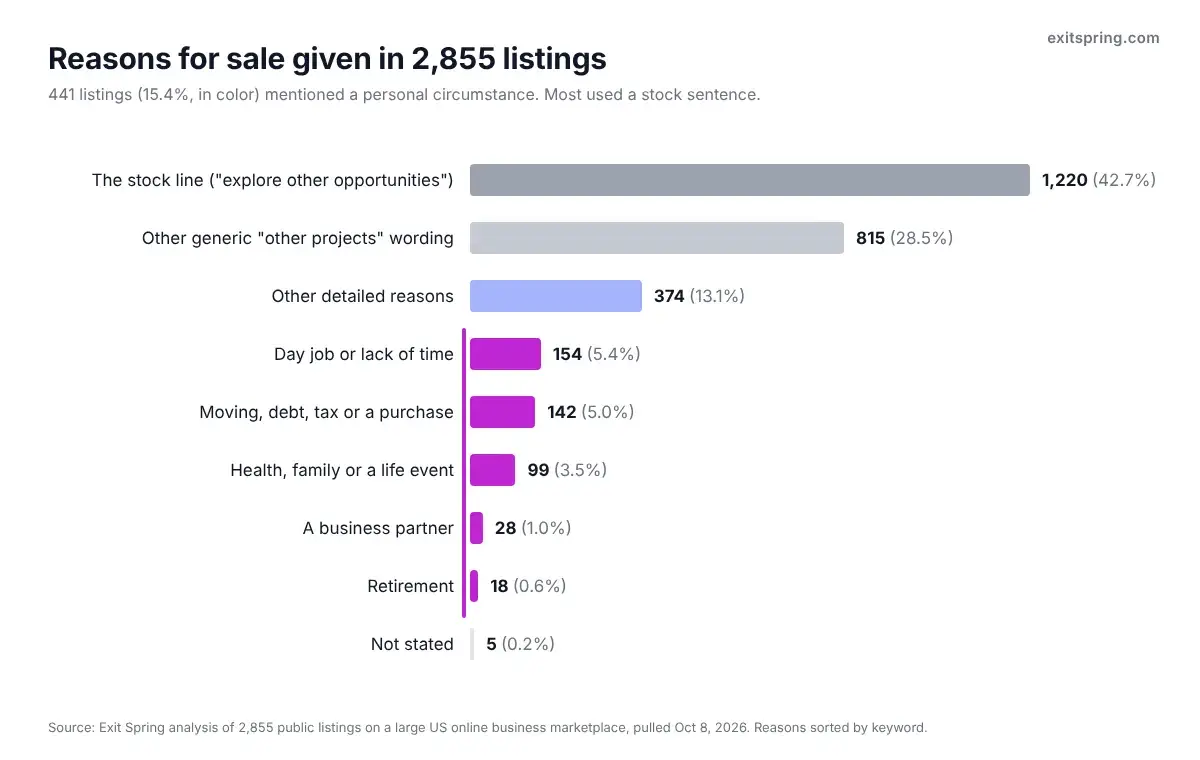
A linked data source means the page showed figures pulled from a connected account, most often Amazon Seller Central (297 listings), Google Analytics (293) or Shopify (140). The stock line is one of about 40 near-identical variants, such as "The Seller would like to explore other opportunities," which appeared word for word 662 times.
The public page covers 12 months. Of the 2,855 listings, 2,490 showed exactly 12 months of monthly profit, revenue and expenses, and none showed more, so the 36-month P&L in a CIM is the first time a buyer sees the longer record.
| What the public listing showed | Listings | Share of 2,855 |
|---|---|---|
| A domain among the assets included | 2,507 | 87.8% |
| Social media accounts in the sale | 1,438 | 50.4% |
| An email list or subscriber base | 1,003 | 35.1% |
| A trademark named among the assets | 728 | 25.5% |
| Supplier or manufacturer relationships | 652 | 22.8% |
| A note that inventory is priced on top | 464 | 16.3% |
| Written procedures (SOPs) | 409 | 14.3% |
| Exactly two risks listed | 1,664 | 58.3% |
Since 2022, only 11 of 1,023 listings left the risks field empty.
Seller support followed one pattern. Of the 2,717 listings that named a support period, 1,953 offered 30 days, 365 offered 60 days and 263 offered 90 days or more.
Reasons for sale in 2,855 listings
The reason for sale was the least specific field on the page. Only 441 listings, 15.4%, mentioned a personal circumstance such as a job, a move, a home purchase, family, a business partner or retirement, and some of those still ended in generic wording.
A buyer reads the CIM's reason-for-sale section looking for the detail the public page left out. Harbor & Pine's says Priya starts a full-time role at a cookware brand in January 2027, and she offered 60 days of support, double the usual 30, to finish the handover before then.
Proof that goes in the appendix
Remote buyers trust the platform screen more than the seller's spreadsheet. The appendix of an online-business CIM carries an export or screenshot for each figure in the body, with the date it was pulled and the account it came from.
| Claim in the CIM | Export that proves it | Detail a buyer checks |
|---|---|---|
| Shopify revenue by month | Shopify's "Total sales over time" report, exported to CSV | Export to CSV so the appendix holds the full monthly record |
| Payment processor deposits | Stripe's payout reconciliation report, or its balance report for manual payouts | Each payout ties to a deposit on the bank statement |
| PayPal sales and refunds | A custom activity download from PayPal | PayPal lets account holders download up to seven years of history, 12 months per request |
| Traffic by channel | A GA4 report downloaded as CSV or PDF | GA4's 2- or 14-month retention setting affects explorations, not the standard reports |
| Organic search clicks | Search Console's Performance report, exported with its chart and table | The export date range should match the P&L months |
| Ad spend and return | A Google Ads statistics table download, plus an Ads Manager export for Meta | Monthly spend should match the advertising line in the P&L |
| Amazon payouts, if sold there | Date Range Reports from Seller Central's Payments reports | Summary PDF and transaction CSV for each 12-month period |
The 36 months of P&L matter beyond the CIM. A buyer who borrows through the SBA 7(a) program needs the seller's financial statements for the last three complete fiscal years, dated and signed or certified by the seller, under Appendix 20 of SBA SOP 50 10 8.1, effective October 1, 2026. The same SOP requires the lender to verify the seller's figures, usually against IRS tax transcripts requested through IVES on Form 4506-C, or with Form 8821. Our guide to buying an online business with an SBA loan covers the lender's side.
Can a buyer rely on what a CIM says?
A buyer often can't sue over a CIM statement alone when the NDA and the purchase agreement say only the purchase agreement's representations count. In RAA Management v. Savage Sports Holdings, decided May 18, 2012, the Delaware Supreme Court held that non-reliance and waiver clauses in an NDA barred a buyer's fraud claims over statements made during due diligence, including a document in the data room.
RAA had walked away before signing a purchase agreement and sued to recover its deal costs. Its NDA said the seller made no promise about the accuracy of the "Evaluation Material" and that only representations in a signed sale agreement would have legal effect.
A seller can't use the same wording to escape its own deliberate lies inside the purchase agreement. The Delaware Court of Chancery said so in ABRY Partners v. F&W Acquisition in February 2006, and the Delaware Supreme Court endorsed that framework in Express Scripts v. Bracket Holdings on February 23, 2021.
The Court of Chancery's November 2015 decision in Prairie Capital III v. Double E Holding added that no "magic words" are needed. A clause in which the buyer lists what it relied on, read with an integration clause, worked as a non-reliance clause and covered omissions outside the contract as well as statements.
| Deal structure | Rules that usually apply to CIM statements | Example |
|---|---|---|
| Asset sale (domain, store, inventory, accounts) | State contract and fraud law; the NDA and purchase agreement decide what the buyer may rely on | A buyer of a Shopify store's assets can claim only on the representations listed in the asset purchase agreement |
| Sale of all the company's stock | Also federal securities antifraud rules | In Landreth Timber v. Landreth (1985), the Supreme Court held that selling 100% of a company's stock is a securities sale |
| Sale of LLC membership interests | Depends on the facts, mainly how passive the buyer will be | The Fourth Circuit in Robinson v. Glynn (2003) found an LLC interest held by an active member was not a security |
Rule 10b-5 under the Securities Exchange Act bars any untrue statement of a material fact, and any omission of a material fact needed to keep the statements made from being misleading, in connection with buying or selling a security. In RAA the court assumed New York law applied and said the outcome would be the same under Delaware law. A deal governed by another state's law can come out differently.
General information as of November 2026, not legal advice. Ask a lawyer to review your NDA and purchase agreement before the CIM goes out.
Customer data in the CIM and the data room
Customer email addresses and order histories belong in the purchase, not in the CIM. California's Consumer Privacy Act excludes from the definition of a "sale" the transfer of personal information as an asset in a merger or acquisition in which the buyer takes control of the business, provided the information is used or shared consistently with the law, under Cal. Civ. Code § 1798.140(ad)(2)(C). That matters only if the business is covered by the CCPA, whose thresholds leave out many small stores.
That exception describes a transfer to the party taking control. Bidders who read a CIM and never buy don't take control of anything, so Harbor & Pine's CIM reported its 27,400 subscribers as a count, an open rate and a revenue share, with no names or addresses.
The Federal Trade Commission set out its view of customer data in a sale in May 2015, during the RadioShack bankruptcy. It asked that the data go only to a buyer in substantially the same line of business and stay under the privacy policy in force when it was collected.
How long does it take to write a CIM?
A CIM for a small online business usually takes two to four weeks to draft once the financials are clean, in line with the BDC's estimate. Most of the wait is the seller pulling 36 months of monthly reports from each platform and reconciling them to bank deposits.
| Week of drafting | Work | Harbor & Pine (composite) |
|---|---|---|
| 1 | Pull 36 months of Shopify, Stripe, PayPal and ad account reports; match them to bank statements | Priya found $3,800 of PayPal refunds missing from her spreadsheet |
| 2 | Build the monthly P&L, add-backs and SDE bridge | Her own $24,000 salary and a one-off $6,500 rebrand were added back |
| 3 | Write the sections, take dated screenshots, list every asset | 19 exports, each labeled with its source account |
| 4 | Seller and adviser review; anonymize the teaser | The teaser called it "a cookware-care brand on Shopify" with no brand name |
Harbor & Pine's teaser went to 41 buyers. Fourteen signed the NDA and read the CIM, six asked questions on a call, and two sent letters of intent within five weeks.
Mistakes that cost sellers offers
| CIM mistake | What a buyer does | Example |
|---|---|---|
| Figures in the CIM don't match the P&L | Lowers the offer or walks | A CIM claims $148,000 SDE while the spreadsheet sums to $139,500 |
| Blind teaser gives away the brand | Contacts suppliers or staff directly | A teaser mentions "the cast-iron care brand with 27,000 subscribers" |
| Reason for sale is one stock line | Asks why on the first call, then digs | "The Seller would like to explore other opportunities" and nothing more |
| Screenshots carry no dates | Asks for fresh exports, adding two weeks | A GA4 channel chart cropped without the date range |
| Raw customer list in the data room | Gets data they may not be allowed to keep | An order export with 27,400 names and addresses |
| Inventory value missing | Argues the price includes stock | $41,000 of cast-iron kits sitting in the warehouse |

A clean CIM also makes due diligence shorter, because the buyer checks the same exports a second time instead of asking for new ones. Our online business due diligence checklist lists what comes after the LOI, and how long it takes to sell an online business shows where the weeks go.
Frequently asked questions
Is a CIM legally binding?
RAA Management spent about $1.2 million chasing a deal it never signed, and the court left it with no claim, because its NDA was the only binding document it had. A CIM creates no obligations on its own, as the Corporate Finance Institute's guide says. After closing, a buyer's claims rest on the representations written into the asset purchase agreement.
What is the difference between a teaser and a CIM?
A two-page blind teaser for a $380,000 Shopify store gives the category, revenue, SDE and asking price with no brand name. The CIM follows only after an NDA and names the business, its accounts, its suppliers and its monthly results. Twenty-seven of Harbor & Pine's 41 teaser readers never asked for the CIM.
Who writes the CIM?
Priya's broker drafted Harbor & Pine's 26-page CIM in three weeks from her Shopify, Stripe and PayPal exports, and Priya checked every figure before it went out. A seller listing without a broker writes the CIM alone and does the reconciliation work too.
Does the CIM include the asking price?
Harbor & Pine's CIM stated its $380,000 price on page one. Online-business CIMs often name a price because buyers compare many listings, while some advisers leave it out to collect offers first. A missing price usually means the seller wants bids.
How long should a CIM be for a small online business?
Harbor & Pine's CIM ran 26 pages, well short of the 30 to 150 pages found in corporate deals. Length should come from the appendix exports, not from padding the market section. A business with 36 months of clean monthly data rarely needs more than 40 pages.
Can I share my customer list in the CIM?
A count of 27,400 subscribers, a 41% open rate and the share of revenue from email tell a buyer what the list is worth without exposing anyone. California's privacy law exempts the transfer of customer data to an acquirer, and that exception doesn't clearly reach bidders who never buy.
How do I value my business before writing the CIM?
A seller with $148,000 of SDE can test a price range in a few minutes with our free valuation tool before committing to a figure on page one of the CIM. Our online business multiples by type study shows how asking multiples differ by business model.
Ready to prepare your CIM? Read how selling with Exit Spring works, or start with a free valuation.
| How we researched this | What we did |
|---|---|
| Listing data | 2,855 public listings from one of the largest US online business marketplaces, pulled October 8, 2026, sold and for sale; reasons for sale sorted by keyword, with the stock line defined as the marketplace's one-sentence "explore, focus on, pursue or use the capital for other opportunities or projects" wording |
| Legal sources | Read the court opinions and statutes linked below; Delaware cases apply where the deal documents choose Delaware law |
| Composite | Harbor & Pine is a composite built from typical deals, not a single real business |
Sources
- Corporate Finance Institute, CIM - Confidential Information Memorandum, modified May 7, 2026
- Financial Edge Training, Confidential Information Memorandum, May 9, 2025
- Business Development Bank of Canada, Confidential information memorandums, glossary
- U.S. Small Business Administration, SOP 50 10 8.1: Lender and Development Company Loan Programs, effective October 1, 2026
- IRS, Form 4506-C, IVES Request for Transcript of Tax Return PDF, Rev. October 2022
- Justia, RAA Management, LLC v. Savage Sports Holdings, Inc., 45 A.3d 107 (Del. 2012)
- Delaware Courts, ABRY Partners V, L.P. v. F & W Acquisition LLC (Del. Ch. 2006)
- Delaware Courts, Express Scripts, Inc. v. Bracket Holdings Corp. (Del. 2021)
- Justia, Prairie Capital III, L.P. v. Double E Holding Corp. (Del. Ch. 2015)
- Justia, Landreth Timber Co. v. Landreth, 471 U.S. 681 (1985)
- Justia, Robinson v. Glynn, 349 F.3d 166 (4th Cir. 2003)
- Legal Information Institute, 17 CFR § 240.10b-5
- Justia, California Civil Code § 1798.140
- Federal Trade Commission, FTC requests bankruptcy court take steps to protect RadioShack consumers' personal information, May 18, 2015
- Faegre Drinker, M&A 101: Key Concepts in Nondisclosure Agreements, March 27, 2018
- Shopify Help Center, Sales reports and Finances reports
- Stripe Docs, Payout reconciliation report
- PayPal Help, How to View and Download Statements and Reports
- Google Analytics Help, Data retention and Share and export reports
- Search Console Help, Performance report
- Google Ads Help, Create, save, and schedule reports from your statistics tables
- Empire Flippers public marketplace listings, pulled October 8, 2026 (Exit Spring analysis)
Get new listings in your inbox
Fresh businesses for sale every Monday, plus practical buying and selling tips.
Unsubscribe anytime. No spam.
Keep reading
The Asset Purchase Agreement for an Online Business in 2026: Clauses, Schedules and Closing

How to Buy a SaaS Business in 2026: Prices, Churn, Code and Due Diligence
Turnkey Online Businesses in 2026: What They Cost, What Hands-Off Leaves Out and How to Buy One
Ready to make a move?
Browse vetted online businesses or get a free valuation of yours.