
How to Sell a Mobile App in 2026: Price, Apple and Google Transfers, and Taxes
Mobile apps that sold on one of the largest US online business marketplaces asked a median 2.92 times annual net profit, or about 35 times monthly profit, across 17 sold app listings we pulled on October 8, 2026.
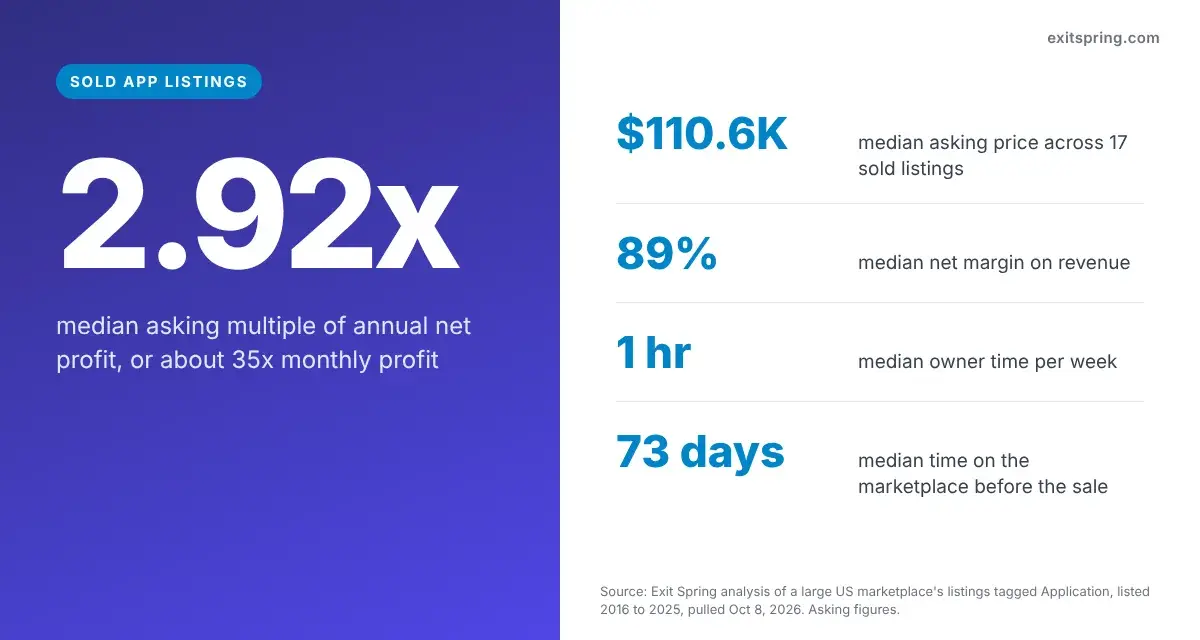
The median listing in that group asked $110,589 and took one hour of owner time a week. Eleven of the 17 kept 85% or more of their revenue as profit.
An app lives inside a developer account at Apple, at Google, or both, and neither company lets you hand over the login. You sign a purchase agreement with the buyer, and then each store moves the app from your account to theirs through its own transfer process.
How much is a mobile app worth?
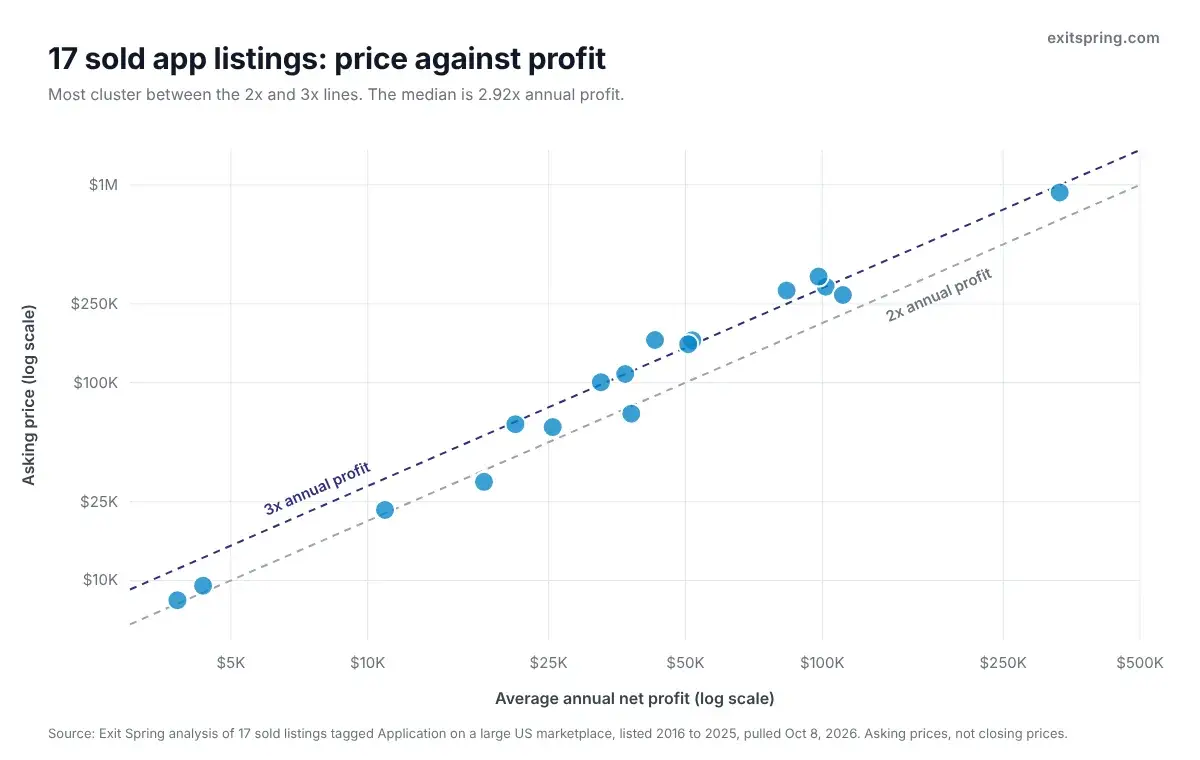
A profitable mobile app is usually priced at 2 to 3.5 times its annual net profit. In our sample of 17 sold app listings, the middle half asked between 2.17x and 3.08x, and the median was 2.92x. Apps earning under $25,000 a year asked closer to 2x.
Net profit in these listings works like seller's discretionary earnings (SDE). SDE is what the business earns in a year after store fees and running costs, with the owner's own pay and one-off costs added back. Buyers divide the asking price by that figure to get the multiple, and our own guide to how to value an online business walks through the add-backs line by line.
Asking multiples
| Group of sold app listings | Listings | Median asking multiple | Median asking price |
|---|---|---|---|
| All sold app listings, 2016 to 2025 | 17 | 2.92x | $110,589 |
| Listed 2022 to 2025 | 9 | 3.00x | $110,589 |
| Listed 2016 to 2021 | 8 | 2.54x | $107,974 |
| Under 3 years of earnings at listing | 6 | 2.25x | $64,637 |
| 3 years of earnings or more | 11 | 3.00x | $156,374 |
| Every sold listing on the marketplace, all business types | 2,670 | 2.58x | $92,500 |
The highest multiple in the group, 3.83x, belonged to a business software app listed in February 2025. It earned $42,866 a year, needed three hours a week, and sold after 10 days on the marketplace.
The lowest, 1.75x, was a 12-year-old subscription app earning $18,023 a year. Its profit had fallen 29% against the prior period, and it took 329 days to sell.
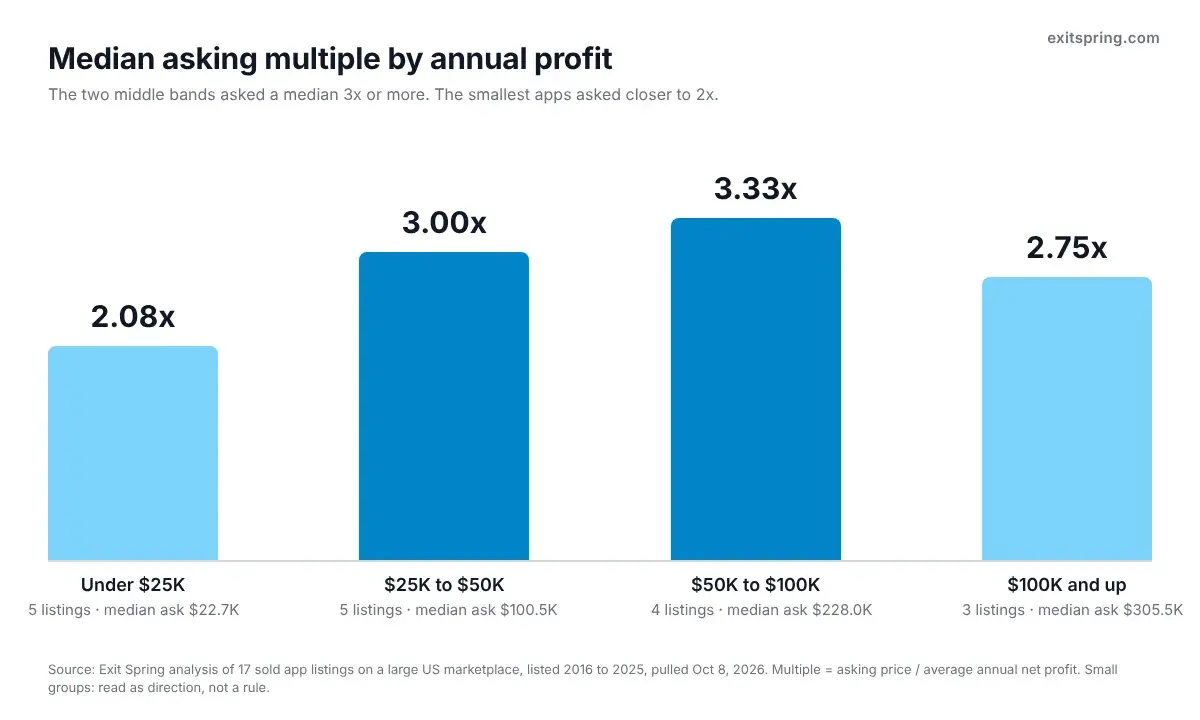
The five apps earning under $25,000 a year asked a median 2.08x, while the nine earning $25,000 to $100,000 asked a median 3.08x. Three apps cleared $100,000 a year, and they asked a median 2.75x, so treat the top band as a hint rather than a pattern.
Sensor Tower's State of Mobile 2026 report, published in January 2026, put 2025 in-app purchase revenue at $167 billion, up 10.6% on 2024, with non-game apps passing games for the first time.
Just 17.3% of newly launched apps reach $1,000 a month in revenue within two years. That figure comes from RevenueCat's State of Subscription Apps 2026, built on data from more than 115,000 apps.
Price drivers
| What changes the price | What a buyer looks at | Example |
|---|---|---|
| Revenue model | Share of revenue from auto-renewing subscriptions versus ads or one-time purchases | A habit tracker with 80% annual subscriptions reads as steadier income than a game earning only from banner ads |
| Platform spread | Revenue split between the App Store and Google Play | An iOS-only app loses half its addressable market if one store pulls it |
| Trend | Last 6 and 12 months of profit against the year before | The 1.75x app above had lost 29% of its profit |
| Age of earnings | Months since the first dollar of revenue | Our 6 apps with under 3 years of earnings asked 2.25x |
| Owner time | Weekly hours, and who answers support tickets | A 1-hour-a-week app with a contractor on call transfers more cleanly than a 20-hour solo build |
| Acquisition channel | Organic search in the store, paid ads, or one viral source | A meditation app getting 70% of installs from one App Store keyword carries ranking risk |
| Code and stack | Language, framework, third-party SDKs and their licenses | A Flutter app with one codebase for both stores is cheaper to maintain than two native apps |
Our online business multiples by type study puts apps beside other business models, and the app listings on our marketplace show current asking prices.
Due diligence for an app
Buyers check app revenue in the store dashboards themselves, shown live on a screen share or exported as reports.
App Store Connect keeps pre-transfer sales data with the seller's account. Google's earnings and payout reports stay behind when an app moves to a new owner.
Due diligence
| What the buyer checks | What to prepare | Example |
|---|---|---|
| Revenue | 24 months of App Store Connect and Google Play earnings reports, matched to bank deposits | A buyer ties $8,140 of App Store proceeds for June 2026 to the Apple payment that reached the seller's bank in early August |
| Subscribers | Active paid subscriptions, monthly churn, trial-to-paid conversion | 4,100 active subscribers with 4.8% monthly churn |
| Costs | Server, analytics and contractor invoices for the same 24 months | An AWS bill that rose from $210 to $350 a month after a feature launch |
| Installs | Downloads by source, store keyword rankings, paid ad spend | 62% of 2026 installs from App Store search, 21% from Apple Search Ads |
| Code | Repository access, build instructions, list of SDKs and their licenses | A buyer's developer builds both apps from a clean machine in under a day |
| Ownership | Signed copyright assignments from every contractor who wrote code or made artwork | A freelancer who drew the app icon in 2021 signs an assignment before closing |
| Store standing | Policy warnings, rejected updates, rating history | A 4.7 rating on 3,900 App Store reviews with no open policy notices |
Our full online business due diligence checklist covers the legal and financial items that apply to every business type.
Can you transfer an app to another developer account?
Apple and Google both let a developer move a live app to another developer account. The app keeps its reviews, ratings and current users. Apple processes a transfer in up to two business days after the buyer accepts, and Google Play support responds within two business days of the buyer's approval.
Apple App Store transfer
Only the Account Holder on the seller's Apple Developer Program membership can start a transfer, and they need two details from the buyer, the buyer Account Holder's Apple Account and the buyer's Team ID. The request stays pending until the buyer accepts it in App Store Connect or it expires after 60 days.
Apple sets out the conditions in its app transfer criteria. Both accounts must have accepted the latest paid and free agreements, the app needs at least one version released on the App Store, and it can't be on pre-order or waiting for review. No In-App Purchase product ID in the app can already be in use in the buyer's account, and Apple Arcade apps can't be transferred at all.
Before starting, the seller removes TestFlight builds, testers and test information, plus any Xcode Cloud data. An app with auto-renewable subscriptions needs an app-specific shared secret, which the seller creates and gives to the buyer so their servers keep validating receipts.
Some guides, including pages updated as recently as 2025, still say apps that use iCloud can't be transferred. Apple's current transfer overview says iCloud containers and user data move to the buyer once the transfer is accepted.
For apps with Sign in with Apple, the seller generates a transfer identifier for each user, and the buyer has 60 days from accepting the transfer to exchange those identifiers for their own user IDs.
Google Play transfer
On Google Play, the seller submits the transfer request in Play Console and the buyer approves it in their own account. Both sides need the registration transaction ID from their developer account, which Google says you can find by searching your email for the developer registration fee receipt.
Google's transfer page lists no fee for the transfer itself. A buyer without a Play developer account pays Google's one-time $25 registration fee to open one.
Users, download statistics, ratings and reviews, content ratings, the store listing, subscriptions and policy declarations all move to the buyer. Earnings, payout and estimated sales reports stay behind, along with orders placed before the transfer, promotions and test groups.
Apple and Google side by side
| Apple App Store | Google Play | |
|---|---|---|
| Who starts it | Seller's Account Holder in App Store Connect | Seller in Play Console |
| What the buyer provides | Apple Account and Team ID | Registration transaction ID |
| Fee | None for the transfer; $99 a year for the buyer's membership | None for the transfer; $25 once for a new account |
| How long | Up to 2 business days after the buyer accepts | Support responds within 2 business days of approval |
| Reviews and ratings | Move with the app | Move with the app |
| Subscriptions | Continue; seller hands over the shared secret | Move with the app |
| Sales history | Seller keeps it; buyer sees only later transactions | Earnings reports stay with the seller |
| Deadline | Request expires after 60 days | Not stated |
| Buyer uses a different default currency | Not covered on the transfer pages | An app earning only from in-app purchases is unpublished until the buyer reprices and republishes it |
The services that sit outside the stores
The store transfer moves the listing and its users. The code, the servers and the ad accounts that make the app run are separate, and each changes hands its own way.
Firebase handles a change of owner through project permissions. The seller adds the buyer as an Owner in the project's permission settings, Firebase sends an invitation that stays pending until the buyer accepts, and the seller can then remove their own access. Google's Play transfer page also tells sellers to unlink Firebase projects from the old Play account and relink them to the new one.
AdMob accounts can't be merged. A buyer who wants the ad revenue sets up ad units in their own AdMob account and ships an app update with the new IDs, which Google's transfer page describes as updating the ad SDK integrations.
Google began enforcing developer registration on September 30, 2026 in Brazil, Indonesia, Singapore and Thailand, with a global rollout planned for 2027, and its FAQ warns that a developer who loses a signing key can't register those app packages.
Closing the sale
In an escrow closing, the buyer funds escrow, the seller starts both store transfers, and the funds go to the seller only once the buyer confirms the app, its subscribers and its revenue now sit in their accounts.
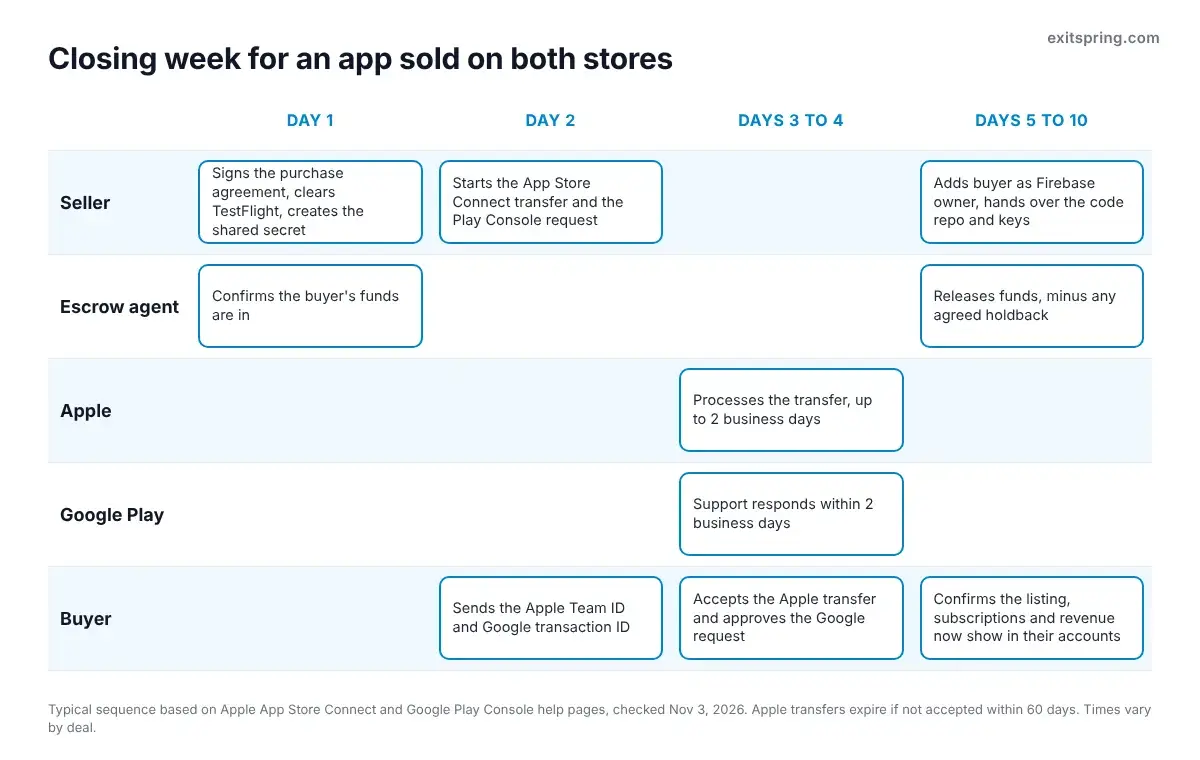
A holdback keeps part of the price back until the app proves itself under the new owner. A 90-day window suits a subscription app, long enough to see one or two renewal cycles and any drop in ratings after the handover. Our guide to seller financing and earnouts covers how to word these terms.
A composite sale: the Lumen sleep-sounds app
The numbers below are a composite built from typical deals and our listing data, not a single real sale. Lumen is a sleep-sounds app on both stores with a monthly and an annual subscription, run by its founder, Theo, and one freelance developer.
| Lumen, 12 months to July 2026 | Amount |
|---|---|
| App Store subscription billings | $96,000 |
| Google Play subscription billings | $34,000 |
| Store fees at 15% | -$19,500 |
| Proceeds paid to Theo | $110,500 |
| AWS and audio streaming costs | -$4,200 |
| Analytics and subscription tools | -$1,800 |
| Freelance developer | -$12,000 |
| Apple Search Ads | -$9,000 |
| Developer memberships and other software | -$1,500 |
| SDE | $82,000 |
Theo listed Lumen at $260,000, or 3.17x SDE. The first offer came in at $215,000 (2.62x) from a buyer who already owned two wellness apps.
They agreed on $235,000, which is 2.87x SDE and about 34 times monthly profit. The buyer paid $210,000 through escrow at closing and held back $25,000 for 90 days, payable if active paid subscribers stayed at 90% or more of the 4,100 counted at signing.
| Lumen deal date | Step |
|---|---|
| August 12, 2026 | Asset purchase agreement signed |
| August 13, 2026 | Both transfers started; buyer accepts the Apple transfer |
| August 17, 2026 | Google Play support completes the transfer |
| November 15, 2026 | $25,000 holdback due, 90 days later |
2026 store changes buyers will ask about
Store rules changed several times between late 2025 and October 2026. Buyers build their offer on the fees each store charges from the closing date onward.
2026 store changes
| Change | Date | What it means in a sale |
|---|---|---|
| Google Play allows alternative billing and external links for US users | October 29, 2025 | A buyer may plan to move US subscribers to web checkout |
| Google Play splits its fee into a service fee (10% on subscriptions and the first $1 million) and a 5% fee for Play Billing in the US, EEA and UK | June 30, 2026 | Subscriptions billed through Play still pay 15% in total; alternative billing pays 10% |
| Same Google Play fee structure in Australia and Japan | September 30, 2026 | Check which markets your Android revenue comes from |
| Android developer verification enforced in Brazil, Indonesia, Singapore and Thailand | September 30, 2026 | Buyers will ask for the signing key setup and registration status |
| Apple single EU business terms take effect, with a 5% Core Technology Commission for apps distributed outside the App Store | October 1, 2026 | EU App Store commission rates and payment options change too; the 5% applies to apps distributed outside the App Store |
| Apple App Review Guidelines last updated, US storefront still exempt from anti-steering rules | October 16, 2026 | US apps can link to outside purchase pages |
Apple's Small Business Program still charges 15% to developers earning up to $1 million in proceeds a year. Apple counts a transferred app's proceeds for that year against every account that starts or accepts the transfer, so a buyer whose combined proceeds pass $1 million can lose the 15% rate.
How long does it take to sell an app?
The 17 sold app listings spent a median 73 days on the marketplace before they sold. Listings from 2022 onward took longer, a median 105 days against 46.5 days for earlier ones. After the purchase agreement is signed, each store transfer adds about two business days.
Seven of the 17 apps sold within 60 days of listing, and five took more than 200. Our days-to-sell study breaks timing down for every business type.
How is the sale of an app taxed in the US?
A US app sale is usually structured as an asset sale, and both buyer and seller file IRS Form 8594 to report how the price is split across asset classes. The buyer amortizes the purchased software, goodwill and other intangibles over 15 years under Section 197 of the Internal Revenue Code.
Goodwill held more than a year is generally taxed at long-term capital gains rates. Payments for a consulting agreement or a non-compete count as ordinary income.
Code you wrote yourself is the exception app sellers miss. Under 26 U.S.C. § 1221(a)(3), a copyright held by the person whose own efforts created it isn't a capital asset, so a solo developer can owe ordinary income tax on the part of the price allocated to the software.
General information as of November 2026, not legal or tax advice. Our guide to taxes when selling an online business covers state taxes and installment sales, and sellers based abroad should read how to sell an online business from outside the US.
Frequently asked questions
Do reviews and ratings transfer when an app is sold?
Lumen's 3,900 App Store reviews moved to its buyer with the app. Apple's transfer overview says an app keeps its reviews and ratings, and Google lists ratings and reviews among the items that move in a Play transfer.
What happens to subscribers when an app changes owner?
Lumen's 4,100 paid subscribers kept renewing after the sale, with the revenue now landing in the buyer's accounts on both stores. On Apple, the seller has to create an app-specific shared secret before the transfer and give it to the buyer, whose server uses it to validate receipts. Orders placed before a Google Play transfer stay with the seller's account.
Can an app that uses iCloud be transferred?
An app that syncs notes through iCloud moves its iCloud containers and user data to the buyer once the transfer is accepted, according to Apple's current transfer overview. Some guides still list iCloud as a blocker, a limit Apple's current pages no longer include. Apps in Apple Arcade, and sandboxed Mac apps that share an App Group container with other apps, remain non-transferable.
Do I have to sell my whole developer account?
A seller with five apps can sell one and keep four. Both stores move individual apps between accounts, so the developer account itself stays with you. Selling the company that owns the account is a separate route, usually a stock sale, and it brings the company's other liabilities with it.
Can I sell an app with no revenue?
An app earning $0 has no profit to multiply, so buyers price it on downloads, ratings and code, usually through an auction marketplace such as Flippa. The smallest app in our sample earned $3,814 a year and asked $7,946.
Do I need to hand over the source code?
Lumen's buyer took over two repositories on closing day, one for iOS and one for Android, and built both apps before shipping the first update. Plan to transfer the repository, build instructions and any signing and API keys at closing, alongside signed copyright assignments from contractors who wrote code.
How do I work out what my app is worth before listing?
A seller earning $40,000 a year at our 2.92x median would expect asks near $117,000. Your own figure depends on trend, platform spread and owner hours. Our free valuation tool gives a range from your last 12 months of profit.
Ready to price your app? Start with the valuation tool, then read how selling with Exit Spring works or browse the marketplace to see what buyers are looking at this month.
How we researched this
| Item | What we did |
|---|---|
| Data source | Public listings from one of the largest US online business marketplaces, pulled October 8, 2026 |
| Sample | 17 sold listings tagged Application, listed 2016 to 2025; 4 more for sale were left out of the medians |
| Multiple | Asking price divided by average annual net profit; asking figures, not final sale prices |
| Store rules | Checked on Apple and Google help pages and developer blogs on November 3, 2026 |
Sources
- Apple Developer, Overview of app transfer, App Store Connect Help, checked November 3, 2026
- Apple Developer, App transfer criteria, checked November 3, 2026
- Apple Developer, Initiate an app transfer
- Apple Developer, Accept an app transfer
- Apple Developer, Enrollment, Apple Developer Program
- Apple Developer, Transferring your apps and users to another team, Sign in with Apple documentation
- Apple Developer, App Store Small Business Program
- Apple Developer, App Review Guidelines, last updated October 16, 2026
- Apple Developer News, EU business terms update, August 18, 2026
- Google Play Console Help, Transfer apps to a different developer account, checked November 3, 2026
- Google Play Console Help, Service fees
- Google Play Console Help, Changes to Google Play in the US
- Android Developers Blog, Expanded billing choice on Google Play, June 24, 2026
- Android Developers, Android developer verification
- Android Developers, Developer verification FAQ, last updated September 30, 2026
- Firebase Help, Manage project members and permissions
- Google AdMob Help, Users FAQ
- Sensor Tower, State of Mobile 2026, January 2026
- RevenueCat, State of Subscription Apps 2026, 2026
- IRS, About Form 8594, Asset Acquisition Statement Under Section 1060
- Legal Information Institute, 26 U.S. Code § 197
- Legal Information Institute, 26 U.S. Code § 1221
- Empire Flippers public marketplace listings, pulled October 8, 2026 (Exit Spring analysis of sold app listings)
Get new listings in your inbox
Fresh businesses for sale every Monday, plus practical buying and selling tips.
Unsubscribe anytime. No spam.
Keep reading
How to Sell an Amazon KDP Business in 2026: Price, Account Merges and the New Title Limits
How to Sell a YouTube Channel in 2026: Price, Ownership Transfer and the 2027 Partner Program Change
How to Sell a Content Website in 2026: Value, Google Risk and Moving Ad and Affiliate Accounts
Ready to make a move?
Browse vetted online businesses or get a free valuation of yours.