
How to Sell an Amazon KDP Business in 2026: Price, Account Merges and the New Title Limits
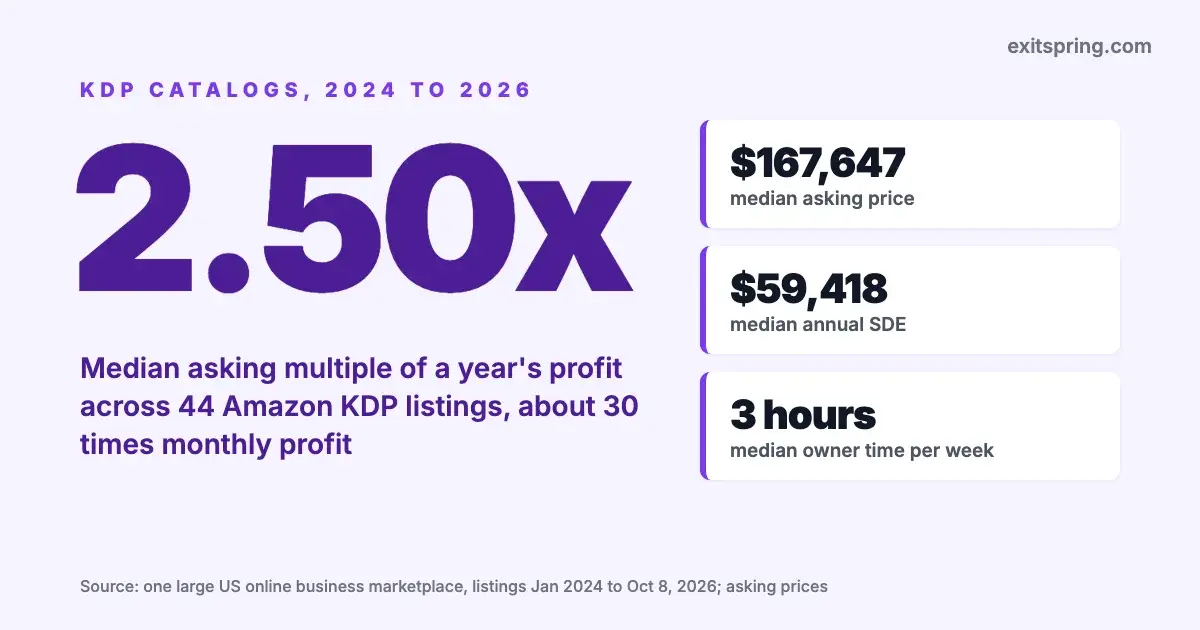
Amazon KDP publishing businesses listed from January 2024 to October 8, 2026 asked a median 2.50 times a year's profit, across 44 listings on one of the largest US online business marketplaces.
Amazon reported $69.3 million of total KDP Select author earnings for September 2026 on its KDP Select help page. Most of that comes from the monthly KDP Select Global Fund, which pays for page reads, and it is only the subscription side of the business. Sales royalties on ebooks, paperbacks and hardcovers come on top.
Amazon changed KDP three times between July and October 2026.
| Date | KDP change | What a buyer now asks the seller |
|---|---|---|
| July 7, 2026 | The top of the 70% ebook royalty band on Amazon.com rose from $9.99 to $12.99 (KDP) | Which titles were repriced, and in which month |
| September 21, 2026 | New titles capped at 2 per book format each week, with a matching cap on first submissions (KDP; Vappingo) | How many titles a new owner can add before the next holiday season |
| October 22, 2026 | Kindle Unlimited renamed Kindle+, with audiobooks added for US subscribers and paid from the same Global Fund (KDP; Written Word Media) | How much income comes from page reads, and whether it moved after October |
What is an Amazon KDP business worth in 2026?
An Amazon KDP business listed between 2024 and October 2026 asked a median 2.50 times its annual seller's discretionary earnings (SDE), which is about 30 times monthly profit. SDE is the profit before the owner pays themselves. Half of the 44 listings asked between 2.25x and 2.92x, and the 32 that had sold by October 8 asked a median 2.71x.
| KDP listings, 2024 to October 8, 2026 | Listings | Median asking multiple |
|---|---|---|
| All | 44 | 2.50x |
| Sold by October 8 | 32 | 2.71x |
| Still for sale on October 8 | 12 | 2.30x |
| Listed in 2024 | 15 | 2.92x |
| Listed in 2025 | 16 | 2.71x |
| Listed in 2026 | 13 | 2.25x |
| Nonfiction catalogs | 23 | 2.50x |
| Coloring, puzzle and low-content catalogs | 15 | 2.50x |
| Earning for under 2 years when listed | 13 | 2.33x |
| Earning for 4 years or more | 20 | 2.83x |
The median asking price was $167,647 against median SDE of $59,418. The median owner reported 3 hours of work a week. Sold listings took a median 64 days from listing to sale.
Rows with under 20 listings point in a direction and prove little on their own. We counted every listing with KDP income, sold or not, so these figures differ from our online business multiples by type, which counted 27 sold listings since 2024 whose first income source was KDP, at 2.75x.
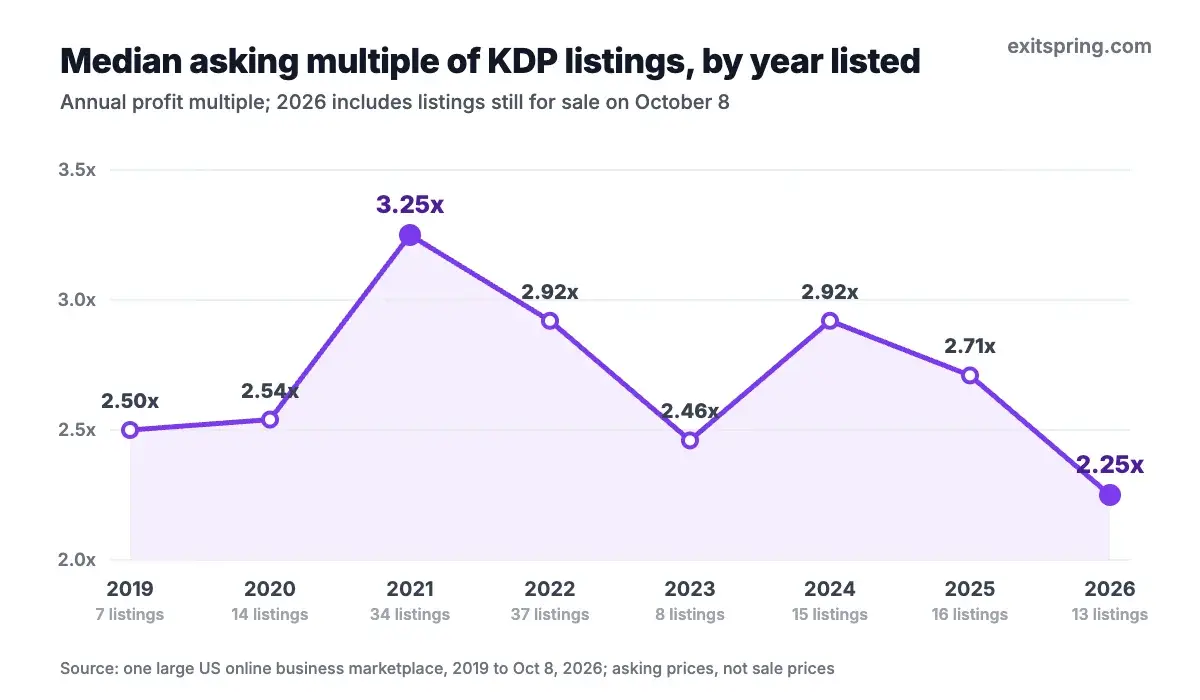
Listings from 2021 asked a median 3.25x, the highest of any year since 2019. The 2026 row mixes 5 sold listings with 8 still for sale. Our data can't tell whether the unsold ones will sell at their asking prices or come down. Our guide to how to value an online business walks through the SDE calculation a buyer will repeat.
What buyers are buying
Of the 152 KDP listings in our data from 2015 to 2026, about 95 were nonfiction catalogs, 35 sold coloring, puzzle or low-content books, about 15 were fiction and 7 were children's books. We sorted each listing by the words in its title and summary, then checked the fiction group by hand, so a catalog of puzzle books and travel guides counts once.
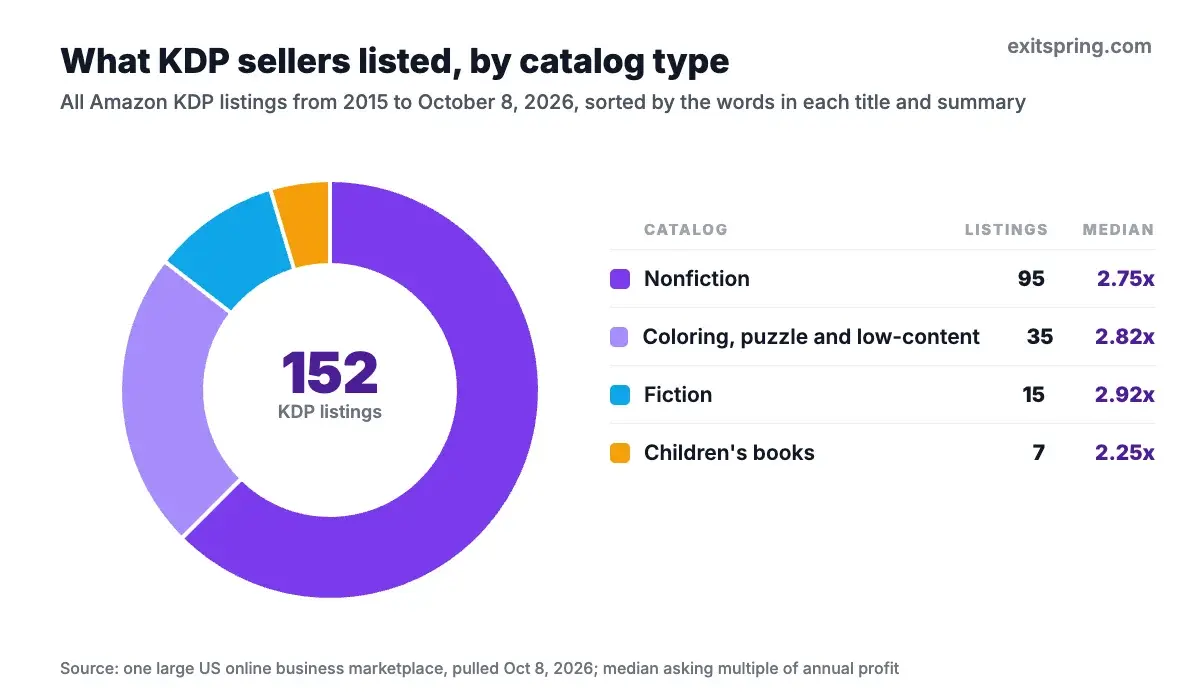
Across all years the four groups asked within a narrow range, from 2.25x for children's books to 2.92x for fiction.
| KDP listings, 2015 to 2026 | Listings | Median asking multiple |
|---|---|---|
| Under 30 titles | 35 | 2.92x |
| 30 to 149 titles | 52 | 2.54x |
| 150 titles or more | 39 | 2.82x |
| Earning for under 2 years when listed | 55 | 2.58x |
| Earning for 2 to 4 years | 50 | 2.67x |
| Earning for 4 years or more | 47 | 2.92x |
Of the 152 listings, about 125 stated how many titles they held, and the median was about 65.
KDP's own definition of a low-content book covers notebooks, planners, diaries, prompt journals and log books (KDP). Coloring and puzzle books usually fall outside it. A low-content title can't use the free KDP ISBN, and Expanded Distribution to bookstores and libraries "is not supported for low-content books, regardless of the ISBN option you select."
In July 2024 a catalog of 1,900 adult coloring books, each under its own author name, asked 2.33x. At 2 new paperbacks a week, KDP's limit since September 21, 2026, building it again would take more than 18 years.
Of the 152 listings, 85 mentioned pen names or several author profiles, and the 55 that gave a number had a median of 7. KDP allows pen names but asks every account to enter the owner's legal name on its "Your identity" page, so Amazon knows who stands behind them (KDP).
Royalties a buyer will check
| Income line | Royalty rule on Amazon.com in October 2026 |
|---|---|
| Ebook, $2.99 to $12.99 | 70% of list price after a delivery cost of $0.15 per MB is deducted (KDP) |
| Ebook outside that band | 35% of list price |
| Paperback at $9.99 or more | 60% of list price minus printing cost (KDP) |
| Paperback at $9.98 or less | 50% of list price minus printing cost |
| Paperback through Expanded Distribution | 40% of list price minus printing cost |
| Kindle+ reading and listening | A share of the monthly KDP Select Global Fund, by pages read or listened |
A 70% ebook also has to be priced at least 20% below the book's print edition on Amazon. KDP says it pays royalties about 60 days after the end of the month of sale (KDP Terms), so a seller's last two months of royalties arrive after a sale closes.
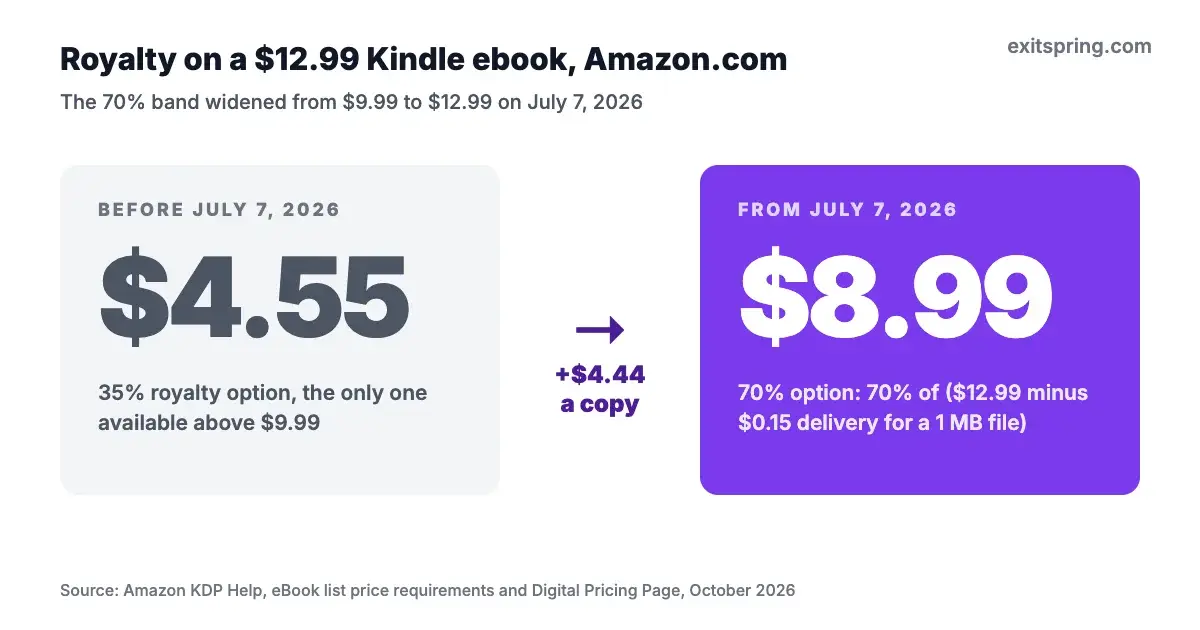
A $12.99 ebook earned $4.55 a copy at 35% before July 7, 2026. At 70%, with a 1 MB file, the same copy now earns $8.99. Existing books did not switch on their own. Amazon's FAQ on the change says "Your current price and royalty option stay the same unless you choose to make a change," so a seller who repriced after July 7 has at most two full months of the higher royalty, August and September, to show a buyer in October.
KDP Select requires the ebook to be "exclusive to the Kindle Store for the KDP Select enrollment period," and each 90-day enrollment renews automatically unless the publisher turns renewal off (KDP). Since October 22, 2026, audiobook listening is paid from the same fund. Amazon says it is "investing additional funds" to cover the audio side (KDP). KDP announces each month's fund near the 15th of the following month (KDP), so the October 2026 figure is due around November 15.
Before you list
| Step | What to do | On the woodworking catalog |
|---|---|---|
| Title list | One row per title with format, ASIN or ISBN, pen name, KDP Select status and 12 months of royalties | 58 rows, sorted by royalties, with the deck-building guide at the top |
| Royalty proof | Download monthly royalty reports and match each payment to a bank deposit | 24 months matched before the listing went live |
| Contracts | Collect signed agreements from ghostwriters, illustrators, cover designers and narrators | Two cover designers had never signed one, and both did before the sale |
| AI record | Note which titles used AI for text, images or translation, and what was disclosed to KDP | A one-page log, title by title |
| Advertising | Export campaign settings, keywords and 12 months of ad results | 41 campaigns exported as spreadsheets |
| Titles to keep | Unpublish any title you won't sell before the merge and keep its files, then republish it from a new account afterwards, since a merge takes every published book and KDP allows one account at a time | Marcus kept no titles back |
Of the 152 listings, 43 said ghostwriters wrote some or all of the catalog. A buyer of a ghostwritten catalog asks to see each writer's signed agreement.
Can you sell a KDP account?
An Amazon KDP account can't be sold as a login. KDP's terms allow a publisher one account at a time and bar letting "any third party" use the program through your account. Amazon does allow two routes. Its help pages describe merging one KDP account into another, which brokers use to move a catalog to the buyer, and the terms let the seller assign the agreement to a buyer's company when selling all or substantially all of the business's assets.
| KDP Terms, updated October 21, 2026 | Rule |
|---|---|
| Section 4.2 | "You may maintain only one account at a time" |
| Section 4.3 | No third party may use the program through your account |
| Section 10.3 | Rights may pass "to any corporation or other entity without consent in connection with the sale of all or substantially all of your assets" |
| Section 10.3, notice | Written notice to Amazon within ten business days of the assignment |
KDP's help page is just as clear about single books. "We cannot move specific books from one account to another," it says (KDP). A seller can't sell their top ten titles and keep the rest in the same account.
Of the 18 KDP listings posted on the marketplace from October 14, 2025 onward, 13 told buyers they could "either take over the full KDP account or merge the books into an existing account." Taking over a personal account by changing its login details runs into section 4.3 of the KDP terms, so a buyer who wants the whole account usually buys the company that owns it.
Three ways to transfer a KDP catalog
| Route | How it works | What the buyer gives up |
|---|---|---|
| Account merge | Seller emails KDP from the address on the old account, names one live book and its ASIN or ISBN, and asks Amazon to merge it into the buyer's account | Sales reports, active ads and A+ Content stay behind |
| Company sale | Buyer buys the company that holds the KDP account and updates the authorized representative on the "Your identity" page | Nothing moves; the buyer inherits the company's tax history and any old account problems |
| Republishing | Seller unpublishes; buyer uploads the files to their own account as new titles | Every title starts as a new product page and uses the buyer's weekly title allowance |
A merge needs at least one live book in the account being merged and complete tax and bank details on both accounts. KDP lists what it does not carry over: the old account information, the tax profile, sales reports, payment information, active ads and A+ Content. The seller should take down ads on the old account first. KDP adds that reports "will no longer be accessible with the old account," so the seller downloads them before asking.
Flippa's KDP transfer guide, prepared in March 2025, says Amazon may take 24 to 72 hours to process a merge once both sides reply.
The company route depends on the account already sitting in a company. KDP's identity page says that when a business's authorized representative changes, the account holder updates the representative's details and verifies that person's identity. A buyer taking over a seller's company also takes over its old contracts and tax filings, so the purchase agreement has to cover them.
A 58-title catalog in ebook, paperback and hardcover needs 13 weeks to republish at 2 new titles per format each week.
What a merge leaves behind
| Item | What happens | On the woodworking catalog |
|---|---|---|
| Sales reports | Inaccessible from the old account after the merge | Marcus downloaded 36 months of royalty reports first |
| Amazon Ads | Active ads don't carry over, and the buyer runs ads from their own account | The buyer rebuilt 41 campaigns in the first week |
| A+ Content | Has to be recreated in the new account | Images and text for 12 product pages were handed over as files |
| Audiobooks | ACX titles sit under a separate Audible agreement, outside the KDP merge | Nine audiobooks were listed in the purchase agreement as a separate transfer |
| Copyright | Moves only by a signed written assignment (17 U.S.C. § 204) | A schedule of all 26 manuscripts and covers was attached |
| Outstanding royalties | KDP pays them about 60 days after each month ends | Royalties for sales before the merge date went to Marcus, whichever account received them |
Of the 152 KDP listings in our data, 66 warned buyers that royalties arrive 30 to 90 days late and that money still due to the seller would be settled after the handover.
Buyer checks
| Check | What the buyer looks at | The woodworking catalog's answer |
|---|---|---|
| Royalties | 24 months of KDP royalty reports against bank deposits | Reports matched deposits within $40 a month |
| Advertising | Ad spend as a share of royalties, by month | Ads took 23% of revenue |
| Kindle+ share | Page-read income as a share of the total | 18% of revenue, up from 12% two years earlier |
| Concentration | Revenue from the top three titles | 44%, led by a deck-building guide |
| AI disclosure | Which titles used AI for text, images or translation | No AI text; two covers used AI images, disclosed to KDP |
| Rights | Contracts for ghostwriters, illustrators and narrators | Seventeen ghostwritten books, each with a signed copyright assignment |
| Account health | Takedowns, content warnings and identity checks | One title paused in 2024 over a trademark in its subtitle, since fixed |
KDP's content guidelines define AI-generated content as "text, images, or translations created by an AI-based tool," and say it stays AI-generated "even if you applied substantial edits afterwards" (KDP). Publishers must tell KDP about it when publishing. A book written by a person and edited with AI tools doesn't need the disclosure.
| AI in KDP listings, 2024 to 2026 | Listings |
|---|---|
| Used AI tools in production, or sold them as assets | 7 |
| Named AI only as a way to grow | 1 |
| Seller stated no AI wrote the book texts | 1 |
| No mention of AI | 35 |
One health catalog listed in October 2026 was translated into four languages with AI-assisted tools. KDP counts AI translations as AI-generated.
The woodworking catalog (composite)
Marcus and his catalog are a composite we built for this guide, not a real sale. He published 26 woodworking and home-repair books under three pen names, 26 as ebooks and paperbacks and 6 also in hardcover, for 58 KDP titles.
In the 12 months to August 2026 the catalog earned $107,500 in royalties and spent $36,080, of which $24,600 went on Amazon Ads, for SDE of $71,420.
Marcus asked $193,000, or 2.70 times SDE. The buyer, who ran an LLC publishing gardening guides, offered $160,000 after finding that the deck-building guide alone earned 19% of royalties and that new titles were now limited to 2 per format each week. They agreed on $172,000, about 2.41 times SDE or 29 times monthly profit.

The buyer paid $152,000 at closing on September 28, 2026. Marcus emailed KDP the same day from the address on his account, naming one live title and its ASIN, and Amazon confirmed the merge on October 2. The remaining $20,000 is held back until the first KDP royalty payment into the buyer's account, due in late December for October sales, matches the October reports.
Marcus had written nine of the books himself. The other seventeen were ghostwritten, which mattered for his tax bill.
Taxes on a KDP sale
Both sides report how the price splits across the assets on IRS Form 8594. Under 26 U.S.C. § 1221(a)(3), a "literary, musical, or artistic composition" held by the taxpayer "whose personal efforts created such property" is not a capital asset (law.cornell.edu). An author selling books they wrote may therefore owe ordinary income tax on the part of the price allocated to those copyrights, while goodwill may get capital gains treatment. Titles bought from ghostwriters under signed copyright assignments may also fall outside the rule, and an adviser should confirm the split before the allocation is signed.
On the buyer's side, copyrights acquired as part of buying a business are section 197 intangibles, amortized over 15 years (26 U.S.C. § 197). Our guide to taxes when selling an online business covers installment sales and state tax.
Questions sellers ask
How much is a KDP business making $5,000 a month worth?
Marcus's composite catalog earned $71,420 of SDE in a year, about $5,950 a month, and sold for $172,000. At the median of 2.50 times annual profit in our 2024 to 2026 data, $5,000 a month of SDE points to an asking price near $150,000. Ad spend counts against that profit before the multiple is applied.
Can I sell some of my books and keep the rest?
KDP's help page says Amazon "cannot move specific books from one account to another," and a merge moves every published book in the account. A seller who wants to keep some titles has to unpublish them before the merge and republish them from a new account afterwards, since KDP's terms allow one account at a time. Each republished title counts against the 2-per-format weekly limit.
Can I sell a low-content KDP account?
A coloring catalog of 1,900 titles asked 2.33x in July 2024, and low-content catalogs in our 2024 to 2026 data asked a median 2.50x. A geography catalog listed in August 2024 held more than 1,000 books, of which 148 were earning, and buyers count the earning titles before they price the rest.
Do I lose my reviews and rankings in a merge?
All 58 of Marcus's titles moved to the buyer's account in one merge, completed on October 2 in our composite example. KDP's help page says a merge "will move your published books" and lists sales reports, active ads and A+ Content among what stays behind; reviews aren't on that list. Republishing creates new product pages, which start without the old pages' history.
How long does it take to sell a KDP business?
The 32 KDP listings in our data that sold since 2024 took a median 64 days from listing. The merge itself took four days in our composite example, and Flippa's guide puts Amazon's processing time at 24 to 72 hours. Our guide on how long it takes to sell an online business breaks that down by business type.
Does Kindle+ change how buyers value page reads?
KDP Select authors earned $69.3 million in total for September 2026, the last full month before audiobooks joined. Buyers will compare page-read income before and after October 22, 2026, and may weigh Kindle+ income below sales royalties until a few months of the new fund have been reported.
Can a buyer outside the US take over a KDP catalog?
A buyer in Hong Kong or Germany can receive a merged catalog once their own KDP account has complete tax and bank details, the condition KDP sets for both accounts. KDP Select is open to authors "regardless of where you live." Our guide to selling an online business from outside the US covers cross-border payments.
Can I sell a KDP catalog written with AI?
Nine of the 44 listings since 2024 mentioned AI, and seven described using AI tools. KDP allows AI-generated books but requires publishers to disclose AI-generated text, images and translations, so a buyer will ask which titles were disclosed and when.
Selling through Exit Spring
Run your catalog's numbers through the free valuation tool, then see how selling works. Our due diligence checklist lists the financial records buyers request. Buyers looking for publishing businesses browse our Amazon KDP businesses for sale. If you also run a physical product brand, our guide to selling an Amazon FBA business covers the Seller Central side.
Sources
- Amazon KDP Help: Manage your KDP account (merging and closing); eBook list price requirements; Digital pricing page and delivery costs; Paperback royalty; Create a book (title limits)
- Amazon KDP Help: Kindle+; KDP Select; KDP Select enrollment and earnings; KENP and Global Fund timing; Low-content books; Content guidelines; Identity and pen names
- Amazon: KDP Terms and Conditions, last updated October 21, 2026
- Vappingo: KDP publishing limit, September 2026; Written Word Media: Kindle Unlimited is now Kindle+, October 22, 2026
- Flippa: KDP account transfer guide, March 2025
- US law: 17 U.S.C. § 204; 26 U.S.C. § 1221; 26 U.S.C. § 197; IRS Form 8594
- Listings data: Empire Flippers public listings, 2,855 listings pulled October 8, 2026, of which 152 had Amazon KDP income; asking prices, not sale prices
General information as of November 2, 2026, not legal or tax advice. KDP changed its royalty band, title limits and subscription program in 2026; check each help page before you start a transfer.
Get new listings in your inbox
Fresh businesses for sale every Monday, plus practical buying and selling tips.
Unsubscribe anytime. No spam.
Keep reading

How to Sell a YouTube Channel in 2026: Price, Ownership Transfer and the 2027 Partner Program Change

How to Sell a Content Website in 2026: Value, Google Risk and Moving Ad and Affiliate Accounts

How to Buy an Online Business With an SBA Loan in 2026: Rules, Down Payment and Requirements
Ready to make a move?
Browse vetted online businesses or get a free valuation of yours.