
How to Buy a SaaS Business in 2026: Prices, Churn, Code and Due Diligence
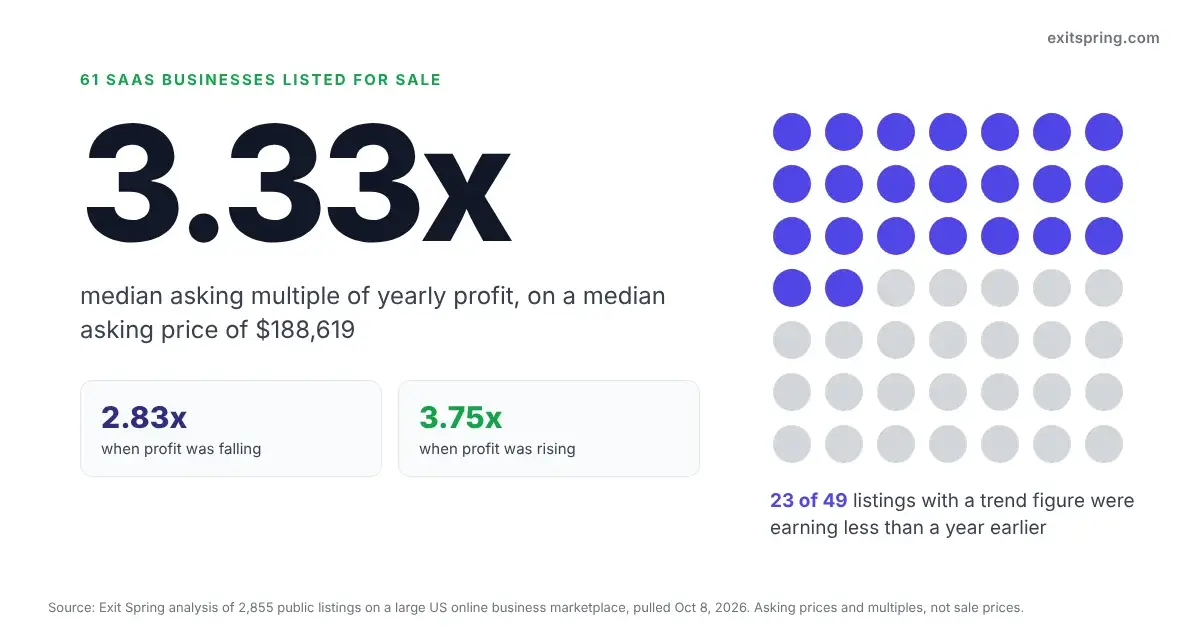
The 61 SaaS businesses listed on one of the largest US online business marketplaces, pulled October 8, 2026, asked a median $188,619, or 3.33 times yearly profit, and 23 of the 49 that reported a profit trend were earning less than a year earlier.
Buying a SaaS business means taking over software that customers pay for by subscription, along with its code, its payment account and its customer list. Our guide to selling a SaaS business covers the founder's side of the same deal. Every figure below comes from the buyer's side of the table.
How much does a SaaS business cost?
A small SaaS business costs a multiple of its yearly profit. In our October 2026 data, 61 SaaS listings asked a median $188,619 on a median $50,239 of yearly profit, and 38 of the 61 asked under $250,000. The middle half of asking prices ran from about $82,000 to $354,000. The same listings kept a median 71% of revenue as profit, and the median owner reported three hours of work a week.
| Asking price | SaaS listings | Median asking multiple | Median yearly profit | Median owner hours a week |
|---|---|---|---|---|
| Under $50,000 | 10 | 2.25x | $17,671 | 3 |
| $50,000 to $100,000 | 8 | 3.33x | $21,459 | 1 |
| $100,000 to $250,000 | 20 | 3.58x | $48,140 | 3.5 |
| $250,000 to $500,000 | 15 | 3.50x | $101,415 | 3 |
| $500,000 or more | 8 | 4.29x | $310,249 | 4 |
Sellers of larger SaaS businesses often quote a multiple of revenue. We worked out all three versions for the same listings.
| How the asking price was measured | Listings | Median | Spread |
|---|---|---|---|
| Asking price divided by yearly profit | 61 | 3.33x | 2.50x to 4.00x for the middle half |
| Asking price divided by yearly revenue | 61 | 2.16x | 1.58x to 2.98x for the middle half |
| Asking price divided by 12 months of current MRR | 21 | 2.35x | 0.69x to 6.32x, lowest to highest |
MRR is monthly recurring revenue, the subscription income a business would collect in a month if nothing changed. Stripe's billing documentation defines it as the monthly-normalized value of all active and past-due subscriptions, with a $600 yearly plan counted as $50 a month.
Only 21 of the 61 listings published an MRR figure, and all 21 were listed in 2022 or later.
Age moved the asking multiple as well. Our seller guide found that SaaS businesses under three years old asked a median 2.50x, and those more than six years old asked 3.67x.
Six of the 61 listings were still for sale on October 8, 2026. They asked from about $109,000 to $2.6 million, at a median 3.10x, and three of the six had been listed for more than 300 days. Our study of multiples by business type compares SaaS with other models, and how to value an online business explains the profit figure behind the multiple.
23 of 49 SaaS listings had falling profit
Forty-nine of the 61 listings reported how profit had changed over the past year. Twenty-three showed a fall and 26 showed a rise. The median fall was 23% and the median rise was 29%.
| Profit trend at listing | SaaS listings | Median asking multiple | Median asking price | Median days on the marketplace |
|---|---|---|---|---|
| Falling | 23 | 2.83x | $221,811 | 89.5 |
| Rising | 26 | 3.75x | $219,409 | 57.5 |
| Fell 20% or more | 14 | 2.88x | $188,583 | 87 |
| Rose 20% or more | 16 | 3.83x | $298,986 | 56 |
Revenue moved the same way. Twenty-seven of the 48 listings with a revenue trend had falling revenue, and they asked a median 2.92x against 3.83x for the 21 with rising revenue.
Among listings from 2021 onward with a trend figure, 20 of 43 SaaS businesses (47%) had falling profit, against 449 of 1,346 listings of every other model (33%).
A SaaS business with falling profit asked 0.92 of a turn less than one with rising profit. On the median $50,239 of profit, that gap is about $46,000.
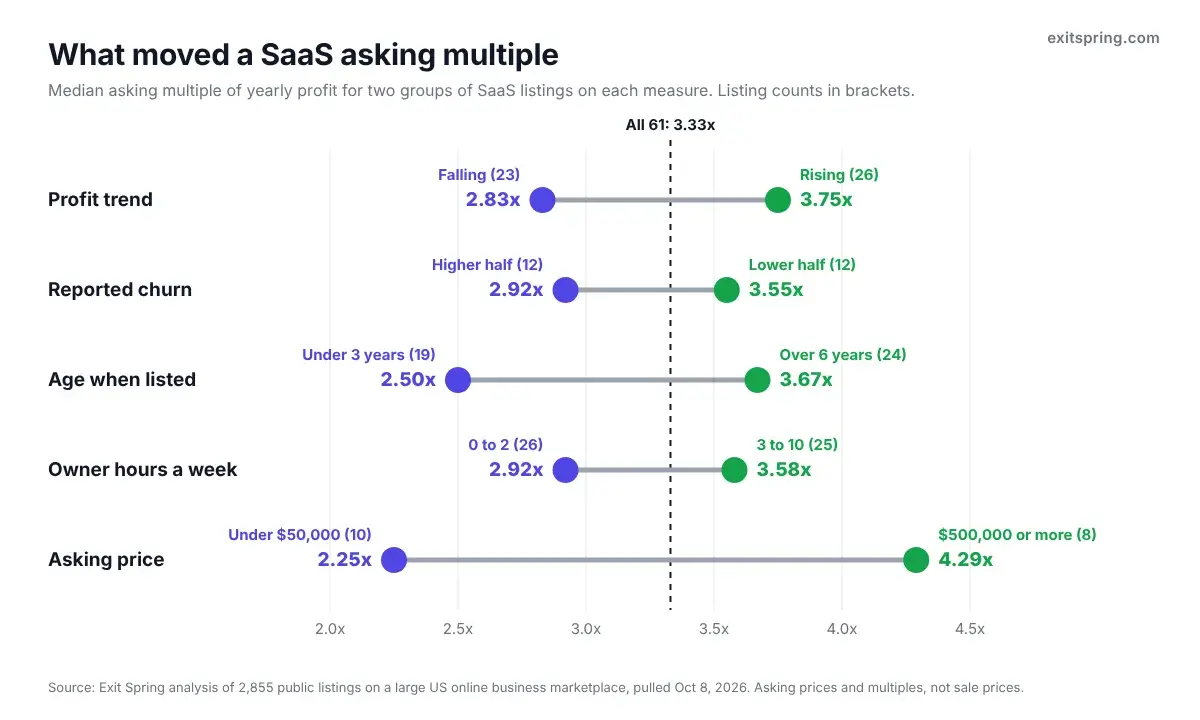
Our data can't show why a SaaS business was shrinking when its owner listed it. Fifty-three of the 61 sellers gave a reason for selling that mentioned other projects, businesses or opportunities.
What does churn tell a SaaS buyer?
Churn is the share of subscribers or subscription revenue a SaaS business loses in a period, and it tells a buyer how much of the revenue being bought will still be there a year later. In our data, 24 SaaS listings reported a churn figure. The median was 7.35%, and the lower-churn half asked 3.55x against 2.92x for the higher-churn half.
| Reported churn | SaaS listings | Median asking multiple | Median asking price |
|---|---|---|---|
| 6% or less | 10 | 3.63x | $221,722 |
| Above 6%, up to 10% | 5 | 2.92x | $126,000 |
| Above 10% | 9 | 2.92x | $188,619 |
The feed does not say what period each churn figure covers. Two listings described theirs as monthly, and none described it as yearly. All 24 figures came from listings dated 2022 or later. In four listings, the churn figure in the data field differed from the one in the seller's own description, 15.4% against "around 17.5%" in one case.
Stripe's documentation defines the subscriber churn rate as the subscribers who churned in the past 30 days, divided by the subscribers active 30 days ago plus the new subscribers added since. A business that started the month with 1,000 subscribers, added 100 and lost 100 has a rate of 9.1%.
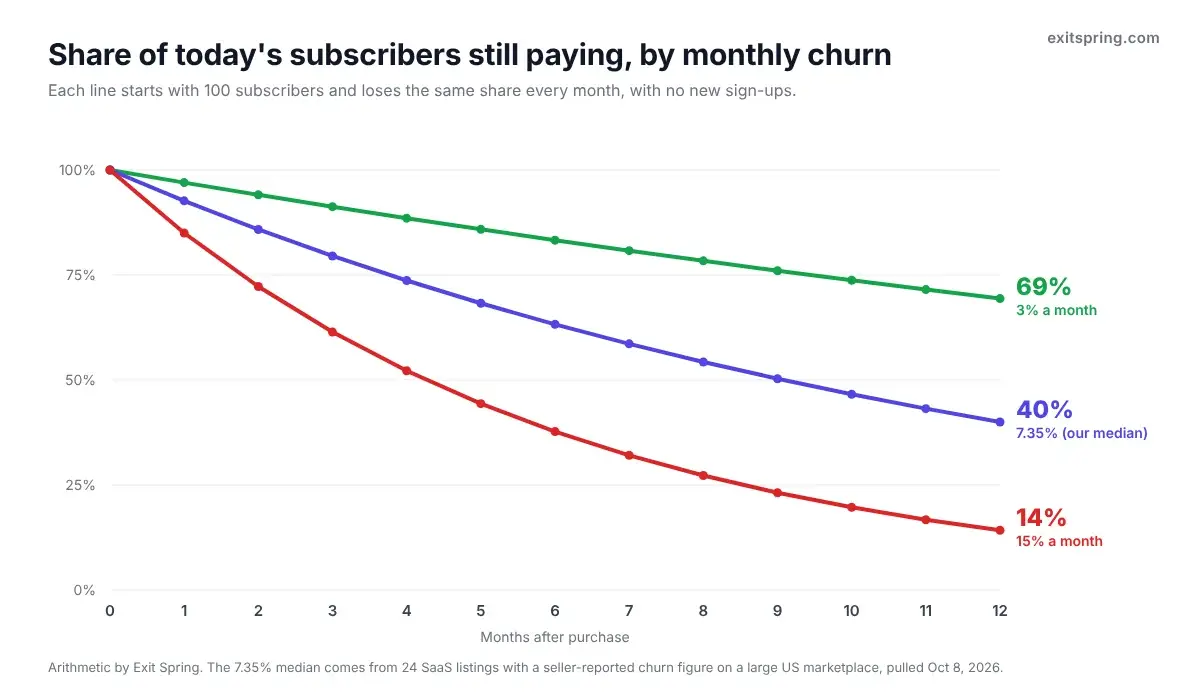
| Monthly churn | Share of today's subscribers left after 5 months | Left after 12 months |
|---|---|---|
| 3% | 86% | 69% |
| 5% | 77% | 54% |
| 7.35% (the median in our data) | 68% | 40% |
| 10% | 59% | 28% |
| 15% | 44% | 14% |
Stripe's own example uses 10% monthly churn and arrives at the same 59% after five months. A business at the 7.35% median loses six in ten of today's subscribers within a year.
For scale, SaaS Capital's 2026 survey of more than 1,000 private B2B SaaS companies, published April 24, 2026, put median gross revenue retention at 91% a year for bootstrapped companies with $3 million to $20 million of yearly recurring revenue. Those companies are many times the size of the listings in our data, where the median MRR was $6,200.
| What three sellers said about their own churn figure | Reported churn |
|---|---|
| A Shopify app seller said a higher rate is common for Shopify apps, and that the app serves newer stores | 15.4% |
| A seller said Stripe showed a higher rate than the reported figure, which the seller had adjusted for canceled subscribers who later reactivate | 24% |
| A seller with yearly plans and a few older monthly plans called churn low | 3.3% |
Who maintains the code after the sale?
Someone has to keep the software running, and in a small SaaS business that person is often the seller. In our data, at least 13 of the 61 SaaS listings put bug fixes, new features or other technical work among the owner's own tasks, and 32 mentioned a developer, a programmer or a development team.
| What we checked in the 61 SaaS listings | Listings |
|---|---|
| Mentioned customers or support among the owner's tasks | 51 |
| Named the programming language, framework or host | 42 |
| Mentioned a developer, programmer or development team | 32 |
| Listed source code or a code repository among the assets for sale | 26 |
| Listed bug fixes, new features or other technical work among the owner's tasks | 13 |
| Carried a risk line about the buyer's unfamiliarity with the coding language and tech stack | 8 |
| Named development or technical help in the seller's support offer | 7 |
Source code appeared by name in the asset list of 26 listings. Most of the other 35 used wording such as "all site content/files", which a buyer should ask the seller to spell out in the purchase agreement.
| Owner hours a week | SaaS listings | Median asking multiple | Median asking price |
|---|---|---|---|
| 0 to 2 | 26 | 2.92x | $132,190 |
| 3 to 10 | 25 | 3.58x | $212,302 |
| 11 or more | 10 | 3.08x | $188,501 |
Of the 60 listings that stated a support period, 41 named 30 days, eight of them as a minimum. One listing from 2018 said its sellers were not developers, had outsourced development of the Java application, and that the developers were not yet aware of the sale.
US copyright law requires a transfer of copyright ownership to be in writing and signed by the owner (17 U.S.C. § 204(a)). Code written by a contractor with no signed assignment may still belong to the contractor, a point our seller guide covers under code written by contractors.

SaaS due diligence
| Area | What to request | Example |
|---|---|---|
| Revenue | Read-only access to the payment account and 12 months of bank statements | Stripe's "MRR per subscriber per month" report matched to deposits |
| MRR against revenue | A split of revenue into subscriptions, yearly plans, one-time fees and services | In 10 of the 21 listings with an MRR figure, 12 months of MRR came to less than 80% of reported yearly revenue |
| Churn | The seller's definition, then Stripe's "Customer MRR changes" report for every cancellation | Kilnroster (composite): 119 cancellations in 12 months on about 248 subscribers, or 4% a month |
| Customers | Revenue by customer, largest first | One listing earned from 419 users spread across 19 companies |
| Code | Repository access for a reviewer, a list of every contributor and their signed assignments | A six-hour paid review by an outside developer |
| Hosting and tools | Every account the software needs, its owner and its monthly cost | AWS, a database host, an email service and an error tracker |
| Platform dependence | The platform's rules and the app's review history | Eight listings mentioned Shopify, six a WordPress plugin and three a Chrome extension |
| Traffic | Analytics and Search Console access | 40 of the 61 listings mentioned organic search or organic traffic |
| Lifetime deals | A count of customers who paid once for permanent access | Three listings sold lifetime plans and four more took one-time payments |
| Team | Each contractor's role, rate and whether they will stay | One developer on a $500 monthly retainer |
Our due diligence checklist covers the financial and legal review that applies to every online business.
Taking over Stripe, AWS and GitHub
| Account | What the provider says | Buyer's step |
|---|---|---|
| Stripe | The current owner contacts Stripe Support first to confirm which details need updating, then Stripe enables editing of the representative, and the bank account, legal business name and tax ID are changed in the Dashboard | Confirm in writing who contacts Stripe and when; a buyer in another country follows a separate Stripe process |
| AWS | Assigning an account to another entity needs AWS's consent, which AWS gives in most cases when its account assignment requirements are met | Take over the root email and password, replace the multi-factor device and the payment method |
| GitHub | Issues, pull requests, wiki, stars and watchers move with a transferred repository; webhooks, secrets and deploy keys stay attached | Accept the transfer invitation; one sent to a personal account expires after one day |
How do you finance a SaaS acquisition?
Most small SaaS acquisitions are paid for with cash, a seller note or an SBA 7(a) loan. Under SBA procedure SOP 50 10 8.1, which took effect October 1, 2026, most change-of-ownership loans need historical cash flow of at least 1.25 times yearly debt payments, up from 1.15 times, according to a PilieroMazza summary dated August 24, 2026.
| SBA 7(a) rule under SOP 50 10 8.1 (general information as of November 2026, not legal or lending advice) | What PilieroMazza's summary says |
|---|---|
| Effective date | Applications given an SBA loan number on or after October 1, 2026 |
| Debt-service coverage | 1.25 times for most change-of-ownership loans, tested on historical cash flow |
| Small acquisitions | Treated as standard 7(a) loans regardless of size, with a full credit memorandum and an independent valuation |
| Quality of earnings report | Required when the purchase price is $3 million or more |
| Owners | US citizens or US nationals whose principal residence is in the US |
At 1.25 times, the median SaaS listing in our data, with $50,239 of yearly profit, could carry about $40,200 a year of loan payments before a lender's other adjustments. Our guides to SBA loans for online businesses and seller financing and earnouts cover each route.
What a buyer can deduct
| Tax point (general information as of November 2026, not tax advice) | Rule |
|---|---|
| Asset purchases | Buyer and seller each report the price allocation on IRS Form 8594, attached to their returns for the year of the sale |
| Goodwill, customer lists, trademarks and non-compete covenants | Section 197 intangibles, deducted evenly over 15 years starting with the month of purchase |
| Software bought as part of a business | Custom software bought with a business is also a section 197 intangible; § 197(e)(3) excludes off-the-shelf software and software not acquired with the assets of a trade or business |
| Share purchases | The buyer takes over the company and its existing tax basis, with no new 15-year deduction on the price in most cases |
A buyer who pays $175,000 for SaaS assets and allocates all of it to section 197 intangibles deducts $11,667 for each full year. Our guide to taxes when selling an online business explains the seller's side of the allocation. The contract itself is covered in our guide to the asset purchase agreement for an online business.
Kilnroster: buying a $6,200 MRR tool for $175,000 (composite)
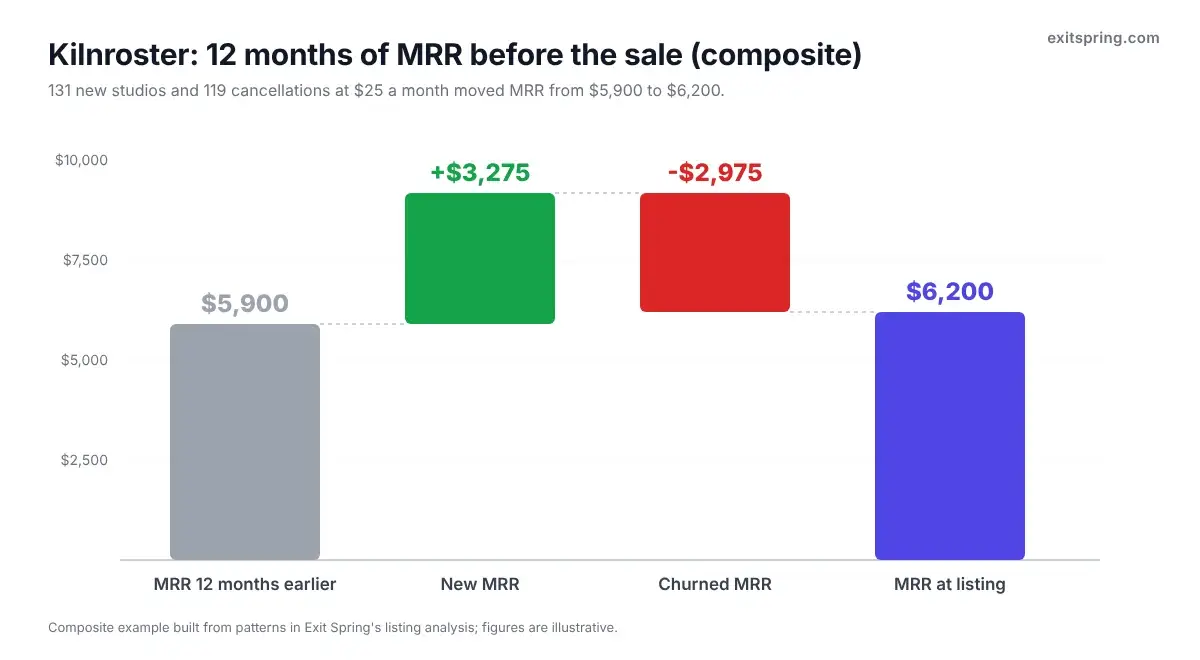
Tomas (a composite built from the patterns above) made an offer on Kilnroster, class-booking software for pottery studios. The listing showed 248 studios paying $25 a month, $56,000 of yearly profit, 4% monthly churn and five hours of owner work a week. Tomas does not write code.
| Kilnroster (composite) | Step |
|---|---|
| June 1, 2026 | Offer accepted at $196,000, or 3.5x yearly profit, subject to due diligence |
| June 1 to 22, 2026 | Stripe exports show 131 new studios and 119 cancellations in 12 months; an outside developer reviews the repository for six hours |
| June 18, 2026 | The seller confirms he fixed bugs himself, about six hours a month, with no cost in the accounts |
| June 24, 2026 | Price revised to $175,000 after a $6,000 yearly developer retainer is added to costs |
| July 15, 2026 | Closing through escrow; $140,000 paid, $35,000 seller note over 24 months |
| July 15 to 17, 2026 | Seller contacts Stripe Support and the account details are updated; the GitHub repository and AWS root login move to Tomas |
| July 15 to August 14, 2026 | 30 days of seller support, including two calls with the new developer |
| October 15, 2026 | 251 studios, $6,275 of MRR |
| Kilnroster (composite) | Figure |
|---|---|
| MRR at listing | $6,200 |
| MRR 12 months earlier | $5,900 |
| New MRR in 12 months | $3,275 |
| Churned MRR in 12 months | $2,975 |
| Yearly revenue at current MRR, including $3,600 of setup fees | $78,000 |
| Yearly profit in the listing | $56,000 |
| Yearly profit after the developer retainer | $50,000 |
| Asking price | $196,000 |
| Price paid | $175,000 |
| Yearly amortization deduction, if all of the price is a section 197 intangible | $11,667 |
| Years to earn back the price at $50,000 a year | 3.5 |
Kilnroster's MRR grew by $300 in the 12 months before the sale. The business signed $3,275 of new MRR to get there.
Exit Spring lists SaaS businesses with verified financials on its marketplace and its SaaS businesses for sale page. Founders can get a free valuation, and first-time buyers can start with our guide to buying an online business.
How we researched this
| Step | What we did |
|---|---|
| Source | 2,855 public listings from one large US marketplace, pulled October 8, 2026 |
| Sample | All 61 listings tagged SaaS with an asking price and a positive yearly profit: 55 sold and 6 still for sale |
| Multiples | Asking price divided by average annual net profit; asking, not final sale prices, which the feed does not publish |
| Trend, churn and MRR | Seller-reported fields; 49 listings had a profit trend, 24 a churn figure and 21 an MRR figure |
| Text checks | Word searches in each listing's summary, task list, risks, asset list and support offer |
| Limits | One marketplace, 61 listings, dating from 2016 to 2026; small groups can move a median by several tenths |
Frequently asked questions
Can I buy a SaaS business if I can't code?
Kilnroster (composite) went to a buyer who doesn't write code, after he added a $6,000 yearly developer retainer to its costs and paid $21,000 less. In our data, at least 13 of 61 SaaS listings put technical work among the owner's tasks. A non-technical buyer needs a named developer and a paid code review before closing.
How much does a micro SaaS cost?
Ten of the 61 SaaS listings in our October 2026 data asked under $50,000, at a median 2.25 times a median $17,671 of yearly profit. Another eight asked $50,000 to $100,000. The smallest ask in the set was $30,295, for a hospitality tool listed in 2016.
What is a good churn rate for a small SaaS business?
The 24 SaaS listings with a churn figure in our data reported a median 7.35%, and the ten at 6% or less asked 3.63x against 2.92x for the rest. At 5% a month, 54% of today's subscribers remain after a year. Ask the seller which formula and which period the figure uses.
What multiple of ARR do small SaaS businesses ask?
Twenty-one listings in our data published an MRR figure, and their asking prices came to a median 2.35 times 12 months of that MRR. The lowest was 0.69 times and the highest 6.32 times. ARR is annual recurring revenue. On profit, all 61 SaaS listings asked a median 3.33x.
How long does a SaaS business stay listed before it sells?
The 52 sold SaaS listings with a recorded figure in our data spent a median 57.5 days on the marketplace, and the 18 of them with falling profit a median 81 days. Kilnroster (composite) took 44 days from accepted offer to closing. The feed records listings that sold, so it can't show how many never did.
Should I buy the assets or the company's shares?
Tomas bought Kilnroster's assets (composite), so the $175,000 price is deducted over 15 years under section 197, at $11,667 for each full year. In a share purchase, the Stripe account, the AWS account and the customer contracts stay in the company's name. So do any unpaid taxes and refund claims from before the sale. This is general information as of November 2026, not legal or tax advice.
Is a SaaS business with falling profit worth buying?
Twenty-three of the 49 SaaS listings with a trend figure had falling profit, and they asked a median 2.83x against 3.75x for the rest. At a 4% monthly churn rate, about four in ten of today's subscribers are gone within a year, and a business has to sign new customers equal to about half its base each year to stay level. A falling business is priced lower because the buyer has to fix the decline.
Sources
- Stripe Docs, Billing analytics: metric definitions
- Stripe Support, Transfer a Stripe account to a different entity due to a business sale or acquisition
- AWS Knowledge Center, How do I assign ownership of my AWS account to another entity?
- GitHub Docs, Transferring a repository
- SaaS Capital, Benchmarking metrics for bootstrapped SaaS companies, April 24, 2026
- PilieroMazza, Five SBA 7(a) changes that could reshape business acquisitions, August 24, 2026
- Legal Information Institute, 26 U.S.C. § 197, Amortization of goodwill and certain other intangibles
- Internal Revenue Service, Instructions for Form 8594
- Legal Information Institute, 17 U.S.C. § 204, Execution of transfers of copyright ownership
- Empire Flippers public marketplace listings, pulled October 8, 2026 (Exit Spring analysis)
Get new listings in your inbox
Fresh businesses for sale every Monday, plus practical buying and selling tips.
Unsubscribe anytime. No spam.
Keep reading
The Asset Purchase Agreement for an Online Business in 2026: Clauses, Schedules and Closing
Turnkey Online Businesses in 2026: What They Cost, What Hands-Off Leaves Out and How to Buy One

How to Sell a Digital Marketing or SEO Agency in 2026: Multiples, Client Contracts and Handover
Ready to make a move?
Browse vetted online businesses or get a free valuation of yours.