
How to Sell an Ecommerce Business in 2026: What 212 Sold Online Stores Asked, and How the Sale Works
Of 2,855 public listings on one of the largest US online business marketplaces, pulled October 8, 2026, the 212 sold ecommerce and dropshipping stores asked a median 2.33 times annual profit, against 2.58x for all 2,670 sold listings with a price and a profit figure.
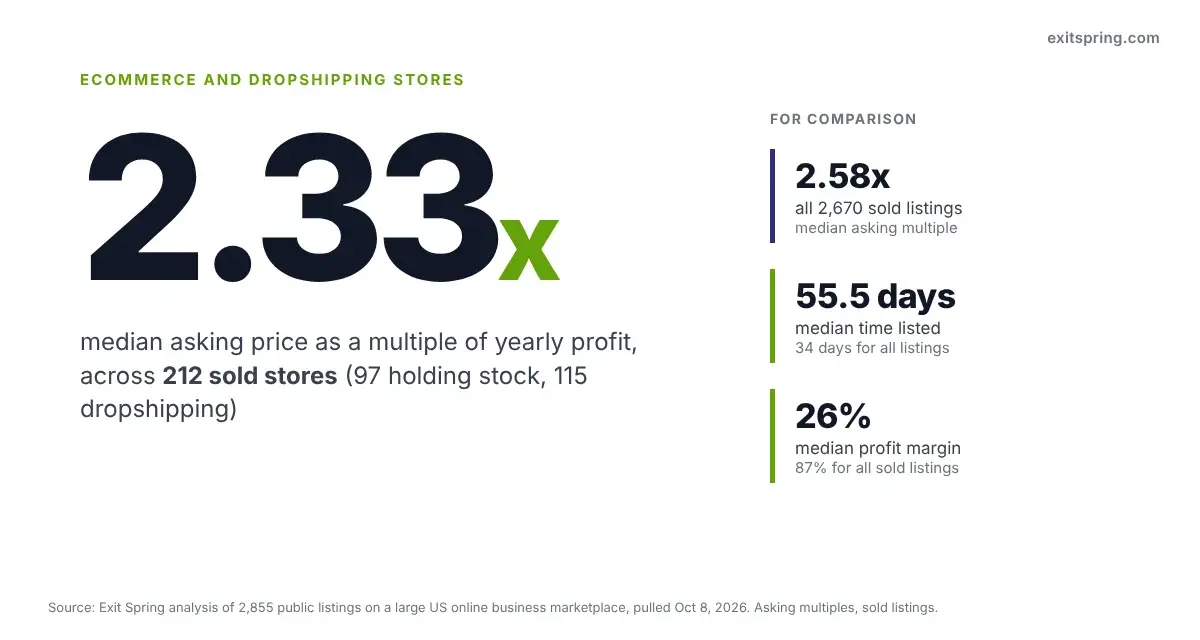
An ecommerce business here means a store that earns its money selling physical products from its own website. We counted a listing when its first income source was "eCommerce" (97 stores that buy and hold their own stock) or "DropShipping" (115 stores whose suppliers ship each order). Amazon FBA brands are left out of the count, and so are Shopify-specific steps. Those have their own guides on selling an Amazon FBA business and selling a Shopify store.
How much is an ecommerce business worth?
An ecommerce business on the marketplace we studied asked a median 2.33x its average annual net profit, so a store clearing $60,000 a year would list near $140,000. Stores that hold their own inventory asked 2.33x and dropshipping stores 2.25x, both below the 2.67x median for Amazon FBA brands in the same feed.
Net profit on these listings is close to what brokers call seller's discretionary earnings (SDE), meaning revenue minus cost of goods, ad spend, fees and every other expense, with the owner's own pay and one-off costs added back. The multiple is the asking price divided by that yearly figure. These are asking prices. The feed doesn't publish what buyers finally paid.
| Business type (first income source) | Sold listings | Median asking multiple | Median asking price | Median yearly profit | Median yearly revenue | Median profit margin |
|---|---|---|---|---|---|---|
| Ecommerce, own inventory | 97 | 2.33x | $140,415 | $69,080 | $245,025 | 29% |
| Dropshipping | 115 | 2.25x | $83,365 | $38,280 | $212,770 | 19% |
| Both store types | 212 | 2.33x | $110,718 | $48,777 | $232,519 | 26% |
| Amazon FBA brands | 682 | 2.67x | $192,675 | $75,373 | $327,504 | 24% |
| All sold listings | 2,670 | 2.58x | $92,639 | $35,517 | $59,360 | 87% |
The middle half of the 212 store listings asked between 2.00x and 2.67x. Only 29 asked 3x or more, about 14%, while 823 of all 2,670 sold listings did, about 31%. Fifty-one stores asked less than 2x.
Our Shopify store guide counted every listing that named Shopify, 341 of them at 2.42x, including FBA brands with a Shopify site on the side. The figures here count only listings whose main income was the store itself, which is why the two medians differ.
Recasting a store's profit before listing
A buyer prices the store on its yearly profit and checks that figure line by line.
| P&L line | Treatment in the recast | Example |
|---|---|---|
| Owner pay | Added back to profit | $3,000 a month in salary adds $36,000 |
| One-off costs | Added back with the invoice attached | A $6,500 product photo shoot in March |
| Meta and Google ad spend | Stays in as a cost of each sale | Ads paused for three months before listing show up as a revenue dip |
| Stock purchases | Expensed when each unit sells (accrual), not when the order is paid | A $40,000 December order spread over the months it sold |
| Refunds and chargebacks | Taken off revenue in the month they happened | The platform refund report has to match the P&L |
Ecommerce stores ask less than other online businesses at every size
Larger businesses ask higher multiples across the whole marketplace, and stores follow the same pattern from a lower base. In every profit band we checked, the median store asked less than the median listing of the same size.
| Yearly profit | Store listings | Store median multiple | All listings | All-listing median multiple |
|---|---|---|---|---|
| Under $25,000 | 60 | 2.17x | 988 | 2.34x |
| $25,000 to $50,000 | 48 | 2.29x | 645 | 2.67x |
| $50,000 to $100,000 | 50 | 2.33x | 494 | 2.67x |
| $100,000 to $250,000 | 42 | 2.50x | 377 | 2.83x |
| $250,000 or more | 12 | 3.17x | 166 | 3.33x |
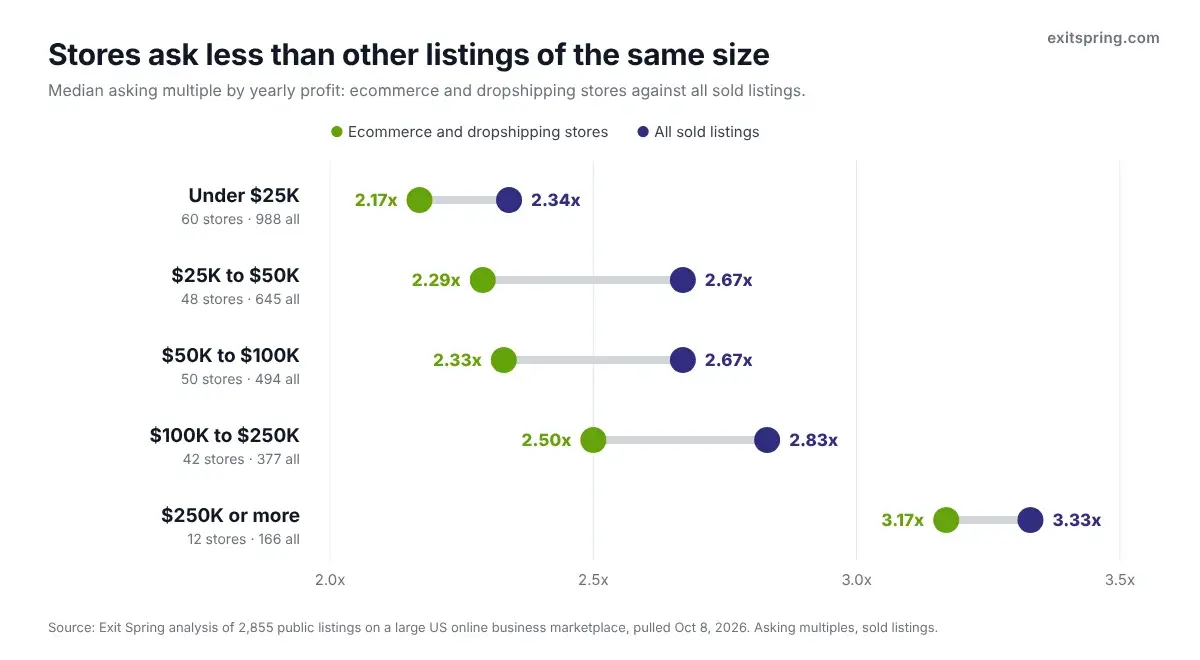
The gap was widest in the middle. A store earning $35,000 a year sat 0.38x below other listings of its size, a difference of about $13,000 on the asking price.
Our data can't say why buyers price stores lower. The listings do show three things that set stores apart. The median store turned over $232,519 a year to make $48,777, a 26% margin, so a small rise in product or shipping costs moves profit far more than it would at the 87% median margin for all sold listings. Store owners reported a median 6 hours a week of work, twice the 3 hours for all sold listings. And a store needs stock or a supplier relationship that a buyer has to keep running from day one.
The 45 stores with margins of 40% or more asked 2.17x, the lowest of any margin band. They were also the smallest, at a median $33,402 of profit.
| Years of revenue when listed | Store listings | Median asking multiple |
|---|---|---|
| Under 2 | 91 | 2.17x |
| 2 to 4 | 66 | 2.33x |
| 4 or more | 55 | 2.58x |
Our multiples by business type study shows older businesses asking higher multiples across the whole marketplace.
Dropshipping stores against stores that hold stock
The 115 dropshipping stores were smaller than the 97 inventory-holding stores, at a median $38,280 of profit against $69,080, and asked slightly less. A dropshipping store owns no warehouse stock. A supplier, often overseas, packs and ships each order after the customer pays, so the store's main assets are its brand, its site, its ad accounts and its customer list.
| Store type and years first listed | Sold listings | Median asking multiple | Median yearly profit | Median profit margin |
|---|---|---|---|---|
| Dropshipping, 2014 to 2019 | 70 | 2.17x | $26,078 | 25.5% |
| Dropshipping, 2020 to 2023 | 27 | 2.58x | $73,748 | 14% |
| Dropshipping, 2024 to 2026 | 18 | 2.29x | $51,973 | 14.5% |
| Own inventory, 2014 to 2019 | 31 | 2.08x | $73,006 | 37% |
| Own inventory, 2020 to 2023 | 32 | 2.71x | $64,240 | 30% |
| Own inventory, 2024 to 2026 | 34 | 2.50x | $63,199 | 25.5% |
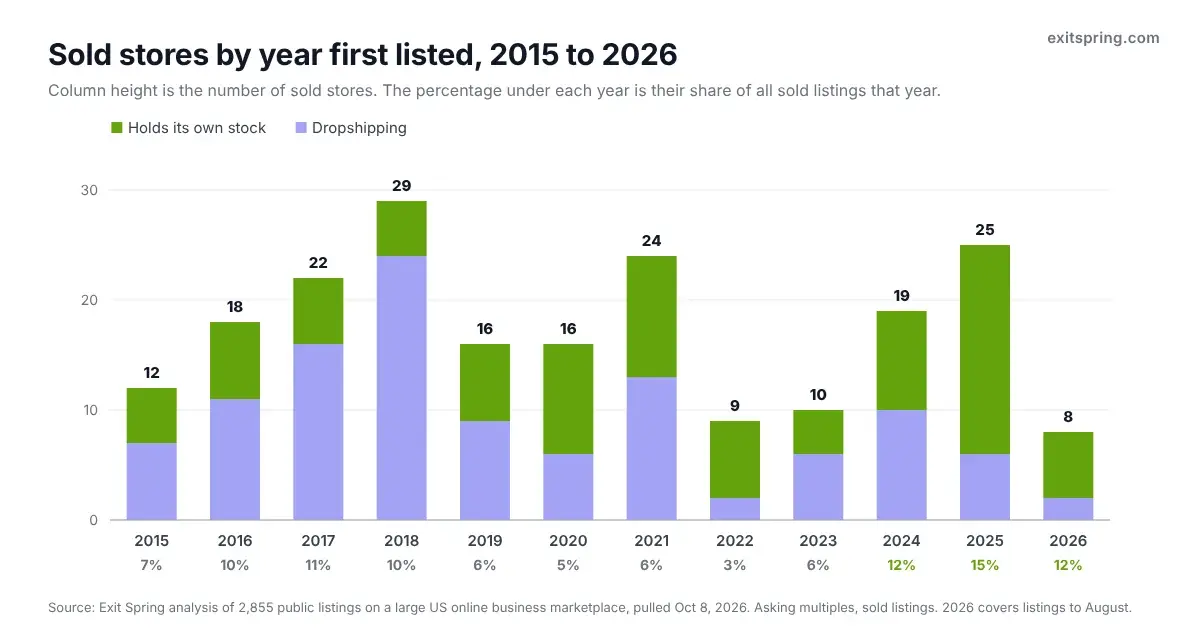
Stores made up 15% of sold listings first listed in 2025, up from 3% in 2022, the highest share in our data. Inventory-holding stores drove that rise. Of the 25 stores listed in 2025, 19 held their own stock and 6 were dropshipping.
| Illustrative dropshipping order, after duty-free entry for parcels of $800 or less ended on August 29, 2025 (Executive Order 14324) | Amount |
|---|---|
| Order value | $40.00 |
| Product cost | $12.00 |
| Profit at the 19% median dropshipping margin | $7.60 |
| Duty at an illustrative 25% of product cost | $3.00 |
| Profit after duty | $4.60 |
Our data can't show whether the end of duty-free entry caused the drop, and the counts are small. In the 12 months before August 29, 2025, dropshipping stores were 12 of 30 store listings. In the months after it, up to the October 2026 pull, they were 3 of 13. Recent stores still for sale are not in these counts, which leaves out slower sales from the later period.
Fifty-six dropshipping listings named supplier contracts or supplier relationships among the assets for sale. Across both store types, the 122 listings that included supplier contracts or relationships asked 2.42x, against 2.17x for the 90 that didn't. Those 122 were also larger, at $52,191 of median profit, so part of the gap is size.
Do stores that also sell on Amazon ask more?
Stores that sold on Amazon as a second channel asked a median 2.50x, above the 2.33x for all stores, across 28 listings. They were also the biggest businesses among the store groups, with median profit of $93,452 and revenue of $373,453, so the higher multiple may reflect size as much as the second channel.
| Store group | Sold listings | Median asking multiple | Median yearly profit | Median days on the marketplace |
|---|---|---|---|---|
| One income source only | 140 | 2.26x | $40,968 | 65 |
| Two or more income sources | 72 | 2.33x | $58,848 | 43 |
| Second channel is Amazon FBA or FBM | 28 | 2.50x | $93,453 | 41 |
| FBA brands that also run a store | 136 | 2.83x | $100,124 | 53 |
Single-channel stores spent 65 days on the marketplace, against 43 for stores with a second income source. Twenty-one listings mentioned TikTok and eight mentioned Etsy in their text, too few for a separate median.
The last row of the table counts brands that list Amazon FBA as their first income source and also run their own store. At 2.83x, they asked the most of the multichannel groups. Amazon's own transfer process and its rules for brand accounts are covered in our Amazon FBA selling guide.
How long does it take to sell an ecommerce business?
Ecommerce stores spent a median 55.5 days on the marketplace before they sold, against 34 days for all sold listings, so a store owner should expect about two months from listing to a buyer. Inventory-holding stores took 59 days and dropshipping stores 53.
| First income source | Sold listings | Median days on the marketplace | Median asking multiple |
|---|---|---|---|
| Amazon Associates | 525 | 17 | 2.58x |
| Display advertising | 563 | 22 | 2.67x |
| Affiliate | 259 | 29 | 2.50x |
| Amazon FBA | 682 | 47.5 | 2.67x |
| Dropshipping | 115 | 53 | 2.25x |
| Ecommerce, own inventory | 97 | 59 | 2.33x |
| SaaS | 53 | 59.5 | 3.33x |
| Amazon KDP | 119 | 63 | 2.83x |
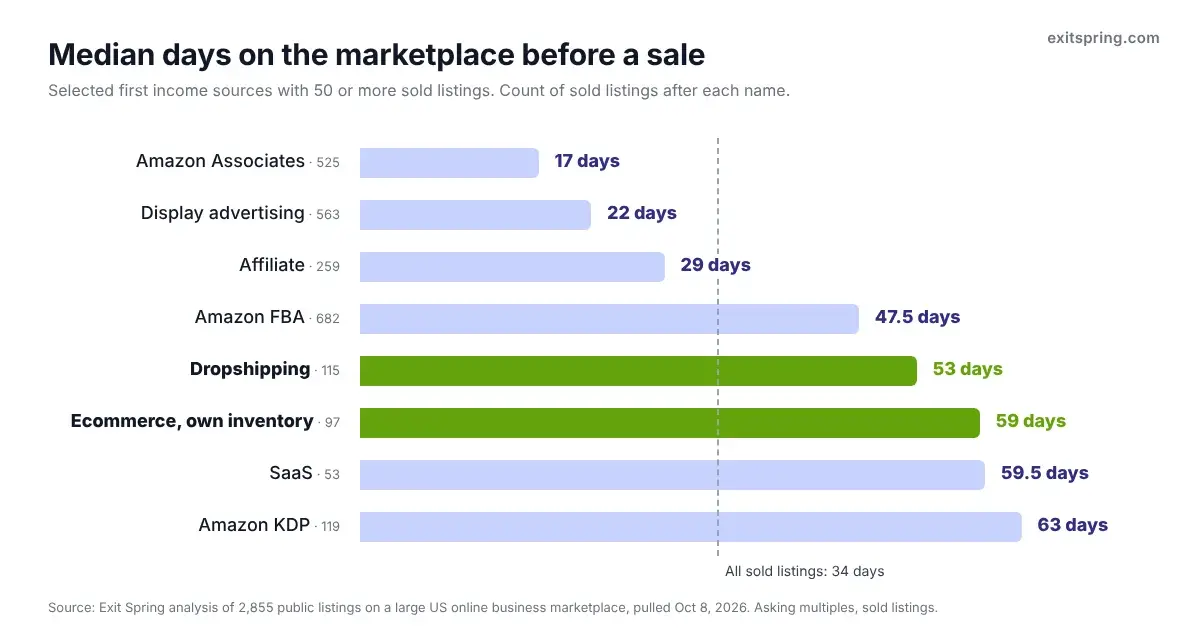
The 50 stores earning $50,000 to $100,000 a year spent a median 111.5 days listed, the slowest of any store band. Days on the marketplace start when the listing goes live, so preparation before that, and the time from a signed letter of intent to closing, come on top. Our study of how long it takes to sell an online business breaks this down by deal size.
The weeks after a letter of intent take longer for a store than for a content site. The buyer's accountant matches supplier invoices to cost of goods, the 3PL schedules a stock count, and any supplier whose agreement can't be assigned without consent has to sign off. In the Tidewater Pet Co. composite below, those steps took 27 days from the signed letter to closing.
What buyers check in an ecommerce store
A store buyer checks the same profit and loss statement any buyer does, plus records a content site doesn't have. Stock, suppliers, refunds and card disputes all affect the profit the buyer is paying for.
| Check | Where the proof lives | What a problem looks like |
|---|---|---|
| Cost of goods | Supplier invoices matched to the P&L month by month | Margin jumps from 22% to 31% in the six months before listing |
| Ad spend | Meta and Google ad account exports for 24 months | Revenue holds while ad spend doubles |
| Returns and refunds | Platform refund reports and the 3PL's returns log | A 14% refund rate on one product line |
| Card disputes | Payment processor dispute reports | Dispute rate near the card networks' monitoring levels |
| Shipping times | Order export with order and ship dates | Orders regularly shipping in 35 days with no delay notice |
| Supplier terms | Signed supplier agreement or written terms | No contract, and prices quoted only in chat messages |
| Stock on hand | 3PL inventory report and a count at closing | 900 units of a product that stopped selling in 2025 |
| Customer list | Email platform export of subscribers | A list that includes people who never opted in |
A payment processor can hold back payouts when disputes rise. Visa's monitoring program counts fraud reports and disputes against settled transactions, and from April 1, 2026 it labels a US merchant "excessive" at a ratio of 1.5%, down from 2.2%. The label also needs at least 1,500 fraud reports and disputes in a month, a count most small stores never reach, so buyers of smaller stores look at the processor's own dispute reports and any reserve it holds.
The FTC's Mail, Internet, or Telephone Order Merchandise Rule says a seller who states no shipping time must reasonably expect to ship within 30 days, and must offer the buyer a delay or a full refund when it can't. The rule applies to a dropshipping store with 20-day supplier lead times as much as to a store shipping from its own 3PL.
Email marketing came up in 169 of the 212 listings. Our due diligence checklist has the full list of documents a buyer will ask for, and our guide on preparing your business for sale covers the clean-up before listing.
How inventory is priced in a store sale
Seventy-one of the 212 store listings carried a note that inventory is not normally or typically included in the list price, 59 of them inventory-holding stores. On those listings, the asking multiple covers the business itself, and the buyer pays for stock separately, usually at the seller's cost.
The usual way to set the stock figure is a count shortly before closing, priced at landed cost from supplier invoices. Stock that hasn't sold in a year is often left out or discounted, since a buyer won't pay full cost for it. The purchase agreement should say which date the count happens on, who counts, and what happens to stock in transit from the supplier.
In an asset sale, buyer and seller each file IRS Form 8594, which sorts the price into seven asset classes. Inventory falls in Class IV, as "stock in trade," and goodwill and going concern value fall in Class VII. Our taxes guide explains why the split matters, since inventory and goodwill are taxed differently for the seller.
Sales tax and bulk sale rules when selling a store
New York updated its bulk sale bulletin on October 16, 2026. Many other states have similar successor liability rules, so a buyer will usually ask for a list of every state where the store is registered and its recent returns. Our article on taxes when selling an online business covers asset sales, installment sales and state tax in more detail.
| Rule (general information as of November 2026, not legal or tax advice) | What it says | What it means in a store sale |
|---|---|---|
| South Dakota v. Wayfair (2018) | The Supreme Court ruled a state could require remote sellers with more than $100,000 of sales or 200 or more transactions into the state to collect sales tax | A store may have sales tax registrations in many states, each with its own filings |
| New York bulk sale notice | The buyer files Form AU-196.10 at least 10 days before paying for or taking possession of the assets | A buyer who skips it may be held liable for the seller's unpaid sales and use tax |
| California successor liability | A buyer who fails to withhold as required becomes personally liable, up to the purchase price | Buyers request a tax clearance certificate before releasing the full price |
| Form 8594 | Both sides report how the price splits across asset classes | Inventory and goodwill are reported separately |
Handing over an ecommerce store
Orders keep arriving while a store changes hands, so each account moves on a set day in the purchase agreement.
| Step | What moves | Example |
|---|---|---|
| Store platform | Ownership of the Shopify or WooCommerce account, apps and theme | The buyer becomes store owner after the seller confirms the transfer |
| Payments | Processor account, payout bank account, business details | Stripe asks the current owner to contact support first, then update the bank account, tax ID and owner email |
| Suppliers | Contracts, price lists, contacts, open purchase orders | A supplier's written consent to assign the agreement to the buyer's company |
| Fulfillment | 3PL contract, stock held there, shipping rates | Stock counted at the 3PL on the day before closing |
| Advertising | Ad accounts, pixels, audiences, creative files | Meta business assets shared to the buyer's business portfolio |
| Customers | Email platform, customer service inbox, open tickets | 9,500 subscribers moved with their consent records |
| Brand | Domain, trademark, social accounts, product photos | A US trademark assigned with a recorded assignment |
Stripe's support page on an account changing hands after a sale says the existing owner should contact Stripe Support before changing anything. It also warns sellers not to email the new owner's details to Stripe.
Of the 212 stores, 136 offered 30 days of support or less, 41 offered 31 to 60 days, 29 offered longer, and 6 gave no period. Fifty listings named a third-party logistics company (3PL) or a fulfillment center, and 45 of those were inventory-holding stores.

A store sale, from listing to handover
Marisol (a composite built from the patterns above) owned Tidewater Pet Co., a New York store selling orthopedic dog beds on its own Shopify site and on Amazon. The store launched in 2019. Over the 12 months before listing it made $318,000 of revenue and $71,500 of profit, a 22% margin, with stock held at a 3PL in New Jersey.
$71,500 of profit put the store in the $50,000 to $100,000 band, where stores asked a median 2.33x. Tidewater also sold on Amazon, and stores with an Amazon second channel asked 2.50x, so Marisol listed at that figure.
| Tidewater Pet Co. (composite) | Step | Amount |
|---|---|---|
| February 2026 | Valuation; salary and photo shoot added back | $71,500 yearly profit |
| April 14, 2026 | Listed, inventory extra at cost | $179,000 (2.50x) |
| June 9, 2026 | Letter of intent, day 56 | $168,000 (2.35x) |
| June 12, 2026 | Buyer sends Form AU-196.10, certified mail with return receipt | 24 days before closing |
| July 2, 2026 | 3PL stock count at landed cost | $43,800 |
| July 6, 2026 | Closing; Shopify, payments and Amazon move | $211,800 paid |
| Form 8594 | Inventory in Class IV, most of the price in Class VII goodwill | $43,800 and about $168,000 |
| August 5, 2026 | Support period ends | 30 days |
Where to sell an ecommerce business
Tidewater Pet Co. went through a brokered marketplace, which checked its P&L before the listing went live and took a fee at closing. On self-serve sites such as Flippa, the owner writes the listing and answers buyers alone. Some stores sell privately to a supplier or a competitor.
Buyers of a store usually sign a nondisclosure agreement before they see supplier names, ad accounts or the full P&L. A confidential information memorandum then sets out the business in one document, from product lines and margins to the 3PL contract. Our guide to the confidential information memorandum covers what goes in one.
The listing itself should give the 12-month profit, the median order value, the refund rate and the stock position, four figures store buyers ask about early. A store that lists stock on hand at cost, and says whether it is included, saves a round of messages with every serious buyer.
At Exit Spring, sellers can start with a free valuation or list on our marketplace. Buyers can browse ecommerce businesses for sale. Sellers based outside the US can read our guide to selling an online business from outside the US, and our article on seller financing and earnouts covers deals where part of the price is paid later.
How we researched this
| Step | What we did |
|---|---|
| Source | 2,855 public listings from one large US marketplace, pulled October 8, 2026 |
| Store definition | Sold listings whose first income source was eCommerce (97) or DropShipping (115), with a price and a positive profit figure |
| Multiples | Asking price divided by average annual net profit; asking, not final sale prices, which the feed does not publish |
| Multichannel | A store with Amazon FBA or FBM listed as a second income source (28 listings) |
| Text counts | Searches of each listing's summary, assets, support terms and work notes for inventory, suppliers, 3PLs and channels, read by hand where wording varied |
| Limits | The feed has no withdrawn listings, so it can't show how many stores failed to sell |
Frequently asked questions
How much can I sell my ecommerce business for?
A store making $50,000 a year in profit would ask about $116,500 at the 2.33x median for the 212 stores in our data. Stores earning $100,000 to $250,000 asked 2.50x, and the 12 earning $250,000 or more asked 3.17x. Exit Spring's valuation tool and our guide on how to value an online business explain how the profit figure is built.
Is inventory included in the asking price?
Seventy-one of the 212 sold store listings said inventory is not normally or typically included in the list price. On those deals the buyer pays for stock on top, usually at cost after a count shortly before closing. In the Tidewater Pet Co. composite, that added $43,800 to a $168,000 price.
Can you sell a dropshipping store?
The 115 sold dropshipping stores in our data asked a median 2.25x, on $38,280 of median yearly profit. Buyers look hardest at supplier terms and shipping times, since the store owns no stock. Since August 29, 2025, parcels shipped from overseas suppliers to US customers no longer enter duty-free under the $800 de minimis rule.
What happens to my Shopify Payments or Stripe account when I sell?
Stripe's help page for an account changing hands after a sale asks the current owner to contact support first, then update the payout bank account, tax ID and owner email. Moving Shopify store ownership and Shopify Payments is covered in our Shopify selling guide.
Do I need to collect or pay sales tax when I sell my online store?
New York requires the buyer of a business to file Form AU-196.10 at least 10 days before paying for or taking the assets, or risk paying the seller's unpaid sales tax. California makes a buyer who fails to withhold personally liable, up to the price paid. Sellers should file final returns in every state where the store is registered.
Is it better to sell now or grow the store first?
Stores with four or more years of revenue asked 2.58x, against 2.17x for stores under two years old. Size counted as well, from 2.17x under $25,000 of profit to 3.17x above $250,000. The 29 stores whose profit had fallen more than 10% asked 2.33x, below the 2.50x for the 78 whose profit had grown more than 10%.
How do buyers check an ecommerce store's numbers?
The buyer of Tidewater Pet Co. (composite) spent 27 days on supplier invoices, ad spend and the processor's dispute report between the letter of intent and closing.
Sources
- Federal Register, Indefinite suspension of the de minimis exemption for merchandise arriving through all modes other than the international postal network, US Customs and Border Protection, June 24, 2026
- New York State Department of Taxation and Finance, Bulk sales (TB-ST-70), updated October 16, 2026
- California Department of Tax and Fee Administration, Revenue and Taxation Code section 6812
- Legal Information Institute, South Dakota v. Wayfair, Inc., 585 U.S. 162, June 21, 2018
- Federal Trade Commission, Business guide to the FTC's Mail, Internet, or Telephone Order Merchandise Rule
- Visa, Visa Acquirer Monitoring Program fact sheet PDF, 2025
- IRS, Instructions for Form 8594, November 2021
- Stripe Support, Transfer a Stripe account to a different entity due to a business sale or acquisition
- Flippa, Sell a business
- Empire Flippers public marketplace listings, pulled October 8, 2026 (Exit Spring analysis)
Get new listings in your inbox
Fresh businesses for sale every Monday, plus practical buying and selling tips.
Unsubscribe anytime. No spam.
Keep reading
The Asset Purchase Agreement for an Online Business in 2026: Clauses, Schedules and Closing
How to Buy a SaaS Business in 2026: Prices, Churn, Code and Due Diligence
Turnkey Online Businesses in 2026: What They Cost, What Hands-Off Leaves Out and How to Buy One
Ready to make a move?
Browse vetted online businesses or get a free valuation of yours.