
Website Flipping in 2026: What 110 Resold Sites Show About Buying, Holding and Selling
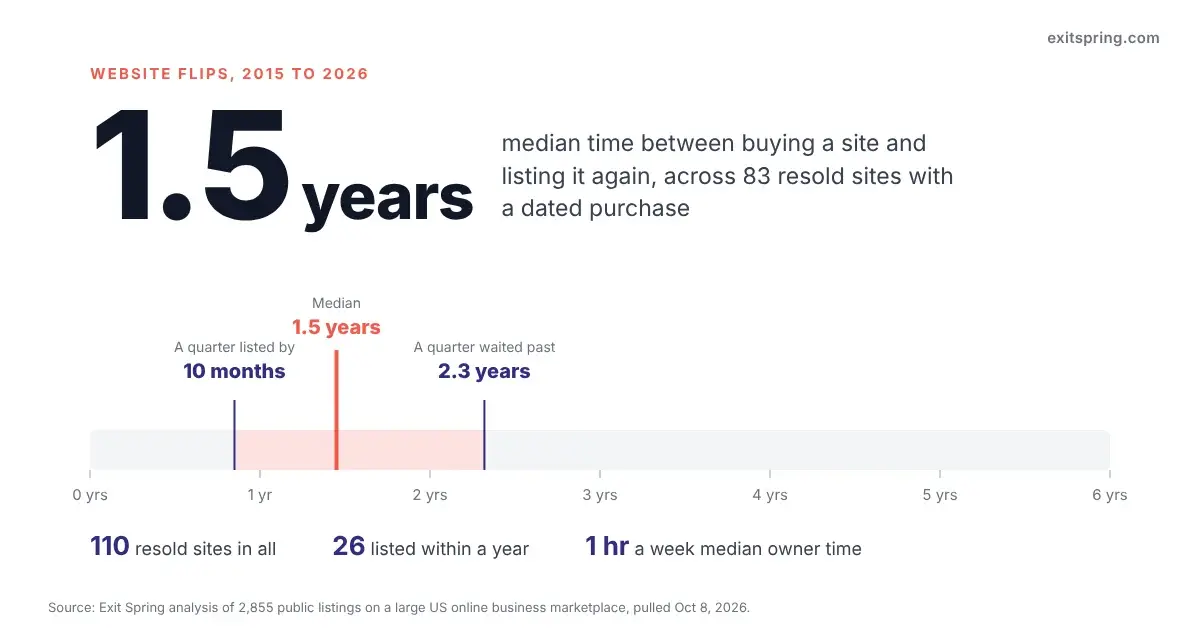
Of 2,855 public listings on one of the largest US online business marketplaces, pulled October 8, 2026, 110 sold sites were being resold by an owner who had bought them, and the 83 with a dated purchase were held a median 1.5 years.
Website flipping means buying an existing website, raising what it earns and selling it again, usually within one to three years. Most of the 110 resold sites in our sample were content sites. Amazon Associates was the main income source for 37 of them, display ads for 31 and other affiliate programs for 9.
What is website flipping?
Website flipping is the business of buying a website that already earns money, improving its traffic or revenue, and reselling it to another buyer at a higher price. A flipper keeps the site's cash flow while holding it. The rest of the return is the gap between purchase price and sale price, after fees and tax.
A domain flipper sells a name with no content or income attached. A builder starts from an empty domain and waits a year or more for search traffic before there is anything to sell.
| Strategy | What changes hands | Where the profit comes from | Typical wait before a sale |
|---|---|---|---|
| Website flip | An earning site with content, traffic and accounts | Higher annual profit, sold at a similar multiple | 1 to 3 years (median 1.5 in our sample) |
| Build and sell | A site you created from a new domain | The whole sale price, minus years of unpaid work | 2 years or more before most buyers will look |
| Domain flip | The name only | Resale of the name to an end user | Unpredictable; many names never sell |
| Portfolio roll-up | Several small sites bought together | Combined profit sold as one larger asset | Often 3 years or more |
The phrase "reselling websites" also covers white-label web design, where an agency sells sites built by another firm. That is a services business, and this guide leaves it out.
Is website flipping still profitable in 2026?
Content sites, the asset most website flippers bought, fell from 53% of sold listings first listed in 2019 to 13% of those listed in 2025 on the marketplace we studied, and their median asking multiple dropped from a 3.58x peak in 2022 to 2.42x. Website flipping can still pay in 2026, mostly by raising a site's profit before the resale.
| Year first listed | Sold content sites | Share of all sold listings that year | Median asking multiple |
|---|---|---|---|
| 2016 | 140 | 75% | 2.17x |
| 2017 | 125 | 62% | 2.50x |
| 2018 | 156 | 54% | 2.42x |
| 2019 | 138 | 53% | 2.75x |
| 2020 | 165 | 54% | 2.83x |
| 2021 | 163 | 43% | 3.50x |
| 2022 | 145 | 49% | 3.58x |
| 2023 | 82 | 52% | 3.08x |
| 2024 | 35 | 21% | 2.75x |
| 2025 | 21 | 13% | 2.42x |
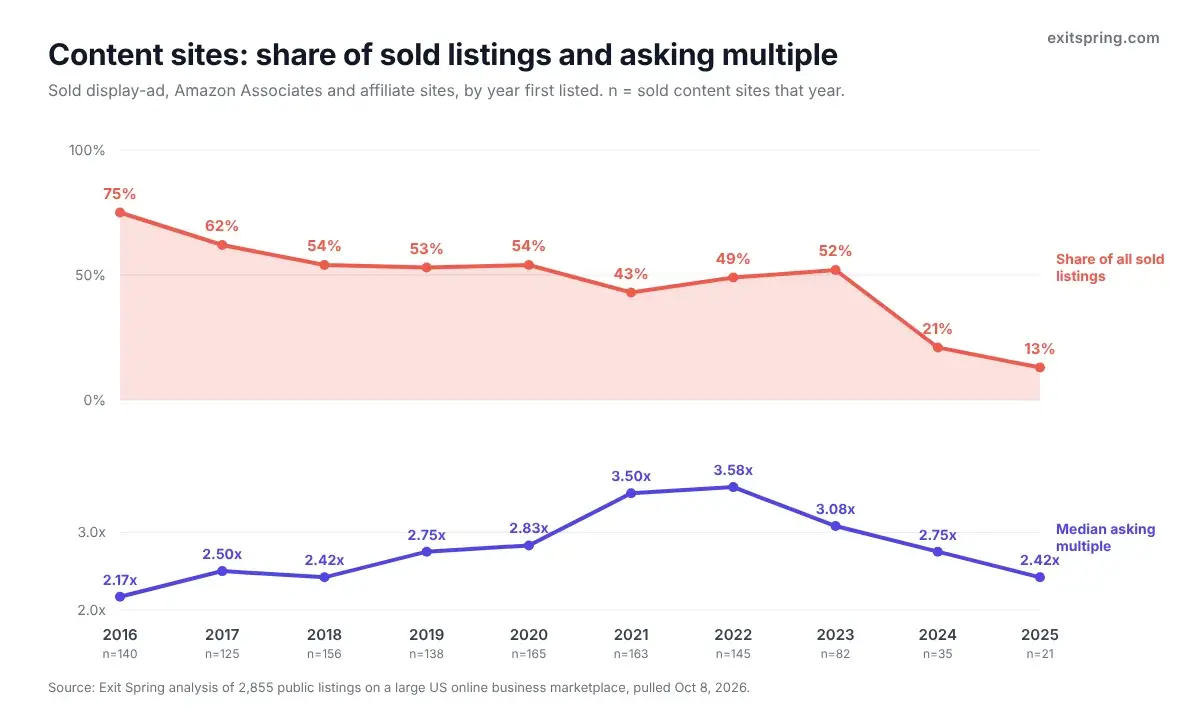
Our data can't show why sellers stopped listing content sites, and some of the drop is a change in the marketplace's own mix toward Amazon FBA, ecommerce and YouTube businesses. Two outside events line up with it. Google's March 5, 2024 announcement said it expected its March core update, together with earlier work, to cut "low-quality, unoriginal content" in results by 40%, and an April 26 update put the result at 45%. In March 2025 browsing data, Pew Research Center found that people who saw an AI summary on Google clicked a regular result in 8% of visits, against 15% when no summary appeared.
We matched 101 of the 110 flips to sites with the same main income source listed in the same year, in groups of at least five. The median matched flip asked 2.75x against 2.67x for the median comparison group, and 55 of the 101 asked more than their own group.
The typical flip asked about 0.08x more than comparable sites. On $24,734 of yearly profit, the median for our flips, that edge is worth about $2,000. A site bought at 2.75x and sold at 2.75x makes money on resale only if annual profit grew in between.
How long do flippers hold a website before selling?
Website flippers in our sample held a site for a median 1.5 years, or about 17 months, between the purchase date named in the listing and the day the site was listed for sale again. A quarter of them listed within 10 months, and a quarter waited 2.3 years or longer.
| Holding period | Resold sites | Median asking multiple | Median asking price |
|---|---|---|---|
| Under 1 year | 26 | 2.67x | $63,403 |
| 1 to 2 years | 30 | 3.08x | $61,927 |
| 2 to 3 years | 13 | not split out | not split out |
| 3 to 5 years | 10 | not split out | not split out |
| 5 years or more | 4 | not split out | not split out |
| All 2 years or more | 27 | 2.92x | $82,577 |
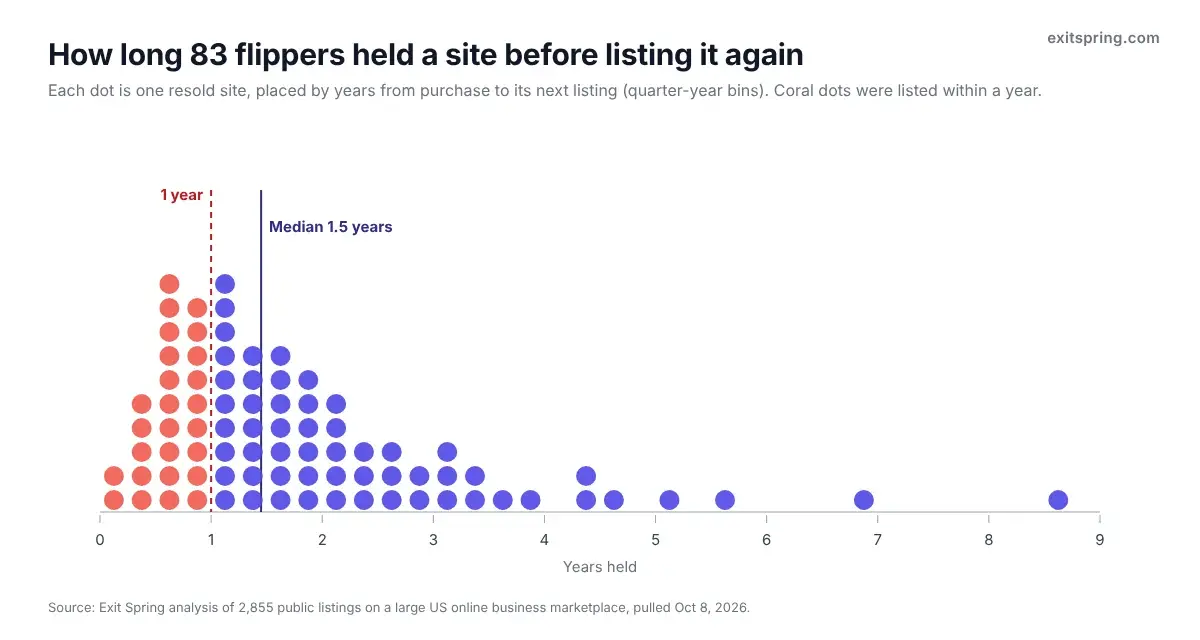
Twenty-seven of the 110 listings gave no usable purchase date, so they are left out of the holding figures. We measured from the purchase date to the first listing date, which means time spent on the market is not included.
Twenty-six owners listed within a year. Under the IRS rules in Tax Topic 409, an asset held for one year or less produces a short-term gain, taxed at ordinary income rates, so a site sold at month 11 can leave the flipper with less after tax than the same sale at month 13.
Sites listed 1 to 2 years after purchase asked a median 3.08x, the highest of the three groups. One possible reason is that a year of the new owner's results gives a buyer a full 12-month profit figure to price against, but 30 sites is too few to prove it.
After four years of revenue, sites list at about 3x
Across all 2,670 sold listings with a price and a profit figure, a business under 2 years old listed at a median 2.33x, and one with 4 to 6 years of revenue listed at 3.00x, at more than twice the median price.
| Years of revenue when listed | Sold listings | Median asking multiple | Median asking price | Median days on the marketplace |
|---|---|---|---|---|
| Under 2 | 1,013 | 2.33x | $60,562 | 23 |
| 2 to 4 | 891 | 2.67x | $101,537 | 31 |
| 4 to 6 | 376 | 3.00x | $142,012 | 38 |
| 6 or more | 383 | 2.92x | $141,251 | 44 |
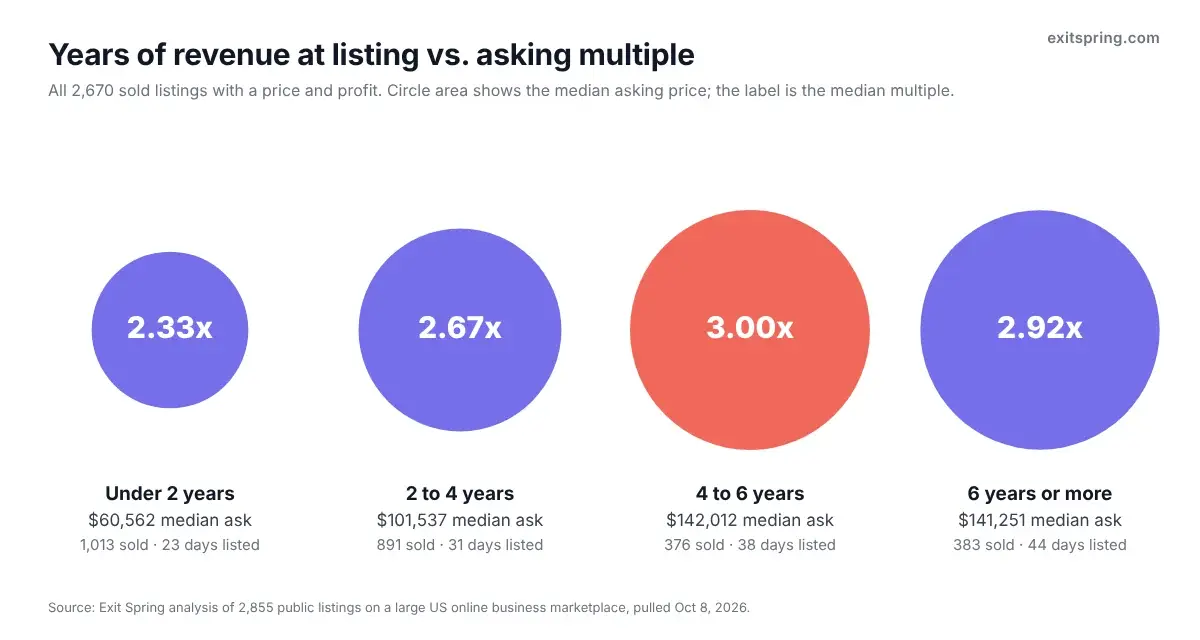
The 609 sold content sites under 2 years old asked 2.33x, and the 130 aged 4 to 6 years asked 3.04x. Older sites also earned more, so part of the higher price comes from larger profit and not from age alone.
Our online business multiples by type study has the same split by business model. For a flipper, the age figures favor a site with at least two years of revenue history, even if a younger one looks cheaper. A site with 18 months of history, held 17 months, reaches the 2 to 4 year band at resale without any extra work.
What to check before buying a site to flip
The purchase price sets how much profit a flipper must add before a resale breaks even. Our guide to buying an online business covers the full process, and current listings are on our content websites for sale page.
| Check before buying | Where the proof lives | What a problem looks like |
|---|---|---|
| Traffic history | Search Console Performance report, 16 months of clicks | Clicks fell by half in March 2024 and never recovered |
| Revenue | Affiliate and ad network dashboards, viewed live on a call | Amazon earnings in the P&L that the Associates report doesn't show |
| Domain history | The Internet Archive's Wayback Machine | The domain belonged to a school or charity before it became a review site |
| Content origin | Writer invoices, draft history, a sample of posts | 400 posts published in two months with no editing history |
| Links | A backlink export and the seller's notes | Paid links from networks the seller won't name |
| Owner time | A written task list with hours per week | "1 hour a week" from a seller who also writes every article |
Google added expired domain abuse to its spam policies in March 2024. The policy, last updated August 28, 2026, describes a domain bought "and repurposed primarily to manipulate search rankings," and one of its examples is "casino-related content on a former elementary school site." Five of the 110 resold sites in our sample were described as built on an expired domain, all of them listed in 2021.
Our online business due diligence checklist has the full list of accounts and documents to request.
Where the extra profit comes from
Of the 110 resold sites, 28 listings said the seller had added little or no new content for months, or had done little work since buying the site. Those owners mostly collected the cash flow while they held it.
| Change after purchase | What it moves | Example on a site with about 55,000 monthly pageviews (composite figures) |
|---|---|---|
| Switch from AdSense to a premium ad network | Revenue per 1,000 pageviews | Raptive requires 25,000 monthly pageviews and a domain at least 6 months old |
| Update older reviews | Rankings on pages that already earn | 45 reviews refreshed with 2026 prices and new photos |
| Add an email list | A second traffic source a buyer can see | 1,900 subscribers from a free gear checklist |
| Cut tool and hosting costs | Annual profit, and so the sale price | $600 a year saved, worth about $1,700 at 2.8x |
| Write down every task | Buyer confidence about hours | A 12-step monthly routine that takes 3 hours |
Raptive's help center sets its 25,000-pageview minimum for sites where at least half of traffic comes from the US, UK, Canada, Australia or New Zealand. Pinecrest Trail, the composite below, met both tests on the day it was bought.
Flipped sites in our sample listed with a median owner time of 1 hour a week, against 3 hours for all sold listings, and spent a median 21 days on the marketplace, against 30. They were also smaller, at a median asking price of $61,927 against $92,639 for all sold listings, and our data can't separate the effect of size from the effect of low hours.
A content site flip, from purchase to resale
Nadia (a composite built from the patterns above) bought Pinecrest Trail, a camping gear review site launched in 2019, in October 2024. The site had 140 articles, about 58,000 monthly pageviews and $15,000 of profit over the prior 12 months, and she paid $42,000, or 2.8 times that profit.
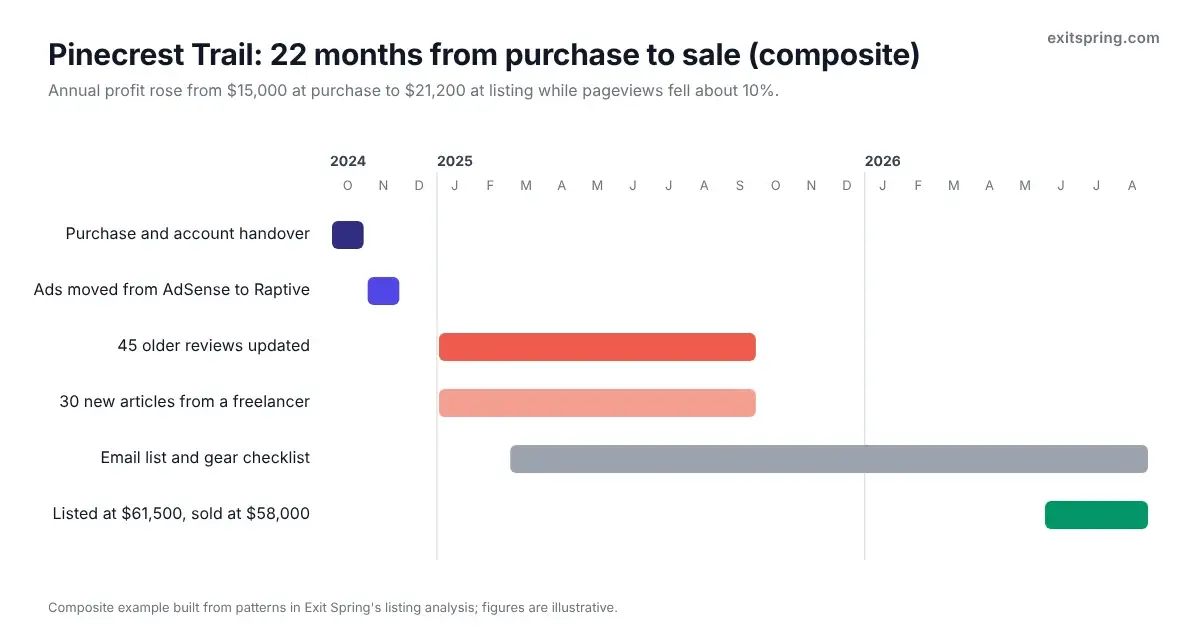
| Date | Step |
|---|---|
| October 2024 | Purchase closes at $42,000; Search Console and analytics access moved, the seller's verification tokens removed |
| November 2024 | Display ads moved from AdSense to Raptive |
| January to September 2025 | 45 older reviews updated, 30 new articles from a freelance writer at $120 each |
| March 2025 | Email list launched with a printable gear checklist |
| May 2026 | 12-month profit reaches $21,200; pageviews down to about 52,000 a month |
| June 2026 | Listed at $61,500 (2.90x) |
| August 2026 | Sold for $58,000 (2.74x), 22 months after purchase |
Traffic fell about 10% while she owned the site, and profit still rose 41%. Display revenue roughly doubled after the ad network change, and the new articles brought in affiliate sales the old ones had missed.
| Pinecrest Trail (composite) | Amount |
|---|---|
| Purchase price, October 2024 | $42,000 |
| Profit taken out over 22 months | $31,800 |
| Sale price, August 2026 | $58,000 |
| Success fee at 8% | $4,640 |
| Gain on sale before tax, ignoring amortization | $11,360 |
| Total pre-tax return on $42,000 | $43,160 |
Most of Nadia's return came from cash flow while she held the site. The resale gain of $11,360 depended on profit rising from $15,000 to $21,200, since the sale multiple of 2.74x was slightly below the 2.8x she paid.
Taxes on a website flip
Taxes on a website flip depend on how long the flipper held the site and whether flipping is a hobby, an investment or their trade. This section is general information as of November 2026, not tax advice, and a flipper should confirm their own position with a tax adviser.
| Tax question | US rule | What it means for Nadia's flip |
|---|---|---|
| Short-term or long-term gain | IRS Tax Topic 409: held more than one year is long-term | 22 months, so long-term rates can apply to capital gain |
| Amortization of the purchase | 26 U.S.C. § 197: intangibles like goodwill and content are amortized over 15 years | She deducted part of the $42,000 each year while she held it |
| Recapture on sale | § 197(f)(7) treats those intangibles as depreciable property, so § 1245 recapture applies | The amortization she deducted is taxed as ordinary income on the sale |
| Dealer status | § 1221(a)(1) excludes property held "primarily for sale to customers" from capital assets | Someone who flips many sites a year may face ordinary income on all gains |
| Price allocation | Form 8594, filed by both buyer and seller in an asset sale | Both sides report how the $58,000 splits across asset classes |
Twenty-six of the 83 dated flips in our sample were listed within a year, so a short-term gain was possible for those sellers. Our article on taxes when selling an online business covers asset sales, installment sales and state tax in more detail.
Selling the flipped site
A flipped site sells the way any small online business does, through a marketplace, a broker or a private buyer. Flippa's self-serve plans start at a $29 fee for a 60-day listing, according to its pricing page in November 2026. At Exit Spring, sellers can list on our marketplace or start with a free valuation.
As of November 2026, ICANN's Transfer Policy requires a registrar to impose a 60-day lock on moving a domain to another registrar after a change of registrant, unless the registrar let the owner opt out beforehand. ICANN's Board approved reforms in June 2026 that would remove this lock once they are implemented. A flipper who changed the registrant name at purchase and then sells within 60 days may have to deliver the domain by an account push at the same registrar.
Google's Search Console help page says a former verified owner who still has a token on the site can verify again and regain access. Removing the previous owner's tokens before the next sale leaves the flipper's buyer as the only verified owner after handover.
Pinecrest Trail's listing carried a dated change log covering the November 2024 ad network switch, the 45 updated reviews and the March 2025 email list. Days-to-sale figures by deal size are in our study of how long it takes to sell an online business, and our content website selling guide covers the listing.
How we researched this
| Step | What we did |
|---|---|
| Source | 2,855 public listings from one large US marketplace, pulled October 8, 2026 |
| Finding flips | We searched every summary and reason for sale for wording that says the seller bought, acquired or took over the business, or that mentions a previous owner, then read each match and dropped the ones about buying only a domain or links, plus one partner buyout |
| Holding period | Purchase month from the listing text to the first listing date (July when only a year was given, March for "early", October for "late"); 83 of 110 had a usable date |
| Multiples | Asking price divided by average annual net profit; asking, not final sale prices, which the feed does not publish |
| Peer comparison | Each flip against non-flip sold listings with the same first income source and listing year, groups of 5 or more |
| Limits | Many sellers who bought their site never say so in the listing, so 110 is a floor, not a count of all flips |
Frequently asked questions
How much money do you need to start flipping websites?
A content site earning $500 a month in profit would ask about $14,000 at the 2.33x median for sites under two years old in our data. Improvements cost money before they raise profit. Pinecrest Trail's 30 new articles cost $3,600 in 2025, months before the extra income showed in its 12-month figures.
Where can I buy websites to flip?
Nadia paid $42,000 for Pinecrest Trail on a brokered marketplace that vetted the listing first. Flippa's self-serve seller plans start at $29 for a 60-day listing.
Is website flipping legal?
Amazon's Associates Program Operating Agreement bars assigning the agreement without Amazon's written approval, so buyers of affiliate sites usually swap the seller's tracking IDs for their own. Buying and reselling a website is otherwise an ordinary asset sale, legal in the US when the seller owns what they sell. Copied articles and photos used without a license are the usual legal problems a buyer inherits.
What is the difference between website flipping and domain flipping?
The 110 resold sites in our sample asked a median $61,927, priced against $24,734 of median yearly profit. A domain flipper sells a name, such as a short .com, often to a company that wants it for a brand, and the price has no profit figure behind it.
How do you value a website before buying it to flip?
Asking multiples for sold content sites ran from 2.33x for sites under two years old to 3.04x at four to six years, in the 2,855 listings we pulled. A flipper should price the site on trailing 12-month profit, check that profit against live dashboards, and then estimate what the site will earn in 18 months. Exit Spring's valuation tool and our guide to how to value an online business explain the method.
Can AI-written content hurt a website flip?
Google's spam policies name scaled content abuse, defined as "many pages are generated for the primary purpose of manipulating search rankings," whether the pages were written by people or software. A flipper who adds 300 machine-written posts in a month to raise traffic before a sale takes on that risk, and a buyer reviewing the publishing history will see it. Raptive also requires content with "meaningful human involvement."
Can I sell a website I bought less than a year ago?
Twenty-six of the 83 dated resales in our sample were listed within a year of purchase, so buyers do accept them. The listing should explain the short ownership, since a buyer will ask why. The seller should also expect a short-term capital gain under IRS rules, and should check whether the previous owner's verification tokens and domain lock still apply.
Sources
- Google, New ways we're tackling spammy, low-quality content on Search, March 5, 2024, updated April 26, 2024
- Google Search Central, Spam policies for Google web search, last updated August 28, 2026
- Pew Research Center, Google users are less likely to click on links when an AI summary appears in the results, July 22, 2025
- IRS, Topic no. 409, Capital gains and losses, reviewed September 24, 2026
- Legal Information Institute, 26 U.S.C. § 1221, Capital asset defined
- Legal Information Institute, 26 U.S.C. § 197, Amortization of goodwill and certain other intangibles
- Legal Information Institute, 26 U.S.C. § 1245, Gain from dispositions of certain depreciable property
- IRS, About Form 8594, Asset Acquisition Statement Under Section 1060
- ICANN, Transfer Policy, updated version in force from August 21, 2025
- Search Console Help, Managing owners, users, and permissions
- Raptive Help Center, Who is eligible for Raptive?
- Amazon Associates, Associates Program Operating Agreement
- Flippa, Pricing
- Empire Flippers public marketplace listings, pulled October 8, 2026 (Exit Spring analysis)
Get new listings in your inbox
Fresh businesses for sale every Monday, plus practical buying and selling tips.
Unsubscribe anytime. No spam.
Keep reading
The Asset Purchase Agreement for an Online Business in 2026: Clauses, Schedules and Closing

How to Buy a SaaS Business in 2026: Prices, Churn, Code and Due Diligence
Turnkey Online Businesses in 2026: What They Cost, What Hands-Off Leaves Out and How to Buy One
Ready to make a move?
Browse vetted online businesses or get a free valuation of yours.