
Sell-Side M&A Advisory in 2026: What a Sell-Side Advisor Does, and How Buy-Side Differs
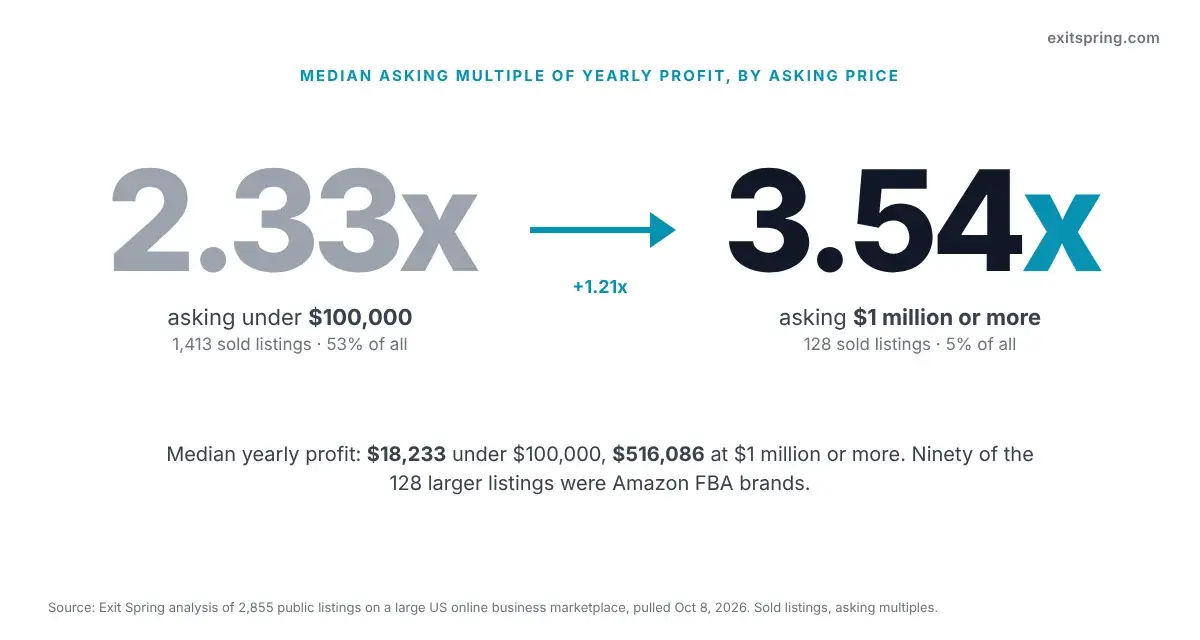
Of 2,670 sold listings with a price and a profit figure on one of the largest US online business marketplaces, pulled October 8, 2026, the 128 that asked $1 million or more asked a median 3.54 times yearly profit, against 2.33x for the 1,413 that asked under $100,000.
Sell-side advisory is the work done for the owner of a business that is being sold. A sell-side advisor prices the business, prepares the documents buyers will read, finds and screens buyers, runs the negotiation and manages due diligence through to closing. In online business sales, the job is done by M&A advisors on larger deals and by business brokers and brokered marketplaces on smaller ones.
What is sell-side advisory?
Sell-side advisory is a service in which an advisor represents the seller of a company in a sale, from setting the price to closing, and is usually paid mostly by a success fee when the deal closes. The advisor works for the seller alone. A buy-side advisor does the mirror job for a company or investor that wants to buy.
| Question | Sell-side advisor | Buy-side advisor |
|---|---|---|
| Who hires them | The owner selling the business | A buyer, such as a private equity firm, a strategic company or a search fund |
| Who pays | The seller, mostly at closing | The buyer, under its own fee agreement |
| Main job | Get the best price and terms from the widest suitable set of buyers | Find targets that fit the buyer's plan and avoid overpaying |
| Key documents | Teaser, confidential information memorandum, data room | Target list, outreach letters, valuation model, diligence report |
| Typical start | Months before the business goes to market | When a buyer sets an acquisition plan |
In the M&A trade, "sell-side" and "buy-side" are also used for investment banks and research analysts. This guide uses the terms only for advisors in the sale of a private business.
What does a sell-side advisor do?
A sell-side advisor runs the sale as a process, with each step meant to put more qualified buyers in front of the seller at the same time. For Northway Labs, the composite later in this guide, the process took about six months from engagement letter to closing.
| Stage | What the advisor does | Online business example |
|---|---|---|
| Valuation | Recasts profit into seller's discretionary earnings (SDE) or EBITDA and sets an asking range | Adds back the founder's $90,000 salary on a SaaS tool |
| Preparation | Cleans the P&L, gathers platform data, writes the teaser and the confidential information memorandum | Twelve months of Stripe exports matched to the bank statements |
| Buyer list | Builds a list of strategic buyers, private equity firms, holding companies and individual buyers | 46 names, from two software firms in the same niche to a search fund |
| Outreach | Sends an anonymous teaser, signs NDAs, shares the full memorandum | 15 buyers sign nondisclosure agreements |
| Buyer calls | Prepares the seller and sits in on calls with interested buyers | Six one-hour calls in two weeks |
| Offers | Collects letters of intent and compares price, cash at close, earnout and seller financing | Three LOIs between $1.7 million and $1.95 million |
| Due diligence | Runs the data room and answers the buyer's questions on time | 140 questions answered over 52 days |
| Closing | Works with both sides' lawyers on the purchase agreement and the handover plan | Accounts move on the day the money arrives |
Our guide to the confidential information memorandum covers the document buyers read first, and our due diligence checklist lists what they ask for afterward.
Buy-side vs sell-side: who works for whom
The difference between buy-side and sell-side advisory is which party the advisor represents and who pays it. When Daniel sold Northway Labs (composite), his sell-side advisor's fee came out of the sale price, and the private equity buyer paid its own buy-side team separately.
Acting for both sides in one deal, which brokers call dual agency, costs an M&A broker its 2023 federal exemption unless both parties get clear written disclosure and give written consent.
On a small online business sale, the marketplace or broker that lists the business is typically paid mainly by the seller, while the buyer may hire their own accountant or lawyer for due diligence. A buyer who wants someone to search for targets on their behalf hires a buy-side advisor and pays that advisor separately.
Where sell-side advisory fits by deal size
Of the 2,670 sold listings in our October 2026 pull, 1,413 asked under $100,000, more than every other band combined.
| Asking price band | Sold listings | Share of all sold | Median asking multiple | Median yearly profit | Median days on the marketplace | Median owner hours a week |
|---|---|---|---|---|---|---|
| Under $100,000 | 1,413 | 52.9% | 2.33x | $18,233 | 23 | 2 |
| $100,000 to $250,000 | 665 | 24.9% | 2.67x | $55,723 | 50 | 4 |
| $250,000 to $500,000 | 312 | 11.7% | 3.00x | $113,561 | 45 | 5 |
| $500,000 to $1 million | 152 | 5.7% | 3.17x | $215,961 | 60 | 5 |
| $1 million to $5 million | 118 | 4.4% | 3.50x | $485,525 | 35.5 | 10 |
| $5 million or more | 10 | 0.4% | 3.83x | $2,101,188 | 22 | 18 |
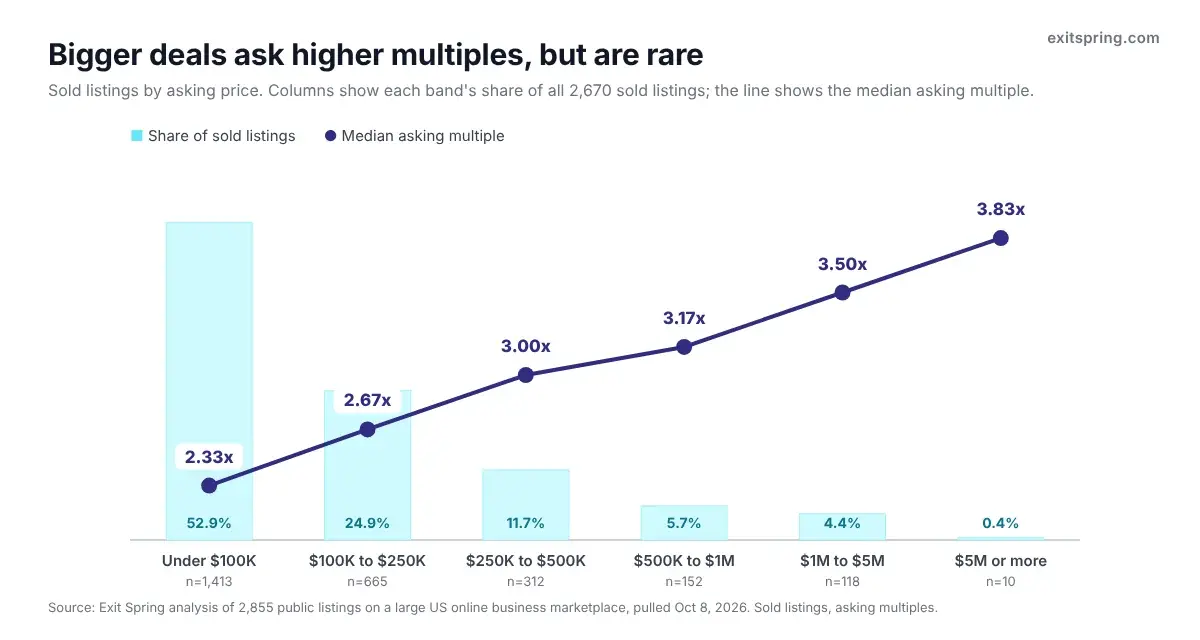
The median multiple rose in each band, from 2.33x to 3.83x, a pattern our online business multiples by type study also found. Ninety of the 128 listings asking $1 million or more were Amazon FBA brands, and the 128 had a median yearly profit of $516,086. Owners of those businesses reported a median 10 hours a week of work, five times the 2 hours for listings under $100,000.
Days on the marketplace peaked at 60 for businesses asking $500,000 to $1 million. Listings asking $1 million or more spent a median 32 days on the marketplace. Our data can't say why. Larger sellers may have done more of the preparation before listing, and some may have had buyers lined up, but the feed doesn't record either.
The IBBA's Market Pulse survey, which covers business sales up to $50 million, prices deals under $2 million as a multiple of SDE and larger deals as a multiple of EBITDA. A sell-side advisor on a $3 million online business will usually present both figures, since a private equity buyer thinks in EBITDA and an individual buyer in SDE.
How sell-side work differs for an online business
Ninety of the 128 sold listings asking $1 million or more in our data were Amazon FBA brands. For those deals, the advisor has to plan around Amazon's own rules on moving a seller account, which our Amazon FBA selling guide covers. A SaaS sale brings code repositories, cloud hosting and customer contracts into the handover, as our SaaS selling guide explains.
| What a buyer checks live | Where it sits | What the advisor reconciles first |
|---|---|---|
| Revenue | Stripe, Shopify or Amazon Seller Central | Monthly payouts against bank deposits |
| Traffic | Google Analytics and Search Console | Sessions and clicks against the memorandum |
| Ad spend | Meta and Google ad accounts | Spend against the P&L marketing line |
| Subscribers | The billing system | Northway Labs' monthly churn against its revenue report |
Buyers of online businesses are also spread across countries. A $1.2 million content portfolio can draw offers from a US holding company, a European media group and an individual buyer in Australia in the same month. The advisor screens each one for proof of funds before the seller shares the full memorandum, and our guide to selling an online business from outside the US covers the cross-border side.
What the seller still does during the sale
Hiring a sell-side advisor doesn't take the owner out of the sale. Daniel spent about six hours a week on the Northway Labs sale between March and July 2026, on top of running the business.
| Seller task | When | Northway Labs example (composite) |
|---|---|---|
| Keep profit steady | The whole process | Monthly SDE stayed within 4% of the $43,300 average |
| Send monthly numbers | Every month after the memorandum goes out | Updated P&L and churn figures to the three LOI bidders |
| Join buyer calls | After NDAs are signed | Six one-hour management calls in April |
| Approve buyers | Before the memorandum is shared | Two direct competitors got the teaser but not the memorandum |
| Decide between offers | When LOIs arrive | Chose the highest offer with the smallest seller note |
| Answer diligence questions | After the LOI | About 140 questions in 52 days, most answered within two days |
A drop in profit during due diligence gives a buyer grounds to ask for a lower price after signing a letter of intent. Northway Labs' SDE held steady through the 52 days, and the $1.95 million price stayed where it was.
Sell-side advisor, business broker or marketplace
Sell-side M&A advisors, business brokers and online business marketplaces all represent sellers, and many firms do more than one of the three. The main differences are deal size, how many buyers they reach, and how much of the process they run.
| Option (Exit Spring's view) | Where it usually fits | What the seller gets | Buyer reach |
|---|---|---|---|
| Self-serve marketplace | Under $100,000 | A listing page and buyer messages, with the seller doing the rest (Flippa's plans start at $29 for 60 days, November 2026) | Anyone with an account |
| Brokered marketplace | $50,000 to about $5 million | Vetted financials, a listing, buyer screening, deal support | The marketplace's registered buyers |
| Business broker | $100,000 to $5 million | A managed sale with the broker screening buyers | The broker's buyer list and listing sites |
| Sell-side M&A advisor | $3 million and up | A full auction process with a target list and multiple offers | Named strategic and financial buyers contacted directly |
Exit Spring sellers can get a free valuation, read how selling works or list on our marketplace.
The M&A broker exemption and what it means for sellers
Section 15(b)(13) of the Securities Exchange Act, in force since March 29, 2023, lets M&A brokers advise on the sale of an eligible privately held company without registering with the SEC as a broker-dealer.
| Rule (general information as of November 2026, not legal advice; other conditions apply) | What it says | What it means for a seller |
|---|---|---|
| Eligible company | In the fiscal year before the engagement, EBITDA under $25 million or gross revenue under $250 million, and no registered securities | Almost every online business sale qualifies on size |
| Buyer control | The broker must reasonably believe the buyer will control the business and be active in managing it after closing | A sale of 100% of an LLC to an operator fits; a sale to passive investors does not |
| No custody | The broker may not receive, hold or transmit the deal's funds or securities | Money moves through escrow or the lawyers, not the advisor |
| Both sides | Representing buyer and seller needs clear written disclosure and both parties' written consent | Ask any advisor who also works for buyers how they handle it |
| Disqualification | The exemption is lost if the broker has been barred or suspended by the SEC, a state or a self-regulatory organization | Check an advisor's history on FINRA BrokerCheck |
| State rules | The federal exemption does not replace state broker registration rules | Ask which states the advisor is registered in |
| Before 2023 | M&A brokers relied on a 2014 SEC staff no-action letter | The 2023 statute put the rules into law |
Most small online business sales are asset sales of the domain, code, content and accounts, so securities rules mostly come into play when shares or LLC interests change hands.
Why owners sell, and how an advisor uses it
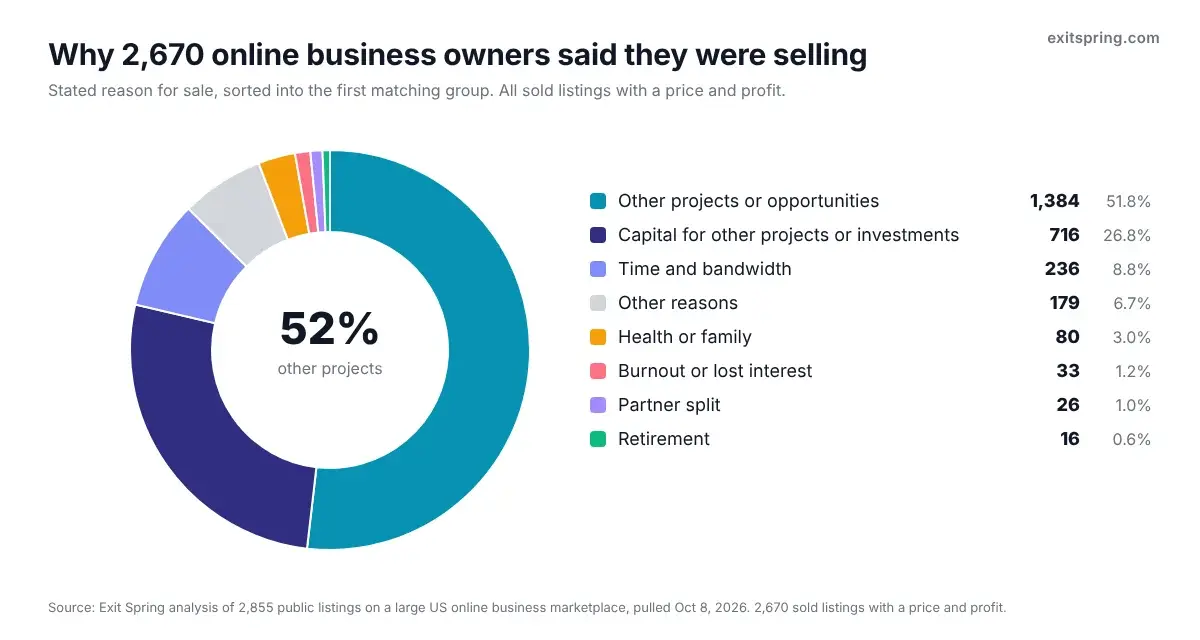
Buyers ask why the owner is selling, and the answer goes in the listing. Across the 2,670 sold listings in our data, 1,384 gave other projects or a new opportunity as the reason, and 716 wanted to raise capital, mostly for other projects or investments. Together the two groups cover 2,100 listings, or 79%.
| Reason for sale, grouped by its first match | Sold listings | Share |
|---|---|---|
| Other projects or opportunities | 1,384 | 52% |
| Capital for other projects or investments | 716 | 27% |
| Time and bandwidth | 236 | 9% |
| Other reasons | 179 | 7% |
| Health or family | 80 | 3% |
| Burnout or lost interest | 33 | 1% |
| Partner split | 26 | 1% |
| Retirement | 16 | 0.6% |
Only 16 sellers named retirement. Many listings said the money would go into another business.
A sell-side advisor will check that the stated reason holds up. A buyer who hears "focusing on other projects" and then finds profit fell 20% in the last quarter will ask whether the decline is the real reason. The advisor's job is to raise that issue before the buyer does, with the numbers and an explanation.
How to choose a sell-side advisor
A $3 million SaaS sale and a $150,000 content site need different buyers, so the first check is whether the advisor has closed deals at the seller's size.
| Question to ask | Why it matters | A useful answer |
|---|---|---|
| How many deals in my size range did you close in the last two years? | A $3 million SaaS sale and a $150,000 content site use different buyer lists | "Seven, between $2 million and $6 million, four of them SaaS" |
| Who would you contact first? | Shows whether a buyer list exists or will be built from scratch | Names of firm types, plus examples of buyers who bought similar businesses |
| How is your fee structured? | Retainers, minimum fees and tail periods vary widely | A written fee schedule with the success fee, any retainer and the tail period |
| Do you also represent buyers? | Dual agency needs written disclosure and consent | A clear yes or no, with how conflicts are handled |
| Who will run my deal day to day? | Senior partners often win the engagement and juniors run it | The named person, and how many deals they are running |
| What happens if the business underperforms during the sale? | Repricing is common when profit slips in due diligence | A plan for monthly updates to buyers and a cash buffer for the seller |
Check that the engagement letter states the term, the fee, the tail period after it ends, and what happens if the seller finds a buyer on their own. Our guide to preparing your business for sale covers the work to do before signing one.
A sell-side process, from engagement to closing
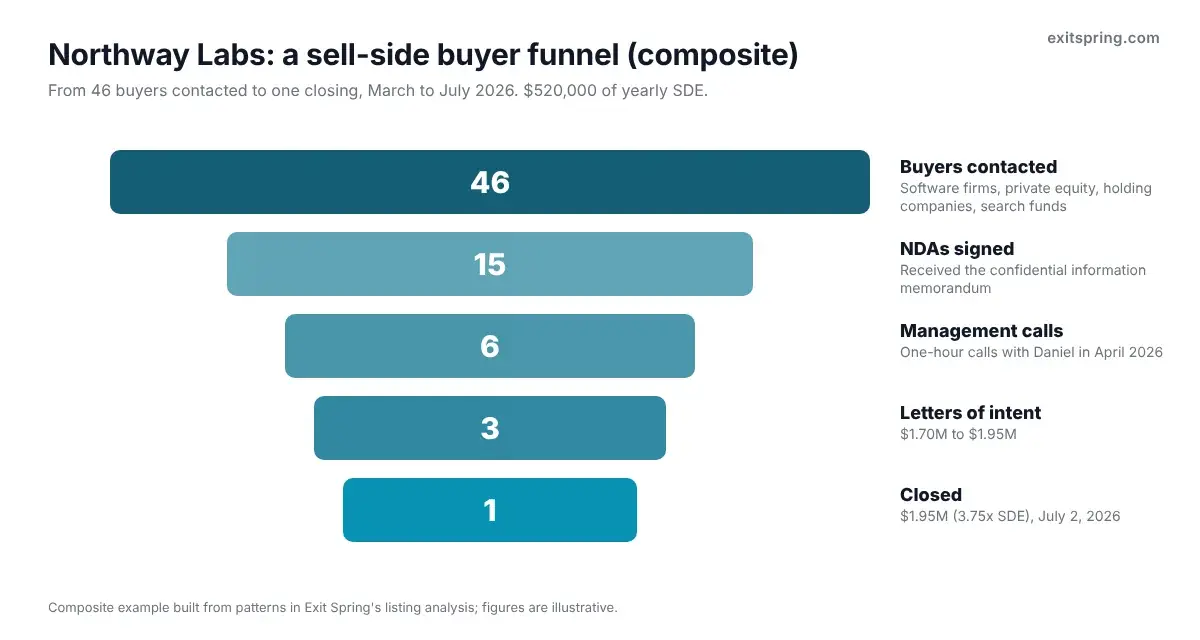
Daniel (a composite built from the patterns above) owned Northway Labs, a scheduling tool for dental clinics run as a Delaware LLC. Over the 12 months before the sale it brought in $1.1 million of revenue and $520,000 of SDE, with Daniel working about 25 hours a week.
| Northway Labs (composite) | Step |
|---|---|
| January 12, 2026 | Advisor hired; salary and a one-off legal bill added back; asking range 3.5x to 4x SDE (the $1M to $5M band's median was 3.50x) |
| February 2026 | Teaser and confidential information memorandum written; data room built |
| March 2, 2026 | 46 buyers contacted: software companies, private equity firms, holding companies and search funds |
| March 2026 | 15 NDAs signed; memorandum sent |
| April 2026 | Six management calls |
| May 4, 2026 | Three letters of intent, from $1.7 million to $1.95 million |
| May 11, 2026 | LOI signed at $1.95 million (3.75x SDE), 85% cash at closing and 15% seller note |
| July 2, 2026 | Closing after 52 days of due diligence; buyer takes 100% of the LLC |
| Northway Labs (composite) | Amount |
|---|---|
| Yearly SDE | $520,000 |
| Highest LOI | $1,950,000 |
| Cash at closing (85%) | $1,657,500 |
| Seller note (15%) | $292,500 |
| Lowest LOI | $1,700,000 |
The gap between the lowest and highest letter of intent was $250,000. Daniel's advisor got three offers on the table at once, and the highest bidder also took the smallest seller note of the three. Our guide to seller financing and earnouts explains how notes like Daniel's are usually structured.
Because the buyer took all of Daniel's LLC interests and ran the business itself, the sale met the federal exemption's control test. The funds went through an escrow agent, not the advisor. Our article on taxes when selling an online business covers how an LLC sale and an asset sale are taxed differently.

How we researched this
| Step | What we did |
|---|---|
| Source | 2,855 public listings from one large US marketplace, pulled October 8, 2026 |
| Sample | 2,670 sold listings with an asking price and a positive yearly profit |
| Multiples | Asking price divided by average annual net profit; asking, not final sale prices, which the feed does not publish |
| Price bands | Grouped by asking price, from under $100,000 to $5 million or more |
| Reasons for sale | Each listing's stated reason sorted into the first matching group, checked in that order: retirement, health or family, partner split, burnout, time, capital, other projects |
| Limits | The feed covers one marketplace and has no withdrawn listings, so it can't show how many businesses failed to sell |
Frequently asked questions
What does sell-side mean in M&A?
Northway Labs (composite), a $520,000-SDE software tool, hired a sell-side advisor who contacted 46 buyers and drew three offers. Sell-side means acting for the seller in a sale. The advisor prices the business, prepares the documents, finds buyers, negotiates and manages due diligence, and is paid mostly when the deal closes.
What is the difference between buy-side and sell-side advisory?
The private equity firm that bought Northway Labs (composite) paid its own buy-side team to find and check software targets, while Daniel's sell-side advisor was paid from the sale price. Each advisor owes its duty to the side that hired it, and an M&A broker relying on the federal exemption can't act for both without written disclosure and consent.
How much does a sell-side advisor charge?
Fees vary by deal size, and most are a success fee paid at closing, sometimes with a monthly retainer or a minimum fee. The engagement letter should state the fee, the retainer, the term and the tail period. For a business under $1 million, a brokered marketplace usually costs less than an M&A advisor running a full auction.
When should I hire a sell-side advisor instead of a broker?
The 128 listings in our data that asked $1 million or more listed at a median 3.54x profit, and buyers at that size are often companies and funds rather than individuals. Above about $3 million, an advisor who contacts named strategic and private equity buyers can create competing offers. Between $1 million and $3 million, many sellers use a brokered marketplace or a business broker, and some add direct outreach to strategic buyers.
Does a sell-side advisor need to be registered with the SEC?
Since March 29, 2023, Section 15(b)(13) of the Exchange Act has let M&A brokers advise on sales of private companies with EBITDA under $25 million or revenue under $250 million without registering with the SEC as broker-dealers. Conditions apply, among them no custody of funds and a buyer who will control the business, and state rules may still apply. Many online business sales are asset sales, where securities rules rarely come up.
How long does a sell-side process take?
Northway Labs (composite) took about six months from the January 2026 engagement letter to the July closing. In our data, sold listings asking $1 million or more spent a median 32 days on the marketplace, a figure that leaves out the preparation before listing. Our study of how long it takes to sell an online business breaks this down by deal size.
Can one advisor represent both the buyer and the seller?
The federal M&A broker exemption allows it only with clear written disclosure to both parties and the written consent of both. Even where it is allowed, a seller should ask how the advisor sets the price when it also works for the buyer. A buyer who wants advice can hire their own accountant or lawyer for due diligence.
Sources
- Legal Information Institute, 15 U.S.C. § 78o, Registration and regulation of brokers and dealers, including § 78o(b)(13)
- Jones Day, New Law Exempts M&A Brokers From SEC Registration, January 2023
- Sidley Austin, US Congress Exempts Certain Merger and Acquisition Brokers From SEC Broker-Dealer Registration, March 6, 2023
- Skadden, SEC Provides No-Action Relief to M&A Brokers in Connection With Broker-Dealer Registration Requirements, February 2014
- International Business Brokers Association, Market Pulse Q2 2026 highlights PDF, August 2026
- FINRA, BrokerCheck
- Flippa, Pricing
- Empire Flippers public marketplace listings, pulled October 8, 2026 (Exit Spring analysis)
Get new listings in your inbox
Fresh businesses for sale every Monday, plus practical buying and selling tips.
Unsubscribe anytime. No spam.
Keep reading
The Asset Purchase Agreement for an Online Business in 2026: Clauses, Schedules and Closing

How to Buy a SaaS Business in 2026: Prices, Churn, Code and Due Diligence
Turnkey Online Businesses in 2026: What They Cost, What Hands-Off Leaves Out and How to Buy One
Ready to make a move?
Browse vetted online businesses or get a free valuation of yours.